


With full riders that cover the entire co-payment in Integrated Shield (IP) riders resulting in 60 per cent higher medical bills, the Ministry of Health (MOH) announced a new requirement for IP riders in 2018. This will require insurers to incorporate a co-payment feature in new Integrated Shield riders, thus removing the option of a full rider with zero co-payment.1
While this requirement was announced in 2018, insurers were given time to work out the new riders and transit their policyholders to the new riders. Therefore, from 1 April 2021 all policyholders will be transited to the new IP riders. In this article, we highlight the three main changes to NTUC Income’s Enhanced Incomeshield rider and how this will affect you as a policyholder.
(See "Are Integrated Shield Plans Necessary?")
#1 Co-payment is now necessary even with a rider
One of the main changes to Income’s Enhanced Incomeshield is the rider. From 1 April 2021, all Plus and Assist riders from NTUC Income will no longer be available for policy renewals. Instead, individuals who are still on the old Plus and Assist riders will have their riders automatically switched to the new Deluxe Care and Classic Care rider respectively.
Previously, individuals with the Plus rider were able to obtain full coverage against hospital bills with no co-payment required. However, going forward this will no longer be available. Instead, policyholders will have to pay out-of-pocket expenses of at least 5 per cent of their hospital bill.
For those who were previously on Assist rider, they will automatically be switched to Income’s Classic Care rider with the same 10 per cent co-payment required for their hospital bill.
Old rider |
Co-payment required by old rider for treatment |
New rider that policy holders will automatically be switched to |
Co-payment required by new rider for treatment |
Plus rider |
0% |
Deluxe Care rider |
5% |
Assist rider |
10% |
Classic Care rider |
10% |
(See "Our honest opinions about CareShield Life and its supplements")
#2 Panel and non-panel treatment
Another new feature is the introduction of panel and non-panel doctors. Under the new riders, policyholders will be eligible for a co-payment cap of up to $3,000 per policy year if they seek treatment from the insurer’s panel healthcare providers. While there will still be a 5 or 10 per cent co-payment required, this cap will put a limit on the maximum out-of-pocket expenses required by the policyholder.
However, should policyholders choose to receive treatment at non-panel providers, there will not be a cap for co-payment. Non-panel charges of up to $2,000 per policy year will also apply for Classic Care rider.
Benefit payable from the new Deluxe Care and Assist Care riders:
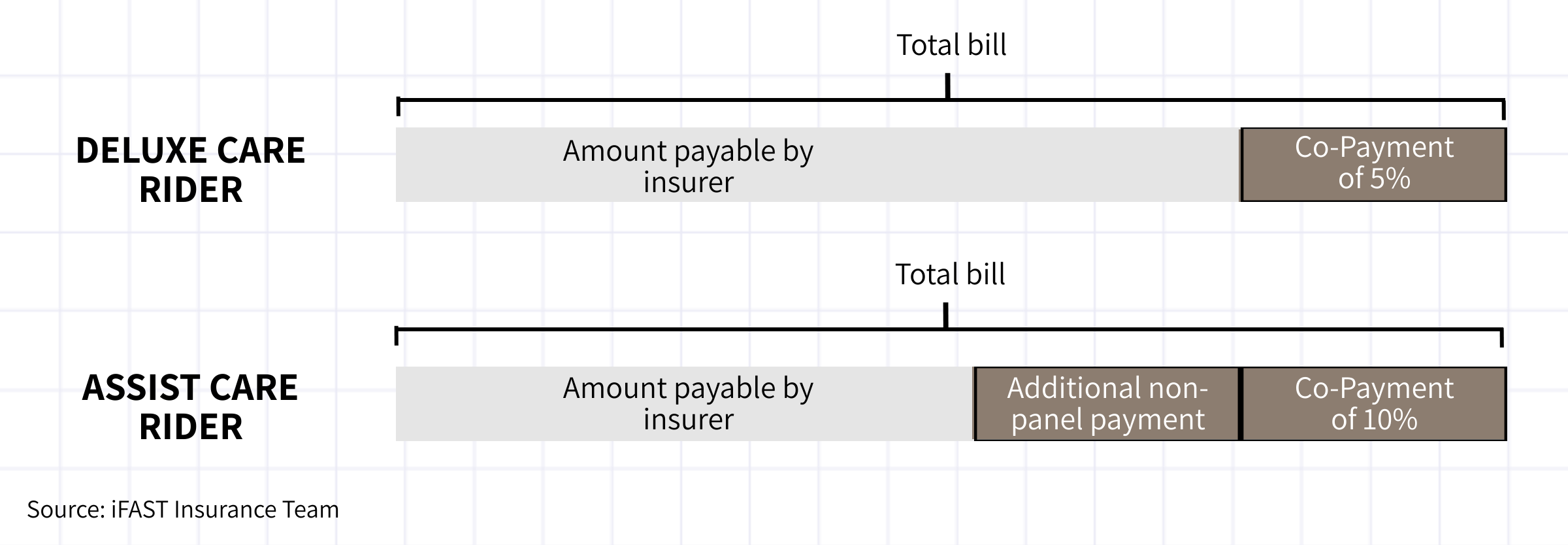
This new feature is meant to encourage policyholders to receive treatment at panel providers. Doing so will limit their out-of-pocket expenses to no more than $3,000 per policy year for both Deluxe Care rider and Classic Care rider.
(Old) Plus rider |
(New) Deluxe Care rider |
(Old) Assist rider |
(New) Classic Care rider |
|
For panel providers |
||||
Co-payment for treatment by panel providers |
0% |
5% |
10% |
10% |
Cap on co-payment for panel treatments |
N.A. |
$3,000 per policy year |
$1,500 to $3,000 per policy year with this differing between plans |
$3,000 per policy year |
For non-panel providers |
||||
Co-payment for treatment by non-panel providers |
0% |
5% |
10% |
10% |
Cap on co-payment for non-panel treatments |
N.A. |
No cap for non-panel |
$1,500 to $3,000 per policy year with this differing between plans |
No cap for non-panel |
Additional non-panel payment |
- |
- |
- |
Up to S$2,000 per policy year on top of co-payment |
Do note that the main treatment must be provided by the panel provider in order for the claim to be considered as panel and have a co-payment limit. This also applies to pre/post hospitalisation treatment and special benefit claims.
(See "Don't Need A Full Critical Illness Plan? Here's Your Alternative")
#3 Hospital cash benefit
The hospital cash benefit refers to a fixed amount that the policyholder will receive if he is admitted to a ward that is lower than the ward his plan entitles him to. For example, a policyholder will receive this hospital cash benefit if he has a plan that covers for Class A ward but choose to stay at a Class B1/B2 ward. This is given on top of the policyholder’s existing medical benefits.
While both Plus and Assist riders used to offer this hospital cash benefit, this will no longer be available in the new Deluxe Care and Classic Care riders. Policyholders will therefore not be entitled to any additional cash benefits for choosing to stay in a lower class ward.
(See "Fixed or Renewable – Which is the better term insurance?")
What these changes mean to us
These changes to Income’s Enhanced Incomeshield riders are likely to result in higher out-of-pocket expenses for us. This is because full riders are no longer available with a minimum 5 per cent co-payment now required for our medical bills.
Additionally, policyholders are also encouraged to opt for panel clinics so as to enjoy less out of pocket expenses. This may impose some limitations on the flexibility to choose your own preferred doctor.
Average Bill at a private hospital |
Amount payable under OLD Plus Rider (No co-payment) |
Amount payable under NEW Deluxe Care Rider (5% co-payment) |
Amount payable under OLD Assist Rider* |
Amount payable under NEW Assist Care Rider (10% co-payment) |
|||
Panel |
Non-Panel |
Panel |
Non-Panel |
||||
Co-payment |
- |
0% |
5% |
5% |
10% |
10% |
10% |
Co-payment limit |
- |
N.A. |
$3,000 per policy year |
No limit |
$3,000* per policy year |
$3,000 per policy year |
No limit |
Non-panel charges |
- |
N.A. |
N.A. |
N.A. |
N.A. |
N.A. |
$2,000 per policy year |
Endoscopy |
$6,000^ |
$0 |
$300 |
$300 |
$600 |
$600 |
$2,600 |
Breast Cancer |
$500,000^ |
$0 |
$3,000 |
$25,000 |
$3,000 |
$3,000 |
$52,000 |
*Assuming coverage for Income Enhanced Preferred plan
^Information shown are based on the private bill size of 2019 incurred claims for policyholders with NTUC Income’s Plus and Assist Riders.
With changes to integrated shield riders, are these riders still worth obtaining? In our next article "Disappointed with the new integrated shield riders? This is what we think", we explore some alternatives for hospitalisation coverage.
If you would like to find out more about the changes or would like a second opinion on whether you should make any changes to your hospital plan, you may contact us here. At FSMOne, we also offer commission rebates for life insurance products, speak to our advisers if you would like to find out more.
Over 10,300 users trust FSMOne with their insurance planning
Live better, safer. Take risks with your investments, not your insurance.
Speak to our experts today to get proper protection.
Available Products on FSMOne Insurance |
Term Life, Whole Life, Critical Illness, Annuity, Health, Endowment, General Insurance (Personal and Commercial) from AIG, Allianz, Chubb, Etiqa Insurance, FWD Insurance, Great Eastern, Manulife, NTUC Income, QBE, Sompo and Tokio Marine Life Insurance *Please check with our advisory team if the product you want is available on FSMOne Insurance |
Interested to learn more? Check out these articles:
4 Tips For Your Next Home Insurance Purchase
When is a renewable term insurance the better option?
How much should I be spending on insurance for my child?
Should I switch from Eldershield to CareShield Life?
What should I do with my maturing endowment plan?
----
1Source: https://www.moh.gov.sg/docs/librariesprovider5/pressroom/current-issues/cos-2018-media-factsheet---keeping-healthcare-costs-sustainable-for-all-singaporeans.pdf