

What is an ILP (Investment-Linked Policy)?
An Investment-Linked Policy (ILP) is a life insurance plan that also allows for wealth accumulation by investing your money in the market to potentially give you higher returns. Typically positioned as a product with dual function, ILPs allows you to simultaneously insure and invest.
When you buy an ILP, your premiums are taken to invest into various sub-funds. These sub-funds are managed by financial professionals. Apart from being used to buy your sub-funds, the premiums that you pay for your policy will also be used to pay insurer expenses, fees and administration costs.
What are Term Life plans?
As explained in our previous article "The Beginner's Guide To Term Insurance In Singapore", term plans are typically used to temporarily cover a protection gap during your working years. Unlike ILPs that serve a dual function of investing and insuring, term life insurance are purely used for protection. A protection gap refers to the shortfall between the coverage amount you need and the amount you currently have.
Term life insurance are non-participating plans and therefore do not have any cash value.
Here are the 4 differences between an ILP and a Term Life insurance plan.
#1 Intention
When deciding between an ILP or term plan, it is important to consider your intention in getting these plans. Are you looking for coverage or do you want to invest through your life insurance plan?
ILP (Investment-Linked Policy) |
Term Life |
|
Coverage includes |
Death and Total Permanent Disability (TPD). |
Death and Total Permanent Disability (TPD). |
Option to add-on riders to enhance coverage |
Yes, riders can be added-on to enhance coverage. |
Yes, riders can be added-on to enhance coverage. |
Usually used for |
Protection and investment. |
Protection only. |
Both ILP and a term plan offers coverage for death and total permanent disability (TPD). There is also the option to add-on riders to both plans should you want to further enhance your coverage.
However, the key difference lies in the intention of purchasing such plans. Term plans are used for the sole purpose of obtaining protection coverage. ILPs on the other hand are purchased for its dual functionality of allowing you to simultaneously insure and invest. Therefore, if you are only looking for insurance to cover your temporary protection gap, an ILP may not be suitable for you.
(See "Best Term Insurance Singapore")
#2 Cash value of policy
ILP (Investment-Linked Policy) |
Term Life |
|
Wealth accumulation |
Yes |
No |
Cash value |
Yes. Amount is not guaranteed and will be dependent on the performance of your sub-funds. Surrendering your ILP in the initial years will also result is little to no surrender value. |
No. |
Another point to consider is the ability to surrender your policy for cash. As ILPs actively invests a portion of your premiums into your chosen sub-fund units, ILPs comes with the possibility of having a cash value. This means that you have the flexibility to surrender your ILP in exchange for a lump sum should you urgently require cash. This cash value of your ILP is not guaranteed as this is determined by the performance of your sub-fund investments.
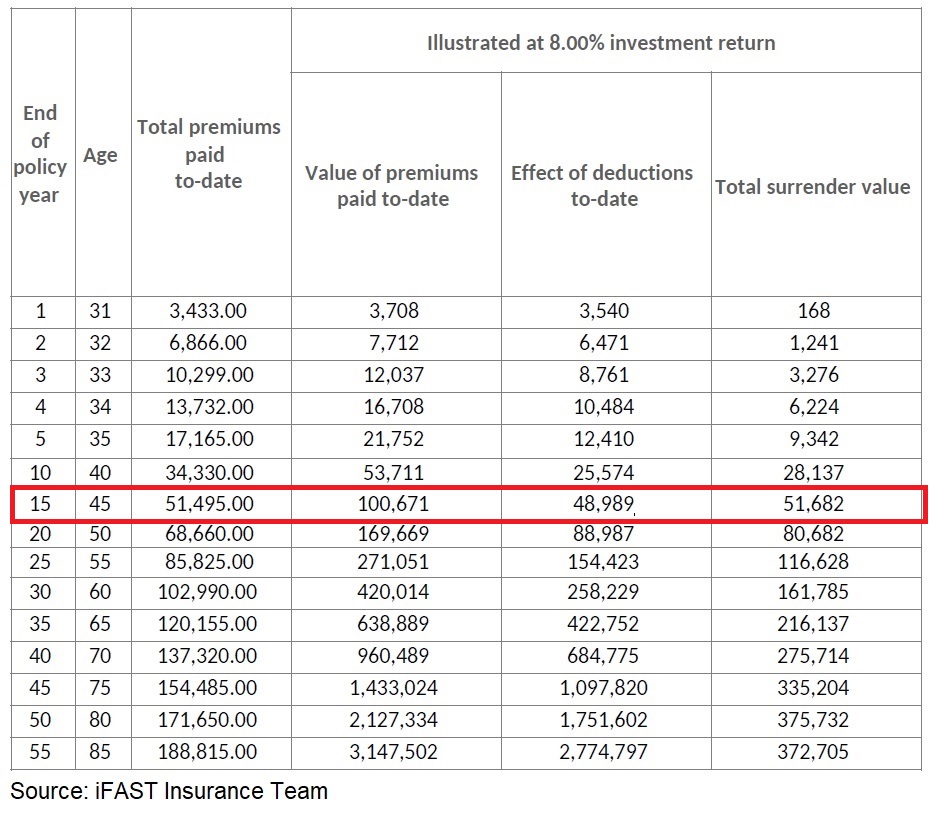
Additionally, as ILPs require you to pay for an insurer’s distribution and administrative fees, surrendering your ILP in the initial years will result in little to no cash value. As shown in the image below, at an illustrated 8 per cent investment return, the non-guaranteed surrender value of your ILP still remains low in the initial years. This ILP will only break even at the 15th policy year. Therefore, while an ILP allows you the option to surrender your policy to cash out, do take into account that the surrender value in the initial years are likely to be lower than the total premiums that you have paid. Note that the illustrated returns are used by insurers to project the potential returns that you may receive and are non-guaranteed. The actual amount received from the policy may be higher or lower than the returns illustrated in the policy.
Term plans on the other hand are non-participating plans. What this means is that term plans only provides protection coverage with no aspect of wealth accumulation. As such, term plans do not accumulate cash values and do not offer the option to surrender and cash out from your policy should you urgently require a sum of money. However, what this also means is that with term plans, you may not feel obligated to continue holding onto the plan until it "breaks even". To put it simply, there is no "lock in" period for a term plan and you are free to terminate your plan as and when you deem fit.
#3 Underlying costs
Another difference between an ILP and term insurance plan is the underlying costs in the policy. While both ILP and term insurance plans have underlying charges, the charges required for the two types of plans are different as shown in the table below.
Insurer's expenses |
ILP (Investment-Linked Policy) |
Term Life |
Annual management charges for funds chosen |
Yes |
No |
Policy fee |
Yes |
No |
Insurance charges |
Yes |
Yes |
Distribution-related costs (e.g. commission, costs of benefits and services paid to distribution channel) |
Yes |
Yes |
Underlying fees are charged on a regular recurring basis. In ILPs, these charges are paid off by selling some of your sub-fund units to pay for these underlying charges.
(See "Direct Term insurance, now available on FSMOne.com")
#4 Cost of getting insurance
An illustration: Age 30 non-smoker male, for a sum assured of $200,000
ILP (Investment-Linked Policy) |
Term Life (Yearly renewable) |
Term Life (Fixed) |
|
Coverage amount |
$200,000 |
$200,000 |
$200,000 |
Annual premiums |
$3,433 |
^$102.40 |
$683.80 |
>^Premiums are not guaranteed and may increase during future renewals.
Premiums are shown before discounts. Information is accurate as of 6 December 2021 with changes subjected to the insurer’s discretion.
As shown in the table above, an age 30 non-smoker male who is looking to get covered for $200,000 will find himself paying just $102.40 for a yearly renewable term life insurance plan. This is contrasted with the $3,433 that the same individual will have to pay if he wishes to combine his insurance and investments into one policy through an ILP.
In our previous article "My agent sold me an ILP. Should I keep it?", we explained that the annual premium paid to the ILP also includes the investment portion in your ILP. However, getting an ILP is not ideal if you do not wish to invest through your life insurance plan as this just results in you unnecessarily paying a higher premium for the frills that comes with an ILP. Instead of paying for an ILP to invest while you insure, a term plan will be the better option if you are just looking for coverage. This allows you to get an affordable term life insurance plan and use the remainder for your own investments.
To conclude,
If you are looking to insure and invest, we recommend keeping your insurance and investment separate rather than to use an ILP to combine both into a single plan. Doing so will allow you to get both low-cost insurance coverage from the term plan and full control over your investments. Moreover, rather than to limit yourself to only choosing the sub-funds that your insurer has to offer in your ILP, keeping your insurance and investment separate also allows you more flexibility. With this freedom to choose your investments, you may choose investment options with lower management fees or a lower administrative cost.
Available Direct Term on FSMOne.com

Want a second opinion on your insurance? We are here to help.
Live better, safer. Get a complimentary review today!
Available Products on FSMOne Insurance |
Term Life, Whole Life, Critical Illness, Annuity, Health, Endowment, General Insurance (Personal and Commercial) from AIG, Allianz, Chubb, Etiqa Insurance, FWD Insurance, Great Eastern, Manulife, NTUC Income, QBE, Sompo and Tokio Marine Life Insurance *Please check with our advisory team if the product you want is available on FSMOne Insurance |
Interested to learn more? Check out these articles:
Best Travel Insurance for Covid-19 coverage
Is CPF Life enough for me to retire?
Understanding mortgage insurance: HPS vs MRTA vs Term Life
Best Maternity Insurance Singapore 2021
Debunking Cancer Insurance Myths – Here Are 4 Things You Must Know