Macro Research

What does a Biden Presidency mean for global markets?

The dust has settled (more or less) on US election. How will a Biden presidency shake up markets and what are the potential impacts on the global macro backdrop?

  • |
  • Published on 14 Nov 2020

What does a Biden Presidency mean for global markets? | Open a FREE FSMOne account and manage all your investments conveniently in ONE place

  • Biden’s win was well received by investors, evident from the strong rally witnessed across global markets. A Biden presidency-divided congress is arguably the best (for markets) among all possible scenarios.

  • The aforementioned implies a possibility of an alleviation of key risks/headwinds on markets: (i) easing of US-China tensions (or at least, no further provocations), (ii) lower possibility of corporate tax hikes and (iii) Smaller risk of tough crackdowns on US Internet giants like Facebook and Apple. 

  • The macro environment differs little pre and post US election. The broader global economy is poised to continue recovering into next year, while global equities and credit markets are slated to benefit from positive risk sentiments. We believe that the pace of growth recovery is still mainly dictated by the path of Covid-19 pandemic.  

  • Looking ahead, a Biden presidency-Split congress will have major impacts on the strength of US currency (and EM currencies) and global interest rates. We believe (i) US Cyclical and small-cap equities, (ii) Asian equities and fixed income & (iii) Emerging market and cyclicals assets will benefit in such a backdrop.

As the most important risk event of 2H20 (US Presidential elections) draws nears to a close, we expect the likely outcome of a Biden presidency coupled with a divided congress (House controlled by Democrats; Senate controlled by Republicans).

Markets cast the vote of confidence for Biden's Win


The combination of a Biden presidency-divided congress is arguably the best (for markets) among other possible scenarios: (i) Trump re-election, divided congress (House controlled by Democrats; Senate controlled by Republicans); (ii) Biden win, blue wave congress (both House and Senate controlled by Democrats) 

The aforementioned implies a possibility of an alleviation of key risks/headwinds on markets: 
i. easing of US-China tensions (or at least, no further provocations)
ii. lower possibility of corporate tax hikes 
iii. Smaller risk of tough crackdowns on US Internet giants like Facebook and Apple. 

Hence, it is no doubt that Biden’s win was well received by investors, evident from the strong rally witnessed across global markets – MSCI world index gains close to 10% on a month to date basis, particularly after major media networks declared Biden the winner of the presidential election on 8th November as he amassed more than 270 electoral votes. Investors’ optimism was further fuelled by the new of an effective vaccine announced by Pfizer Inc and BioNTech on 9 November 2020. 

In this article, we discuss what the implications on global financial markets as a result of the election outcome. 
 

Chart 1:  The stellar month-to-date performance of global equities can be attributed to Biden’s win in the election. 


Chart 2: Global funds have registered strong gains as well


What are the key implications of a Biden Presidency – Spilt Congress?


US-China Tensions placed on hold – positive for risk appetite


Given that the strategic rivalry between US and China are inherently bipartisan – the incoming Biden’s administration does not translate to relaxed trade policies imposed on China – uncertainties surrounding US-China trade/tech disputes will continue to be an overhang in the financial markets. 
 
After all, many key issues causing the rift in the first place remains unresolved: (i) the alleged malpractice of forced technology transfer by Chinese government; (ii) repatriation of manufacturing jobs back to the US – especially in the face of rising unemployment rate in the US. 

However, the squabbles between these two largest economies will likely be more predictable and less aggressive than that of Trump’s administration. With President-Elect Biden’s rich experience as a former Chairperson of Committee on Foreign Relations, we expect him to adopt a friendlier approach towards trade (and less rash implementation of trade tariffs). 

At the same time, it's worth considering that Biden has more urgent domestic issues (resurgence of Covid-19 cases, rising unemployment rate) at hand. With the US-China tensions fading into the background, related headwinds will likely dissipate – Positive for risk sentiment.

  
Smaller fiscal package, more monetary stimulus


We expect Republicans to retain control on the U.S. Senate, making it difficult for Biden’s administration to implement sweeping legislative changes particularly that of fiscal stimulus and tax hikes. 

While we have no doubt that the next round of fiscal stimulus in the US will eventually be passed through Congress – given that the economy is dependent on it – the size of the package under Republican-led Senate is likely to be much smaller than the initial proposal of USD 2.2 trillion budget. 

The inability to tap on a massive fiscal stimulus indicates that policymakers under Biden have to rely on monetary levers to resuscitate the US economy. On a brighter note, the US Federal Reserve has signalled to execute more aggressive measures in the event of the fiscal stimulus falling short of expectations. 

Therefore, we believe the continuation of monetary support will provide a crucial backstop for the economy and risk sentiments pertaining risk assets like equities and high-yield bonds will be positive – Mixed, but generally positive for risk sentiment.  

 
Lower risk of corporate tax hikes and tightened regulations on Big Tech


Biden’s campaign promise to increase taxes on corporations and the wealthiest 1% in the US could potentially have the most direct impact on its equity market. According to estimates by Goldman Sachs and UBS, the corporate tax hikes (if implemented) could reduce S&P 500 index EPS between 5-9%, eroding the value of the index and potentially even dampen risk appetite. 

However, with a Republican-led senate, it would disrupt much of Biden’s plans to raise corporate tax rates, break up Big Tech (FAANGs) and tighten regulations in the sectors like finance and energy. 

With that said, the US tech giants will likely still face increased scrutiny under Biden’s administration.  Drastic anti-trust regulations to break up the Big Tech will be unlikely to pass through a divided congress, assuaging one of investors’ key concerns surrounding the ‘FAANG+’ technology stocks – Facebook, Apple, etc – which have an outsized presence in the S&P 500 Index. 

Thankfully, the likelihood of these scenarios materialising is pretty low now, given the split congress – Positive for risk sentiments. 

How will these implications affect the macro backdrop ahead?


On a big picture perspective, the macro environment differs little pre and post US election. The broader global economy is poised to continue recovering into next year, while global equities and credit markets are slated to benefit from positive risk sentiments. We believe that the pace of growth recovery is still mainly dictated by the path of Covid-19 pandemic.  

That said, the implications of a Biden presidency-Split congress can have major impacts on the strength of US currency (and EM currencies) and global interest rates. 

Weakness in USD dollar


The prospects of a dovish Fed, the expanding US budget deficit and the return to trade multilateralism are likely to weaken the US dollar, while benefiting Asian and emerging market (EM) currencies and asset prices. Historically, there is strong correlation between dollar weakness and Asia/EM corporate earnings and asset prices (Chart 3). 

Chart 3: Weak dollar is favourable for Asian currencies and asset prices


Low interest rate backdrop to persist


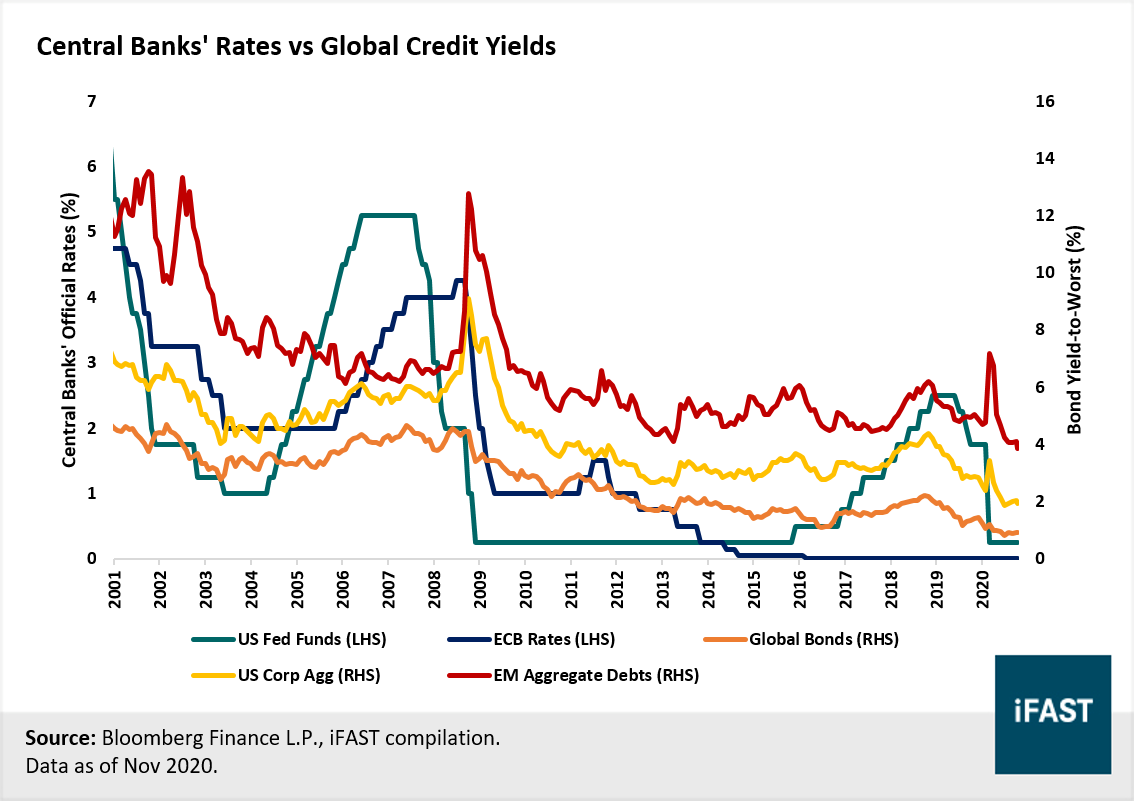
As mentioned, we believe the US Fed will maintain its near zero interest-rate policy, alongside many other central banks globally, for an extended period of time (economists’ consensus is till mid-2023). 

While the loose monetary condition is crucial in cushioning the global economy and supporting businesses, the side effects of the flush liquidity is even lower bond yields across fixed income products, compression in high yield credit spreads and elevated equity valuations (due to the lower equity risk premiums). 

Such a backdrop meant that most investors have to take on introduce greater equity-like exposure (and associated risks) into their portfolios to maintain their required rate of returns,  boosting demand for risk assets like equities and high yield bonds. 

Chart 4: Interest rates are staying low for a prolonged period of time


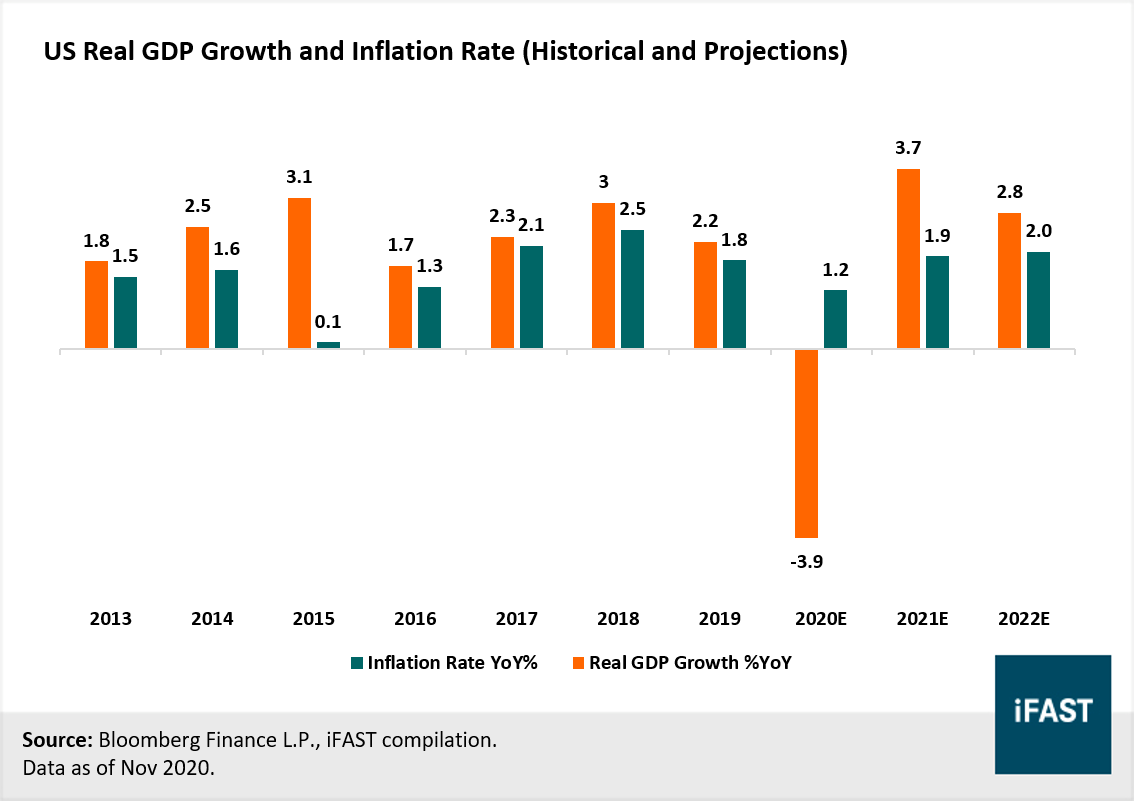
Looking further ahead, we believe that Biden's policies may be moderately reflationary for the US economy, since the government will likely focus on longer-term infrastructure investments and greater economic cooperation with its trade partners via multilateral trade agreements.  

Chart 5: US growth and inflation expectation to be moderately constructive in the next two years.


What financial assets will benefit from the impending macro backdrop?


US Cyclical and small-cap equities

Looking forward, we are increasingly positive on a robust rotation into US cyclicals and small caps stocks. 

We are expecting a US fiscal stimulus (with a focus on infrastructure investment) to be passed post-election – albeit smaller than expected. The post-election stimulus packages (which is expected to include infrastructure, healthcare and environmental initiatives) will likely be well-received by investors, thereby driving positive growth expectation and outperformance in cyclicals and small cap names. 

At the same time, the cheaper valuations for small cap and cyclicals relative to the better-performing large cap and growth stocks so far also serve as a compelling reason for investors to take a closer look at these segments. 


Asian equities and fixed income 


It is no secret that we favor Asian assets this year, given the improving economic fundamentals across 2nd and 3rd quarter. We expect the stronger economic growth in Asia is likely to translate into further upward revisions in earnings in the Asian equities ahead.

With most government bonds in developed nations near zero now, Chinese government bonds are looking increasingly attractive in our view with almost 3% yield-to-maturity. While currency weakness is typically the main draw against China onshore bonds, we expect the CNY to strengthen moderately against the USD over the longer term ahead – a plus for Asian High yields and China government bonds. 


Emerging market and cyclicals assets 


We are turning more positive on EM equities on improving risk appetite and global growth prospects ahead. Firstly, weakness in USD ahead has historically been constructive for EM currencies and equities. Secondly, we expect global growth to continue recovering at a meaningful pace, which is positive for commodity prices. Oil and copper, which are closely driven by global demand prospect, are likely to benefit the most. Rising commodity prices are supportive of EM’s economic growth and positive EM assets.


The Research Team is part of iFAST Financial Pte Ltd.  


All materials and contents found in this site are strictly for general circulation and informational purposes only and should not be considered as an offer, or solicitation, to deal in any of the funds or products found/identified in this site. While iFAST Financial Pte Ltd ("IFPL") has tried to provide accurate and timely information, there may be inadvertent delays, omissions, technical or factual inaccuracies and typographical errors. Any opinion or estimate contained in this report is made on a general basis and neither IFPL nor any of its servants or agents have given any consideration to nor have they or any of them made any investigation of the investment objective, financial situation or particular need of any user or reader, any specific person or group of persons. You should consider carefully if the products you are going to purchase are suitable for your investment objective, investment experience, risk tolerance and other personal circumstances. If you are uncertain about the suitability of the investment product, please seek advice from a financial adviser, before making a decision to purchase the investment product. Past performance is not indicative of future performance. The value of the investment products and the income from them may fall as well as rise. Opinions expressed herein are subject to change without notice. In respect of any matters arising from, or in connection with the said research analyses or research reports, recipients of the report are to contact IFPL at 10 Collyer Quay, #26-01 Ocean Financial Centre Building, Singapore 049315, or by telephone at +65 6557 2853. Where the report contains research analyses or research reports from a foreign research house and if the recipient of such research analyses or research reports is not an accredited investor, expert investor, institutional investor or an ex-accredited investor, IFPL accepts legal responsibility for the contents of such analyses or reports to such persons only to the extent as required by law. Please note that only certain security(ies) herein are available to all investors, while the rest are only available for certain persons to invest in, such as Accredited Investors (as defined in the Securities and Futures Act) or one who invests at least S$200,000 (or its equivalent currency) per transaction. To qualify as an Accredited Investor, one needs to submit a declaration form and certain relevant supporting documents, according to iFAST’s prevailing policies and procedures.

Please read our full disclaimers on the website at ( https://secure.fundsupermart.com/fsmone/policies/328125/investment-account-terms-&-conditions).

iFAST Financial Pte Ltd (IFPL) (registered address: 10 Collyer Quay #26-01 Ocean Financial Centre Singapore 049315, Telephone: 6557 2000) holds the Financial Advisers Licence issued by the Monetary Authority of Singapore ('MAS') to conduct regulated activities of advising on securities, marketing of collective investment schemes and arranging of any contract of insurance in respect of life policies, other than a contract of reinsurance and the Capital Markets Services Licence issued by the MAS to conduct regulated activities of dealing in securities and providing custodial services for securities. While IFPL has made every effort to ensure the independence of the report's contents, IFPL's nature of business is such that IFPL and its connected and associated entities together with their respective directors, officers and staff may be involved in providing dealing or investment-related services in the abovementioned securities, and have taken or may take positions in the securities mentioned in this report, and may also act as the principal for any buy or sell trades.

Ways to Invest with FSM Global
Why FSM Global
Don't have an account with us?
Open an account here
Need Financial Advice?
Make an appointment

We use cookies If you close this message or continue to use this site, you will consent to the use of Cookies, unless you choose to disable them. Click on our Privacy Policy to understand more.