


• A series of regulations on the tech sector has sent many Chinese tech stocks tumbling to their year-to-date lows. We think that the fears of the regulations are overblown and this is a good opportunity for investors to add some China tech exposure to their investment portfolios.
• China has legitimate reasons to regulate the Big Tech companies, as they have grown significantly over the years and wield immense power.
• Moves to rein in Big Tech are not contained in China alone, as the Western countries are also calling for greater regulatory oversight.
• Additionally, the impact of the regulation is uneven and we like companies who demonstrate continued earnings strength.
• The long-term growth story of China’s tech sector remains intact on the back of megatrends, such as rising internet penetration rates and the digitalisation of consumption.
• Investors should use this opportunity to gain exposure to China’s tech sector, through the iShares Hang Seng TECH ETF (HKEX:3067). Our target price for this ETF is HKD 19.40, which represents an upside of approximately 50%.
Recent developments in the China tech space
Over the past month, a series of clampdowns by the government rocked Chinese equity markets. As a result, many Chinese tech stocks have tumbled to their year-to-date lows as rattled investors scrambled to divest their shares.
Figure 1: The Hang Seng Tech index has fallen -40% since its February high
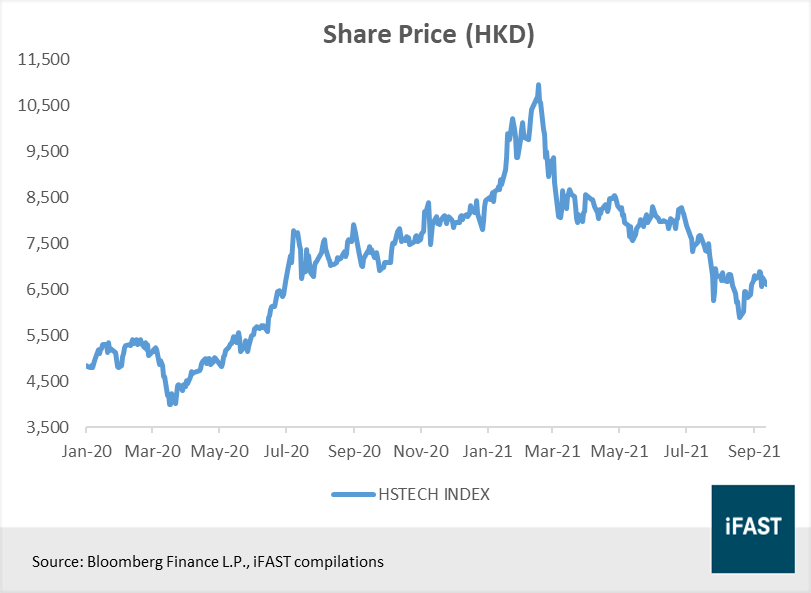
A series of regulatory crackdowns that began late last year with the cancellation of Ant Group’s IPO has intensified in recent months. Alibaba (NYSE: BABA) was slapped by regulators in April with a record fine of USD 2.8 billion for violating antitrust law for its use of the “two choose one (二选一)” exclusivity contracts on merchants.
The relentless crackdown continued in July, with the government banning Tencent Music (NYSE: TME) from owning exclusive rights in the online music industry. In the private education sector, sweeping reforms were also announced, including requiring all private education institutions to register as non-profit entities. Such institutions will also not be able to pursue IPOs or take in foreign capital.
Related Article: Quick Take: China's tech crackdown may strike fear in hearts, but its impact will be uneven
Most recently, gaming stocks took a hit when regulators announced a new rule that limited game time to only three hours a week for players under 18 – from 8 pm to 9 pm on Fridays, Saturdays, and Sundays. Regulators also summoned Tencent (HKEX: 700) and Netease (NASDAQ: NTES) for a discussion regarding further oversight of the gaming industry and the de-emphasis on profits.
With China expected to implement more reforms in its tech sector, the heightened regulatory risk may continue to weigh on investor sentiment in the near term. However, we think that the fears of increased regulation are largely overblown, and this is a good opportunity (if not the perfect opportunity) for investors to add some China tech exposure to their investment portfolios.
Here are the reasons why.
China has legitimate reasons to regulating big-tech companies
China’s Big Tech companies have grown significantly over the years and wield immense power. Such is their influence that it is nearly impossible for consumers and small businesses to navigate daily life outside of tech ecosystems operated by the likes of Tencent (HKEX: 700) and Alibaba (NYSE: BABA).
Yet, despite their dominance, these companies have largely been unencumbered by regulation and have faced nearly zero antitrust scrutiny since their founding. As such, the “two choose one” practice, which forces online merchants to choose only one platform as their exclusive distribution channel, has largely gone unnoticed for years.
If left unchecked, power will remain in the hands of these internet platforms, allowing them to unfairly treat both merchants and consumers, such as price discrimination and rules that prevent brands from selling on different marketplaces.
Furthermore, the lack of competition will impede innovation in the industry, an outcome that is certainly undesirable at a time when achieving technological self-sufficiency is China’s top national priority. As such, a healthy dose of regulation on the sector is perhaps justified and not entirely unreasonable.
This is in line with the regulator’s emphasis that they are not trying to stifle the growth of tech companies, but rather, to safeguard consumer interests and ensure sustainable growth of the sector.
And then there are the social ills that have been created by Big Tech over the years, with several examples elaborated below.
Education inequality and a looming demographic crisis: In the case of the EdTech sector, if the government did not intervene, education inequality would be worsened as only the rich would be able to afford private tutoring. Moreover, the high cost of raising a child in China, including forking out great sums to help children successfully navigate the “gaokao”, disincentivises families from having more children, which would worsen China’s ageing population woes.
Poor working conditions: The toxic ‘996’ working culture is commonplace in the tech sector, with many employees suffering burnout from overwork and are often not compensated for overtime hours. The working conditions of workers in the informal labour economy, such as delivery riders, are also poor. Not only are they overworked and underpaid, but the tight deadlines imposed on them have also forced them to take dangerous routes, resulting in several deaths and injuries.
Add these social ills in, and it is not difficult to understand why China’s authorities are aimed at their tech giants.
China is not alone in regulating Big Tech companies
China is not the only country that is trying to regulate Big Tech companies, as activists and policymakers in the US and Europe have also been calling for greater regulations on tech companies in recent years.
For example, the Justice Department filed an antitrust lawsuit against Google (NASDAQ: GOOGL) in October last year. The lawsuit highlights that Google uses exclusivity contracts to maintain its monopoly in search. The Federal Trade Commission (FTC) has also filed a lawsuit against Facebook (NASDAQ: FB), alleging that the company is illegally maintaining its social networking monopoly through a years-long course of anti-competitive conduct.
The difference between China and its Western developed peers is that the Chinese government has a lot more leverage over their companies. The government is also not subjected to judicial checks and balances, explaining why China has been able to leapfrog both the US and Europe in terms of the speed of its antitrust efforts. While it only took less than four months of antitrust investigation for Alibaba to be slapped with a USD 2.8 billion fine in April this year, the Justice Department’s antitrust lawsuit against Google will not go to trial until September 2023.
China’s Big Tech companies have become dominant market players across many sectors and have gone unregulated for years. Thus, we believe that these steps taken to regulate tech companies are at least a step in the right direction and help China catch up to the regulatory norms of the developed world.
Regulatory impact will vary, with some companies being more resilient
Additionally, the impact of regulations is likely to be uneven. Not all tech companies will be equally impacted by the latest regulations. In fact, some may even benefit.
We are most pessimistic on companies whose earnings will be directly affected. For example, in the private education edtech crackdown, the move to make private tutoring more affordable and even non-profit calls into question the viability of the private tutoring business model, and we think that it could result in these companies losing a huge chunk of their profits.
On the other hand, some companies may benefit from the regulations. JD.com (HKEX: 9618), for instance, may stand to gain as the crackdown on the exclusivity contracts will level the playing field for e-commerce companies, as merchants no longer need to be exclusive to a single platform.
Since the crackdown, JD.com has seen the return of brands such as Starbucks, Bvlgari, and Victoria Secret’s to its platform.
Related article: JD.com: A potential winner amidst China’s Big Tech crackdown
We also think that regulations will not impact Tencent Music significantly. Although Tencent music will no longer be able to have exclusive rights to music licenses, we believe that because of the strong ecosystem on its WeChat platform, which has 1.24 billion monthly active users (MAUs), they will maintain its strength in customer retention and acquisition.
On the platform, there are over 100 mini-programs within the WeChat app, allowing users to conveniently find everything they need on WeChat alone. Mini-programs include popular services such as Didi, Meituan, and PinDuoDuo.
This holistic suite of services increases user stickiness across all the apps in the ecosystem. Additionally, users in China already typically use multiple music streaming platforms to access different artists, hence migration of users should not be a huge concern.
Finally, we continue to like segments where the government has announced plans for investment, which include Artificial intelligence, semiconductors, 5G, and cloud.
Related article: Here’s one segment that could benefit from the crackdown on China’s Big Tech firms
Long-term prospects of China’s tech sector remain intact
In the past five years, China has demonstrated extraordinary advancement, becoming a forerunner in technological advancement. But this is not the end and we expect the next five years to be an even more interesting one.
We continue to like China Tech as the outlook for China’s tech sector remains robust as companies benefit from rapidly unfolding megatrends, such as rising internet penetration rates and the digitalisation of consumption, both of which have been boosted by the pandemic.
With the lockdown measures, most activities have shifted online, driving up the internet penetration rate from 61.2% in 2019 to a record high of 70.4% in 2020. Despite the 9.2 percentage point jump in penetration rate between 2019 and 2020 – the largest ever in China’s internet history – China’s internet market remains far from saturated, with its penetration rate still lagging behind that of North America and Europe.
Figure 2: Internet penetration rates in China remains far from saturated

Another megatrend supporting the growth of China’s tech sector is the increasing digitalisation of consumption, as more and more people are starting to shift towards on-demand services, such as e-commerce, food delivery, and ride-hailing.
E-commerce is one area that has experienced significant growth over the years, with online sales now accounting for 25% of the total retail sales in China today, more than doubling from what it was five years ago (Figure 4).
Figure 3: E-commerce sales as a percentage of total retail sales has been increasing over the years

Even amidst the regulatory crackdown, e-commerce activity remains robust. Across the first half of 2021, the two largest e-commerce players – Alibaba (NYSE: BABA) and JD.com (HKEX: 9618) demonstrated continued strength in revenue growth over the previous year (Figure 5).
This reinforces our confidence in these long-term megatrends as long-lasting growth drivers for the tech sector. In addition, 1H21 numbers also paint a picture that shows the spike in demand for digital services caused by COVID-19 is here to stay, and that consumer behavior is gradually shifting online.
Figure 4: Revenue growth continues to 1H21

Recent sell-off is an opportunity to accumulate more shares
In conclusion, the outlook for China’s tech sector remains promising as long-term megatrends, such as rising internet penetration and the digitalisation of consumption, continue to drive growth. The recent dip has made share prices more attractive than before, giving investors the opportunity to gain exposure to the sector’s long-term growth.
We take the view that diversification is important, as the ongoing regulatory changes will likely have an uneven impact on different companies while raising the level of volatility across the entire sector. Therefore, investors seeking exposure to China’s tech sector can consider our recommended ETF, the iShares Hang Seng TECH ETF (HKEX:3067).
Table 1: Earnings table for China’s tech sector
|
2021E |
2022E |
2023E |
|
|
EPS |
157.90 |
229.00 |
309.10 |
|
Earnings Growth |
-30% |
45% |
35% |
|
PE Ratio |
39.6x |
27.3x |
20.0x |
|
Upside Potential |
- |
9.9% |
48.4% |
|
Source: Bloomberg Finance L.P., iFAST Estimates *Based on our fair PE multiple of 30X |
|||
Based on a fair PE multiple of 30X, our 2023 target price for the iShares Hang Seng TECH ETF (HKEX:3067) is HKD 19.40, which translates to an upside potential of 48.4% based on the closing price of HKD 13.06 as of 21 Sep 2021.
From our previous update, we have lowered our fair PE ratio to our base case scenario of 30X from the 35X bull case to account for the heightened regulatory risk in the near term, as we expect the negative sentiment on the regulations to be an overhang on the sector.
Declaration:
For specific disclosure, at the time of publication of this report, IFPL (via its connected and associated entities) holds a NIL position in the abovementioned securities. The analyst who produced this report holds a position in Alibaba and iShares Hang Seng TECH ETF.
All materials and contents found in this site are strictly for general circulation and informational purposes only and should not be considered as an offer, or solicitation, to deal in any of the funds or products found/identified in this site. While iFAST Financial Pte Ltd ("IFPL") has tried to provide accurate and timely information, there may be inadvertent delays, omissions, technical or factual inaccuracies and typographical errors. Any opinion or estimate contained in this report is made on a general basis and neither IFPL nor any of its servants or agents have given any consideration to nor have they or any of them made any investigation of the investment objective, financial situation or particular need of any user or reader, any specific person or group of persons. You should consider carefully if the products you are going to purchase are suitable for your investment objective, investment experience, risk tolerance and other personal circumstances. If you are uncertain about the suitability of the investment product, please seek advice from a financial adviser, before making a decision to purchase the investment product. Past performance is not indicative of future performance. The value of the investment products and the income from them may fall as well as rise. Opinions expressed herein are subject to change without notice. In respect of any matters arising from, or in connection with the said research analyses or research reports, recipients of the report are to contact IFPL at 10 Collyer Quay, #26-01 Ocean Financial Centre Building, Singapore 049315, or by telephone at +65 6557 2853. Where the report contains research analyses or research reports from a foreign research house and if the recipient of such research analyses or research reports is not an accredited investor, expert investor, institutional investor or an ex-accredited investor, IFPL accepts legal responsibility for the contents of such analyses or reports to such persons only to the extent as required by law. Please note that only certain security(ies) herein are available to all investors, while the rest are only available for certain persons to invest in, such as Accredited Investors (as defined in the Securities and Futures Act) or one who invests at least S$200,000 (or its equivalent currency) per transaction. To qualify as an Accredited Investor, one needs to submit a declaration form and certain relevant supporting documents, according to iFAST’s prevailing policies and procedures.
Please read our full disclaimers on the website at ( https://secure.fundsupermart.com/fsmone/policies/328125/investment-account-terms-&-conditions).
iFAST Financial Pte Ltd (IFPL) (registered address: 10 Collyer Quay #26-01 Ocean Financial Centre Singapore 049315, Telephone: 6557 2000) holds the Financial Advisers Licence issued by the Monetary Authority of Singapore ('MAS') to conduct regulated activities of advising on securities, marketing of collective investment schemes and arranging of any contract of insurance in respect of life policies, other than a contract of reinsurance and the Capital Markets Services Licence issued by the MAS to conduct regulated activities of dealing in securities and providing custodial services for securities. While IFPL has made every effort to ensure the independence of the report's contents, IFPL's nature of business is such that IFPL and its connected and associated entities together with their respective directors, officers and staff may be involved in providing dealing or investment-related services in the abovementioned securities, and have taken or may take positions in the securities mentioned in this report, and may also act as the principal for any buy or sell trades.