Macro Research

US 2021 Market Outlook: Trading at record highs, is it still worth investing?

S&P 500 Index is up 16.5% this year amid a recession year and current third wave of Covid-19 outbreak. As US equities now trading at near record highs, should investors continue investing in this expensive market?

  • |
  • Published on 12 Dec 2020

US 2021 Market Outlook: Trading at record highs, is it still worth investing? | Open a FREE FSMOne account and manage all your investments conveniently in ONE place
Photo by Nik on Unsplash

  • Growth of US economy and market could take off as quickly as the 2nd quarter of 2021. The notion is supported by favourable tailwinds such as (i) improving global growth outlook, (ii) lagged effects of measures this year, (iii) supportive policy backdrop and potentially (iv) the mass distribution of Covid-19 vaccine among US citizens.


  • Valuations of S&P 500 index are expensive relative to history - trading more than forward PE of 20.0X. But we see two major reasons why current valuation is justified in the current macro backdrop. 

  • Earnings of S&P 500 Index will be driven by a healthy mix of secular and cyclical growth factors in the next two years - projected to jump by more than 27% and 17% - partly due to low base effect this year.

  •  Our target price for S&P 500 Index by end-2022 represents an upside potential of +20% from yesterday’s closing price. The rosier growth prospect, alongside a strong line-up of positive catalysts, render the US equities an attractive bet for the year ahead. 

  • Thus, we upgrade our ratings for US equities to 3.0 Stars “Attractive”.


2020 has been remarkable for US equities. Despite plunging 34% from peak to trough in 1Q20, the US equity market (as measured by S&P 500 Index) hit a series of new highs in 2Q20, staging the quickest rebound in history – all amidst a recession year. In fact, S&P 500 Index is now up 16.5% this year on a total return basis even as the Covid-19 situation remains unabated in the US (Chart 1).

Similarly, US funds have done pretty well this year. According to our FSMI US equity index, which tracks the US equity funds on our platforms, US funds have generated a positive return of 9.6% (in SGD terms) on aggregate, on a year-to-date basis (Chart 2). 

We think this is impressive, considering that the market has undergone various major risk events in 2020 – US-China trade war, Covid-19 pandemic, US presidential election, etc. – some of which remain unresolved. Nothing seems to faze the US equity markets.  


However, with S&P 500 Index (our main gauge for US equities) trading near record highs even as Covid-19 health crisis rages on in the US, investors now face a challenging question ahead: To continue investing in the US, or not? 

Chart 1: US equities registered positive returns of 16.5% on a 1-year basis, in a recession year. 
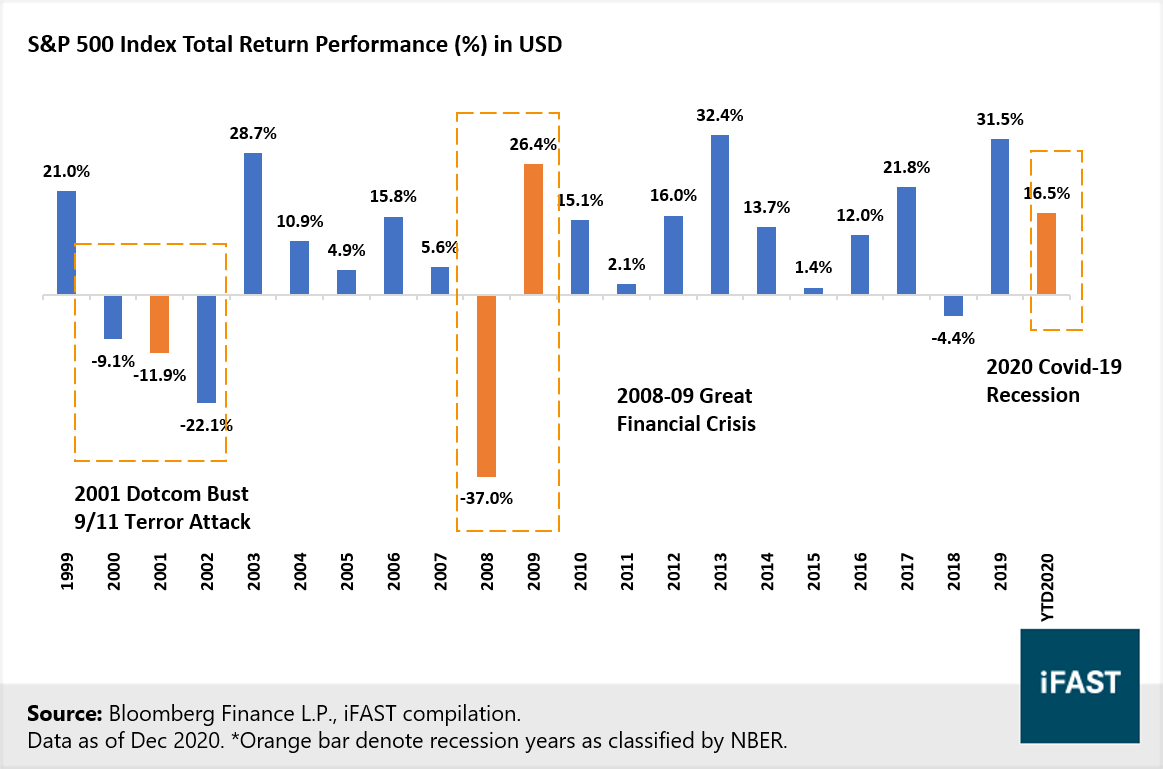


Chart 2: US equity funds have not done shabbily either – up 9.5% on aggregate in SGD terms.


2021 Outlook: Looking past the recession year, a rosier outlook lies in the horizon

Our short answer is yes. 

In the near-term, we expect US equities to face slight resistance from growth and sentiments headwinds in Q1 2021 – particularly the rising Covid-19 daily cases, but they are likely to fade as we draw closer to a possibility of a sizable fiscal stimulus package (estimated at USD 1 Trillion) upon Biden’s inauguration in late-January next year.

Undeniably, a major part of the rebound in US equities this year can be attributed to the swift monetary and fiscal response (more than USD 2 Trillion) by US policymakers as the crisis unfolded. Businesses badly impacted by social distancing restrictions were kept on life support, prevented from shuttering their doors permanently and laying off workers, which could otherwise spark off a disastrous chain of consequences in the US economy. 

That being said, we believe the organic growth of US economy and market could take off as quickly as the 2nd quarter of 2021. The notion is supported by favourable tailwinds such as (i) improving global growth outlook, (ii) lagged effects of measures this year, (iii) supportive policy backdrop and potentially (iv) the mass distribution of Covid-19 vaccine among US citizens (Chart 3).

At the same time, we have witnessed the willingness of US consumers and investors to look past 2020 for better days ahead in the economy and corporate earnings. The US Indexes are heading off to fresh highs while US retail sales are already recovered to above pre-pandemic levels.  

While we acknowledge that uncertainties persist heading into 2021, we believe that a rosier outlook lies in the horizon – one capable of driving the US economy and markets to new heights. In the following sections, we delve deeper into why we remain optimistic in investing in US equities despite its heady valuation now. 

Chart 3: We expect to see a checkmark-shaped recovery in US next year


Economy: A Bumpy Recovery but Brighter Days ahead

2021 will be a crucial year for US policymakers. We believe their immediate focus will be on undoing the Covid-19 damages on households and small businesses – the backbone of the US economy. 

While economic indicators continue to improve in most areas of the US economy across Oct/Nov period, the labour remained well under pressure, evident from the unemployment rate measure. More worryingly, even though temporal unemployment rate has improved constructively after peaking in April, there are signs that the layoffs are shifting into permanently job losses (Chart 4). 

As US continues to battle its 3rd wave of Covid-19 infection, businesses are once again facing the difficult decision to lay workers off and consumers to cut back spending in anticipation of tougher times ahead. 

The huge increase in unemployment caused by the pandemic have greatly reduced disposable income for many households – an important determinant of consumer spending.
 

Chart 4: Policymakers must implement more supportive measures or risk further economic scarring


Given personal consumption’s outsized contribution of 70% to GDP, consumers will play a critical role in the US recovery ahead. 

At this juncture, additional support from the government will be required to prevent a longer-term economy scarring from the Covid-19 crisis. Therefore, we believe monetary and fiscal policy will remain very supportive throughout next year, which in turn will encourage borrowing, investment, and spending – thereby sustaining the recovery.

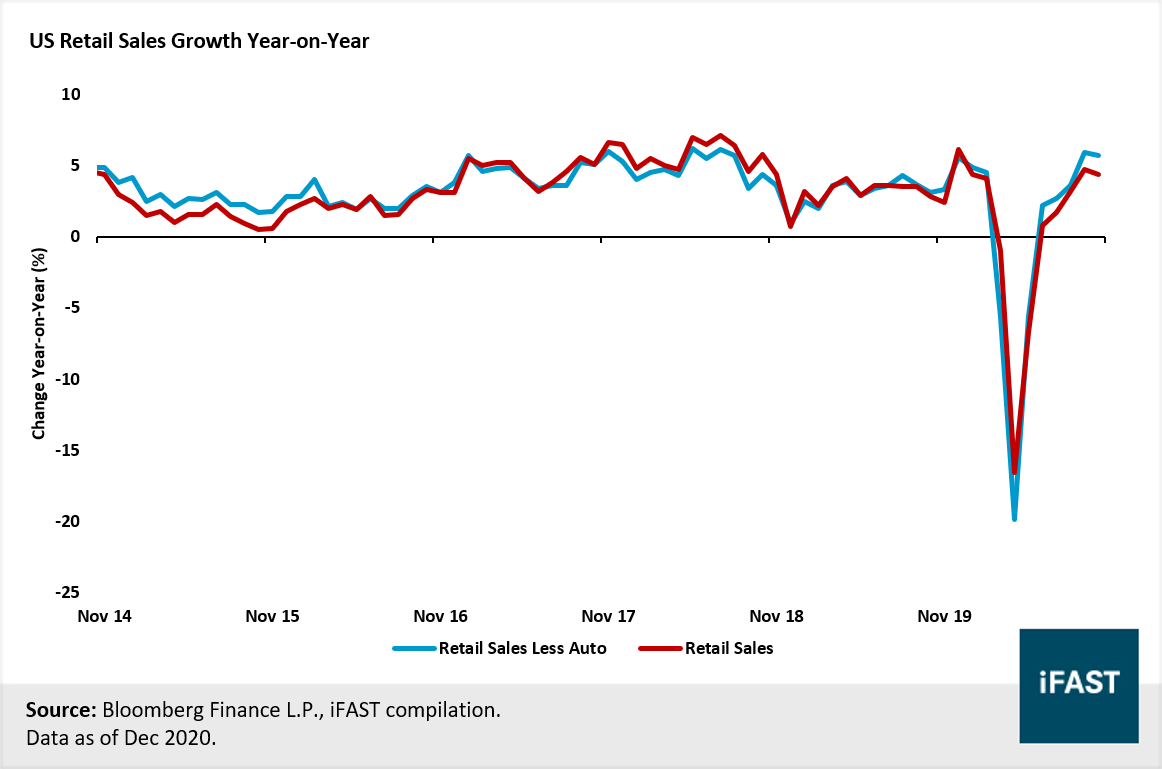
Thankfully, these measures appear to work. Back in May-Aug this year, the combination of economic re-opening and pent-up demand have helped retail sales and consumer confidence rebound. 

Retail spending was also supported by the stimulus of the Coronavirus Aid, Relief and Economic Security (CARES) Act, which rendered households almost USD 270 billion worth of assistance during Mar/Apr period. As a result, retail sales have since recovered above pre-pandemic levels, after surging by 41% quarter-on-quarter in 3Q20 (Chart 5).

While we expect the rising Covid-19 case counts, partial lockdowns, and delay in fiscal stimulus to materialise as weakness in economic data in current and next quarters (i.e. 4Q20 and 1Q21), we believe the growth momentum could gather steam from 2nd quarter of 2021 onwards.

On the monetary end, the Federal Reserve is expected to keep rates near zero and a close watch on the credit markets. On the fiscal side, Biden’s administration is expected to tap on the closely-linked levers of US consumption, labor market and small businesses to revitalise its economy. 

Looking ahead, the upcoming fiscal support package of estimated USD 1 trillion and the promising development on the vaccine front are two major catalysts that can provide a strong uplift to growth expectations. 

Chart 5: The consumer rebound has been swift despite worsening Covid-19 crisis – providing glimmer of hope for US economic future.


Are valuations too expensive now?

While monetary stimulus has not led to any real economy inflation, it has most definitely materialised as asset inflation – particularly in the stock market.

There’s no denying it; valuations of S&P 500 index are expensive relative to history, by conventional metrics like P/E and P/B multiples. S&P 500 Index is currently trading at a forward PE of 20.7X (on consensus estimates of FY21 EPS) – 3 standard deviation above the 10-year average level of 13.9X. 

Chart 6: S&P 500 equities have expanded rapidly in valuation over the last few years. 


In face of such elevated valuations, it is easy to cast the US equities off as expensive and unsustainable. Furthermore, it is also reasonable for investor to feel uncomfortable with such frothy valuation, especially with the high degree of economic uncertainty next year.

However, we argue that there are two major reasons why current valuation is justified in the current macro backdrop. 

Firstly, global interest rates are near zero in developed markets now and are likely to persist at such level for the foreseeable years ahead. Low interest rates drive a natural expansion in equity valuations in multiple ways:

  • lower rates increase the discounted present value of future cash flows 
  • encourage risk taking behaviour because financing costs for leveraged positions are low
  • equities are more attractive to investors on a relative basis because dividend and earnings yields are much higher than fixed income yields
At the same time, the flush liquidity via the Fed quantitative easing program (meant to stimulate the economy) have eventually found its way into equity markets. With more money chasing a relatively limited amount of real assets, we have seen S&P 500 forward PE rising on a structural basis since 2008 GFC, alongside Fed’s burgeoning balance sheet (Chart 7).

Chart 7: Easy monetary policies have driven up asset price inflation – especially in the S&P 500 equities. 


The second, arguably less-mentioned point is that S&P 500 Index have grown increasingly IT-heavy in sector weightage over the last few years. 

The largest and most dominant US companies now tend to be the tech giants and technology-related corporations, which command higher price multiples due to their promising growth prospects (investors are more willing to look past valuations). They are comparatively less sensitive to the cyclicity of the economy, resulting in strong fundamentals, stable cash flows, earnings, and dividends streams, all of which are supportive of stock prices. 

Simultaneously, the Tech and tech-related sectors have displaced the more cyclical and cheaper-valued sectors such as financials and industrials in weightage – inadvertently lifting the overall equity valuation of the S&P 500 basket of stocks. 

Chart 8: Technology and tech-related sector weigh nearly one-third of the S&P 500 Index now


Earnings growth outlook are slated to improve significantly in 2021

Going forward, the growth environment next year bodes well for corporate earnings. As fundamentals start to matter again, the earnings growth of S&P 500 Index in 2021 will be closely watched by investors and thus have a major role to play in supporting the stretched valuations of US equities. 

With the negative impact of Covid-19 pandemic on a number of industries on the index (particularly Energy and Industrials), earnings this year are projected to decline by at least 10%, before jumping by more than 27% and 17% to reach USD 187 and USD 220 per share for FY2021 and 2022 respectively, in part due to the low base effect (Chart 9).

Chart 9: Corporate earnings are projected to face a double-digit contraction this year, for first time since 2008. 


We expect earnings of S&P 500 Index to be driven by a healthy mix of secular and cyclical growth factors in the next few years.

At the sectoral level, secular growth trends continue to empower sectors such as technology, healthcare and consumer discretionary, riding on the megatrends of digital economy, healthcare innovation and sustainability.

The Covid-19 pandemic has inadvertently accelerated the global economies’ transformation into an increasingly digitalised one. As businesses, consumers and households began to adapt to conducting day-to-day affairs in the online world, we believe that the paradigm shift towards a digital economy is nigh irrevocable. 

Consumption trends like 5G upgrade cycle, rising e-commerce penetration and online media consumption will continue to drive double-digit earnings growth for technology giants like Apple, Amazon and Microsoft, regardless of Covid-19 (Table 1).

Table 1: Most of S&P 500 companies are projected to deliver double-digit earnings growth next two years.

No.

S&P 500 Top 10 Holdings

Weight

Sector

2020 EPS%

2021 EPS%

2022 EPS%

1

Apple Inc

6.2%

Information Technology

21.2%

9.3%

7.5%

2

Microsoft Corp

4.8%

Information Technology

19.0%

10.1%

15.6%

3

Amazon.com Inc

4.7%

Consumer Discretionary

48.5%

22.3%

35.3%

4

Alphabet Inc

3.6%

Communication Services

-7.2%

22.7%

19.7%

5

Facebook Inc

2.4%

Communication Services

8.4%

12.9%

19.2%

6

Berkshire Hathaway Inc

1.6%

Financials

-10.4%

15.4%

11.0%

7

Visa Inc

1.5%

Information Technology

9.0%

26.1%

16.6%

8

Walmart Inc

1.2%

Consumer Staples

12.3%

2.3%

6.8%

9

Johnson & Johnson

1.2%

Health Care

-7.9%

13.0%

9.0%

10

JPMorgan Chase & Co

1.1%

Financials

-26.2%

22.2%

16.4%

Source: Bloomberg Finance L.P., iFAST compilation. Data as of Dec 2020.


For healthcare sector, the Covid-19 pandemic have emphasized the need for greater healthcare innovations. We expect governments and businesses around the world to spend more money into purchasing Covid-19 test kits, personal protection equipment (i.e. masks and hazmat suits), sanitation solutions and vaccine shots, which will lift sales and earnings growth. 

On the other hand, the beaten down sectors like Financials, Industrials and Consumer Discretionary could see a massive jump in revenue and earnings next year, on the basis of (i) cyclical recovery next year, (ii) release of pent-up demand upon a mass roll-out of a successful vaccine, (iii) fiscal stimulus measures and (iv) low base effect. We expect to see high double-digit growth typical for these sectors during the early stages of a new economic cycle.

Financials is a key sector we think is worth investing in amid a cyclical rotation. Regulators across the globe has taken several actions earlier this year to ensure that banks conserve sufficient cash to weather through the pandemic downturn. However, given the rising odds of a Covid-19 vaccine, our financial analyst believes that there are positive catalysts lining up for the banking industry in 2021. 


The industrials sector is slated to be the biggest beneficiary for a cyclical rebound as growth broaden out, especially with the likelihood of more fiscal spending after the election bodes well for subsegments such as transport, construction, infrastructure and defense (Chart 10).

Chart 10: Earnings for S&P 500 Index is likely driven by a healthy mix of secular and cyclical growth factors ahead


What could derail US equities ahead?

We see three major risks facing the US equity markets ahead:

Firstly, with the recent Biden presidential victory coupled with a barrage of positive vaccine news, US equities have rallied significantly in the last few months. Positive scenarios such as the upcoming fiscal stimulus, vaccine-recovery are generally priced into the markets, while unresolved headwinds such as the US-China tension were neglected by investors.  

Secondly, valuation levels for US equities are frothy, trading near 20 years’ high – partially driven by the top technology stocks like Apple and Amazon. A near-term sector rotation into the cyclicals and/or industry-wide portfolio rebalancing near the end of this year could spark a sharp pullback in these technology names, leading to a swift correction in S&P 500 Index. 

Lastly, rising inflation and higher growth expectation for 2021 could lead to uptick in yield at the longer-end of the yield curve. Given that the thesis of a justified increase in S&P 500 Index rest on the low interest rates, any slight hint of rate tightening could see a drastic risk-off reflex in the US equity market. 

Overall, we think these are near-term risks that could materialise as volatility in the equity market in the year ahead, but we believe that the rosier growth outlook and corporate earnings recovery will outweigh the impact of the abovementioned risk factors. 

Despite trading at record-high level, US equities could advance by +20% in the next two years 

With Fed’s monetary stance likely to be easy for the next 2-3 years, we have adjusted our fair PE ratio for S&P 500 Index upwards to 20.0X, from our previous value of 18.0X. 

Coupled with our earnings projections for the next two years ahead (28% in FY21 and 17% in FY22), we derived a target price of 4,400 for S&P 500 Index by end-2022. This represents a decent upside potential of +20% from yesterday’s closing price. 

Table 2: We think it’s likely that S&P 500 Index could close above 4,400 by end-2022

US S&P 500 Index

FY2019

FY2020

FY2021

FY2022

PE ratio (X)

22.3

24.9

19.5

16.7

Expected earnings growth (YoY %)

0.8%

-10.4%

27.7%

17.2%

Earnings Per Share (EPS)

163.8

146.8

187.5

220.0

Projected fair price (Based on 20.0X Fair PE ratio)

3,276

2,935

3,750

4,400

Potential upside (%)

-

-

-

+20%

Source: Bloomberg Finance L.P., iFAST estimates. Data as of Dec 2020.


Our US Strategy for 2021: 50-50 on Cyclical Rotation and Secular Growth

Our strategy for US equities will be approach via a bifurcation in risk assets – 50:50 split in investing in US Small Cap growth as well as US Large Cap growth equities. 

In a way, such a barbell allocation enables investors to reap benefits of a cyclical rotation upon a successful vaccine outcome, as well as having exposure to the digital economy megatrends in a backdrop of extended Covid-19 restrictions into 2021.

While interest is ramping up for a sector rotation into value and small caps as we round the bend into 2021, we are still biased towards growth stocks in the long run. In our view, secular growth trends like digital economy and healthcare innovations are here to stay. 

Not to mention, majority of large cap growth firms (particularly the tech giants) have strong balance sheet and ample free cashflow – which could easily be deployed to fund share buybacks and/or distributed to investors as dividends.

On the other hand, we also see how US small-cap stocks could stand to benefit as a major beneficiary of an early-cycle expansion in the US economy in 2021 – given the basket’s sensitivity to economic growth. 

We expect policymakers to implement a supportive mix of monetary and fiscal stimulus to mend the Covid-19 damage on households and small businesses, which are integral to the organic growth of the US economy. In addition, a Covid-19 vaccine and fiscal policy intervention serve as strong catalysts for a rotation into US small-cap stocks.

2021 will be a crucial year for US to pick up in pace of recovery, especially amid a worsening Covid-19 health crisis. The rosier growth prospect, alongside a strong line-up of positive catalysts, render the US equities an attractive bet for the year ahead and upgrade our ratings for US equities to 3.0 Stars “Attractive” heading in 2021. 

Investors can consider gaining exposure to US equities via a combination of the suggested investment products listed in Table 3 below. 

Table 3: Products that investors can consider for Small-Cap and Large-Cap US growth stocks


Chart 11: We believe US equities are an attractive bet for the year ahead, despite the frothy valuations.


The Research Team is part of iFAST Financial Pte Ltd.

All materials and contents found in this site are strictly for general circulation and informational purposes only and should not be considered as an offer, or solicitation, to deal in any of the funds or products found/identified in this site. While iFAST Financial Pte Ltd ("IFPL") has tried to provide accurate and timely information, there may be inadvertent delays, omissions, technical or factual inaccuracies and typographical errors. Any opinion or estimate contained in this report is made on a general basis and neither IFPL nor any of its servants or agents have given any consideration to nor have they or any of them made any investigation of the investment objective, financial situation or particular need of any user or reader, any specific person or group of persons. You should consider carefully if the products you are going to purchase are suitable for your investment objective, investment experience, risk tolerance and other personal circumstances. If you are uncertain about the suitability of the investment product, please seek advice from a financial adviser, before making a decision to purchase the investment product. Past performance is not indicative of future performance. The value of the investment products and the income from them may fall as well as rise. Opinions expressed herein are subject to change without notice. In respect of any matters arising from, or in connection with the said research analyses or research reports, recipients of the report are to contact IFPL at 10 Collyer Quay, #26-01 Ocean Financial Centre Building, Singapore 049315, or by telephone at +65 6557 2853. Where the report contains research analyses or research reports from a foreign research house and if the recipient of such research analyses or research reports is not an accredited investor, expert investor, institutional investor or an ex-accredited investor, IFPL accepts legal responsibility for the contents of such analyses or reports to such persons only to the extent as required by law. Please note that only certain security(ies) herein are available to all investors, while the rest are only available for certain persons to invest in, such as Accredited Investors (as defined in the Securities and Futures Act) or one who invests at least S$200,000 (or its equivalent currency) per transaction. To qualify as an Accredited Investor, one needs to submit a declaration form and certain relevant supporting documents, according to iFAST’s prevailing policies and procedures.

Please read our full disclaimers on the website at ( https://secure.fundsupermart.com/fsmone/policies/328125/investment-account-terms-&-conditions).

iFAST Financial Pte Ltd (IFPL) (registered address: 10 Collyer Quay #26-01 Ocean Financial Centre Singapore 049315, Telephone: 6557 2000) holds the Financial Advisers Licence issued by the Monetary Authority of Singapore ('MAS') to conduct regulated activities of advising on securities, marketing of collective investment schemes and arranging of any contract of insurance in respect of life policies, other than a contract of reinsurance and the Capital Markets Services Licence issued by the MAS to conduct regulated activities of dealing in securities and providing custodial services for securities. While IFPL has made every effort to ensure the independence of the report's contents, IFPL's nature of business is such that IFPL and its connected and associated entities together with their respective directors, officers and staff may be involved in providing dealing or investment-related services in the abovementioned securities, and have taken or may take positions in the securities mentioned in this report, and may also act as the principal for any buy or sell trades.

Ways to Invest with FSM Global
Why FSM Global
Don't have an account with us?
Open an account here
Need Financial Advice?
Make an appointment

We use cookies If you close this message or continue to use this site, you will consent to the use of Cookies, unless you choose to disable them. Click on our Privacy Policy to understand more.