Is HSBC a deep value play, or a value trap? Hint: we think it could more than double.

Since its peak in 2018, HSBC (HKEX:5) has drastically fallen from grace due to a multitude of problems, from Brexit, Hong Kong’s political unrest, to the coronavirus. With the company now trading near its all-time lows, the question beckons: is HSBC a deep value play, or is it a value trap?

  • |
  • Published on 31 Oct 2020

Is HSBC a deep value play, or a value trap? Hint: we think it could more than double. | Open a FREE FSMOne account and manage all your investments conveniently in ONE place
Photo by Shawn on Unsplash

HSBC (HKEX:5) is trading near its all-time low valuations as the bank faces a multitude of problems, from Brexit, Hong Kong’s political unrest, to the coronavirus.

Any dilutive capital raising activities is unlikely to happen. The HSBC today is in a much better shape compared to the HSBC then, with the bank having a strong capital position that is higher than some of its international and Asian peers.

To counter HSBC’s poor profitability, HSBC has also embarked on a restructuring plan. While this could spell short-term pain due to restructuring and asset disposal costs, we believe the restructuring plan will help HSBC deliver better profitability.

We believe the resumption of dividends will also be a major catalyst for HSBC. The dividend suspension was not due to HSBC’s inability to pay dividends. Rather, it was due to UK regulators pressuring HSBC to cancel its dividends. HSBC’s current capital level can more than support the payment of dividends to its shareholders. 

While an investment in HSBC comes with risks, we believe there’s more upside risk than downside risk at this juncture. Our target price of HKD 81 for HSBC is based on a fair PB multiple of 1.1X. We believe HSBC (HKEX:5) has the potential to more than double as its valuation normalises to reflect the bank’s restructuring efforts and post-COVID recovery. 

Since its peak in 2018, HSBC has drastically fallen from grace due to a multitude of problems, from Brexit, Hong Kong’s political unrest, to the coronavirus. HSBC was once investors’ favourite, but its tumbling share price over the past three years has caused even the most loyal investors to lose faith in the bank. 

What happened to HSBC?


The downtrend first started when the Trump administration imposed the first round of tariffs on Chinese goods, with the Chinese government retaliating shortly after. HSBC’s situation worsened as protests started to emerge in Hong Kong during June last year, and was further exacerbated by the coronavirus outbreak six months later.

The final blow for HSBC was the suspension of dividends and share buybacks, as mandated by the UK regulators in March 2020. This series of unfortunate events happened while Brexit talks were ongoing, with the EU and UK unable to come to a consensus despite years of negotiations. 

Chart 1: HSBC share price movement over the last three years 


As of its latest report, the main culprit for the -44% fall in its 9M20 net profits was their provision for credit losses, which surged by almost four-fold to USD 7.6 billion as compared to the same period in 2019. This trend is similar to almost all banks in the world, with global economic activity in the first half of the year coming to a halt in light of the measures implemented to curb the spread of COVID-19. This, in turn, caused a surge in the bank’s provisions as many companies are expected to face difficulties in their loan repayments. 

While it seemed like nothing can drag HSBC down further, its share price went tumbling down again as HSBC faced a possible double whammy of being added into China’s “Unreliable Entity List” and facing US sanctions.  

Trading at roughly 0.5X its book value, HSBC’s valuations today is at an all-time low. The question beckons: is HSBC a deep value play, or is it a value trap? 

Solid capital ratios to keep share dilution at bay


Just 11 years ago, HSBC had to get the support of its shareholders through a rights issue, to raise sufficient capital to tide through the global financial crisis. With so much on its plate currently, it is understandable why investors are wary that the same thing might happen again.

We’d like point out that the HSBC today is in a much better shape compared to the HSBC then. Based on its latest quarterly report, HSBC has continued to maintain a strong capital position, with its CET1 ratio standing at 15.6%. Compared to some of its international and Asian peers, HSBC’s capital position is much stronger, which is something that should reassure investors despite the multitude of problems faced by the bank (Table 1).

Table 1: Capital positions of HSBC and its peers
CET1 ratio Total capital adequacy ratio 
HSBC (HKEX:5) 15.6% 21.2%
Standard Chartered 14.3% 21.5%
DBS 13.7% 16.6%
JPM 13.0% 17.3%
China Construction Bank 13.2% 16.6%
Source: Bloomberg Finance L.P., iFAST compilations
Data as of 2Q20 and 3Q20 (HSBC and JPM) reports

Capital ratios are usually a function of two components – a bank’s available capital and total risk-weighted assets (RWA). During the first nine months of 2020, the increase in HSBC’s available capital more than offset the increase in its RWA, which explained why HSBC has managed to maintain its capital position despite booking in a huge loan loss provision.

Due to more credit rating downgrades, management has further guided in its 3Q20 report that there might be some RWA pressure till the end of 2020. However, we believe it’s important to note that HSBC is still earning profits despite the huge provision for losses, and the suspension of dividends and share buybacks should help to offset the increase in RWA. Therefore, we expect HSBC to maintain a strong capital position throughout the year.

Ongoing restructuring plan paints a brighter future for HSBC


After missing profit estimates in 3Q19, HSBC embarked on a restructuring plan in hopes of improving the bank’s profitability. There are two key aspects to its restructuring plan:

1) Redeploy capital from the underperforming US, European, and global markets businesses to lucrative operations, primarily in Asia 
2) Reduce operating costs and streamline the organisation  

While this could spell short-term pain due to restructuring and asset disposal costs, we believe this restructuring plan paints a brighter future for HSBC. HSBC businesses in Europe and the US have been generating subpar returns over the years, dragging down the Group’s bottom line. On the other hand, its Asia business has always performed better, especially its wealth and personal banking (WPB) segment, which is also expected to do well in the coming years given the emerging middle-class in the region (Chart 2). 

Chart 2: HSBC’s Asia business is more lucrative than in other regions
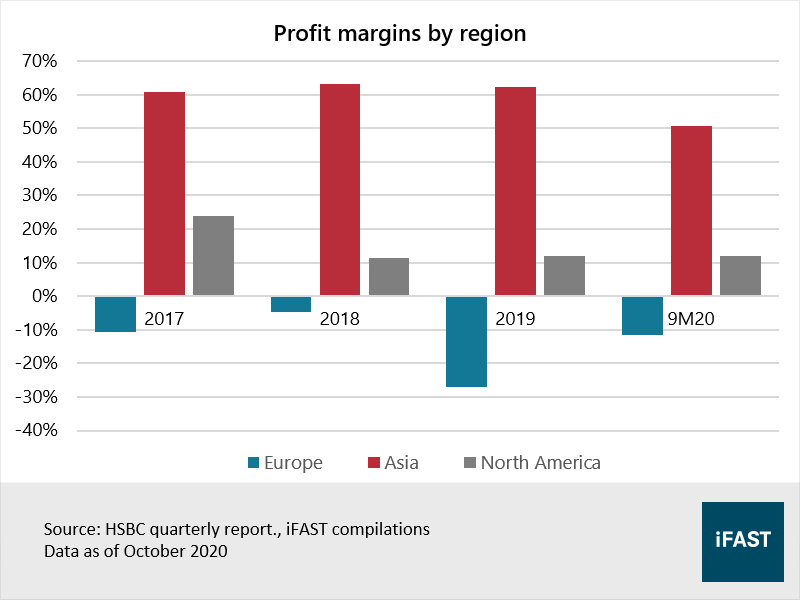
Therefore, by moving out from the underperforming businesses in Europe and the US, HSBC can redeploy capital into the more lucrative business in Asia, improving the bank’s overall profitability.  

HSBC’s poor performance in Europe and the US can also be partially explained by its high operating expenses. Hence, part of the restructuring plan will involve job cuts in mostly US and Europe, slashing about 15% of total employees and cutting annual operating costs by roughly 10%. As compared to other banks with a presence in Asia, HSBC does have a significantly higher cost-to-income ratio. Hence, by streamlining the organisation and cutting jobs, it’s clear that the restructuring plan will directly benefit the bank’s bottom line and profitability in the longer-term.  

Resumption of dividends a major catalyst 


Finally, we see the return of dividends as a major catalyst for HSBC. Earlier this year, the large UK banks, including HSBC, were forced to freeze their 2020 dividends and share buybacks to maintain their capital positions amidst the coronavirus outbreak. However, investors need to know that the dividend suspension was not because of HSBC’s inability to pay dividends. 

Based on its 3Q20 capital levels, if HSBC were to pay out its pre-COVID full year dividends of USD 0.51 per share, it will only see a 90bps drop in their CET1 ratio to 14.4%, which is still significantly higher than the minimum capital ratio (9.5%) it is subjected to. This suggests that HSBC’s current capital level can more than support the payment of dividends to its shareholders. 

While it remains unclear when the dividend ban will be lifted, what we understand is that the UK regulators will be reassessing the banks’ distribution plans in the fourth quarter this year. In other words, HSBC dividends could restart in as early as 2021 once the regulators give the green light to do so, which will serve as a major catalyst for HSBC’s share price if approved. 

When HSBC does resume its dividends, the management team has shared that they will likely be starting at a low pay-out ratio, allowing it to build over time. Assuming a 30% payout ratio that is similar to its US and Chinese peers, HSBC still offers an attractive yield of approximately 5.0% (DPS: USD 0.2). When the management increases the amount of dividends back to its pre-COVID distribution level of USD 0.51, this will equate to a dividend yield of 12.3% based on its last traded price (HKD 32.1). 

Key investment risks


Investors should also be aware that an investment in HSBC does not come without risks. HSBC’s strong presence in both the UK and Hong Kong was once a competitive advantage for the bank, but this has turned sour over the years given the ongoing political crisis in both cities. 

Brexit uncertainty: While the UK has voted to leave EU, it is currently in a transition period ending 31 December 2020, during which both parties will negotiate their new relationship, including agreeing on how companies in the UK will be able to do business in and with the EU after the transition period. Brexit will most likely have a negative impact on the UK economy, and hence, HSBC, especially if the UK and EU are unable to reach an agreement.

However, on a brighter note, HSBC’s management has highlighted that Brexit has already been highly factored into its internal models for loan loss provisions, under which they assume the UK will exit without an existing framework that supports cross-border businesses. Besides, HSBC have already moved most of its UK bank’s clients and business into other EU jurisdictions to ensure business continuity despite Brexit. 

Geopolitical tensions: Domestic social unrest in Hong Kong is also another risk investors need to take note of. China passed the Hong Kong national security law earlier in June this year, and this was met with a lot of backlash, to the extent where the US passed the Hong Kong Autonomy law, which imposes sanctions on financial institutions that helped violate Hong Kong’s autonomy. 

As the largest bank in Hong Kong, HSBC was already caught in the middle of this conflict, but it was made worse when HSBC Asia-Pacific chief executive Peter Wong signed a petition in support of this security law. Therefore, HSBC could face sanctions from the US according to the Hong Kong Autonomy law, causing problems in its various business segments.

Meanwhile, China could also add HSBC to its “unreliable entity list” for its participation in the US-led investigation of Huawei. If listed as an unreliable company by China, HSBC will face difficulties gaining access into China’s economy, threatening HSBC’s restructuring plan to redeploy capital into Asia.


Further spread of COVID-19: Besides the short-term pain arising from restructuring and asset disposal costs, loan loss provisions is also something to take note of. The management believes that the provision for losses should peak in 2020, suggesting better years ahead and has also further guided to hit the lower end of their previously announced full-year provision range of USD 8 – 13 billion (9M20: USD 7.6billion). However, in the event of a re-escalation of the COVID-19 outbreak across the globe, HSBC may see a further drag in its earnings in the following year as a result of higher provisions.  

Is HSBC a deep value play or value trap?


We believe HSBC is a deep value play, with the potential to more than double its share price.

Trading at just 0.5X PB ratio, HSBC is trading at its lowest valuation in more than a decade. At this juncture, we believe there’s more upside risk than downside risk, especially if dividends do resume next year.

Chart 3: HSBC price-to-book ratio over the last decade

Our 2022E target price of HKD 81 for HSBC is based on a fair PB multiple of 1.1X. We believe HSBC (HKEX:5) has the potential to more than double as its valuation normalises to reflect the bank’s restructuring efforts and post-COVID recovery (Table 2).  

Table 2: Valuations of HSBC
HSBC (HKEX:5)
2022E ROE 10.0%
Fair PB 1.1
Target price (HKD) 81.0
Dividend yield 5.0%
Current share price (HKD) 32.1
Upside potential 152%
Source: iFAST estimations
Dividend yield is estimated based on a 30% payout ratio
Data as of October 2020

Things may look difficult for HSBC now, but we believe the bank will get through this. When it eventually does, we’re confident that HSBC’s share price will stage a strong rebound. We urge investors to keep their faith in the bank and scoop up some HSBC shares in anticipation of the bank’s eventual recovery. 

Chart 5: HSBC price and its book value per share   


Declaration:

For specific disclosure, at the time of publication of this report, IFPL (via its connected and associated entities) holds a NIL position in the abovementioned securities. The analyst who produced this report holds a position in HSBC.

All materials and contents found in this site are strictly for general circulation and informational purposes only and should not be considered as an offer, or solicitation, to deal in any of the funds or products found/identified in this site. While iFAST Financial Pte Ltd ("IFPL") has tried to provide accurate and timely information, there may be inadvertent delays, omissions, technical or factual inaccuracies and typographical errors. Any opinion or estimate contained in this report is made on a general basis and neither IFPL nor any of its servants or agents have given any consideration to nor have they or any of them made any investigation of the investment objective, financial situation or particular need of any user or reader, any specific person or group of persons. You should consider carefully if the products you are going to purchase are suitable for your investment objective, investment experience, risk tolerance and other personal circumstances. If you are uncertain about the suitability of the investment product, please seek advice from a financial adviser, before making a decision to purchase the investment product. Past performance is not indicative of future performance. The value of the investment products and the income from them may fall as well as rise. Opinions expressed herein are subject to change without notice. In respect of any matters arising from, or in connection with the said research analyses or research reports, recipients of the report are to contact IFPL at 10 Collyer Quay, #26-01 Ocean Financial Centre Building, Singapore 049315, or by telephone at +65 6557 2853. Where the report contains research analyses or research reports from a foreign research house and if the recipient of such research analyses or research reports is not an accredited investor, expert investor, institutional investor or an ex-accredited investor, IFPL accepts legal responsibility for the contents of such analyses or reports to such persons only to the extent as required by law. Please note that only certain security(ies) herein are available to all investors, while the rest are only available for certain persons to invest in, such as Accredited Investors (as defined in the Securities and Futures Act) or one who invests at least S$200,000 (or its equivalent currency) per transaction. To qualify as an Accredited Investor, one needs to submit a declaration form and certain relevant supporting documents, according to iFAST’s prevailing policies and procedures.

Please read our full disclaimers on the website at ( https://secure.fundsupermart.com/fsmone/policies/328125/investment-account-terms-&-conditions).

iFAST Financial Pte Ltd (IFPL) (registered address: 10 Collyer Quay #26-01 Ocean Financial Centre Singapore 049315, Telephone: 6557 2000) holds the Financial Advisers Licence issued by the Monetary Authority of Singapore ('MAS') to conduct regulated activities of advising on securities, marketing of collective investment schemes and arranging of any contract of insurance in respect of life policies, other than a contract of reinsurance and the Capital Markets Services Licence issued by the MAS to conduct regulated activities of dealing in securities and providing custodial services for securities. While IFPL has made every effort to ensure the independence of the report's contents, IFPL's nature of business is such that IFPL and its connected and associated entities together with their respective directors, officers and staff may be involved in providing dealing or investment-related services in the abovementioned securities, and have taken or may take positions in the securities mentioned in this report, and may also act as the principal for any buy or sell trades.

Ways to Invest with FSM Global
Why FSM Global
Don't have an account with us?
Open an account here
Need Financial Advice?
Make an appointment
Latest Articles More

We use cookies If you close this message or continue to use this site, you will consent to the use of Cookies, unless you choose to disable them. Click on our Privacy Policy to understand more.