


• As part of the Clean Network Initiative, President Trump issued two executive orders on 6 August 2020, prohibiting all US transactions with Bytedance and Tencent.
• At this juncture, we think that the likelihood of a blanket ban on both companies is small as that would entail severe repercussions for both countries, as well as the global economy.
• However, should the bans be enforced, the impact on China’s tech sector should be minimal as most companies are domestically driven.
• Overall, we continue to hold a positive view on China’s tech sector and the Invesco China Technology ETF (NYSE:CQQQ) over the long-term.
On 5 August 2020, the US Department of State announced that it has outlined plans to expand its Clean Network Initiative. The initiative was first launched on 29 April with the goal of “safeguarding the nation’s assets, including citizens’ privacy and companies’ most sensitive information from aggressive intrusions by malign actors, such as the Chinese Communist Party.”
The next day, President Trump issued a pair of executive orders, banning all US transactions with Bytedance, the company which created the viral short video app TikTok, and Tencent, the owner of the WeChat app. The bans will take effect 45 days after the date of the order.
The orders were issued on the grounds that both apps, which are developed and owned by companies in China, poses significant national security risks to the US. It is alleged that both apps automatically collect vast swaths of information from its users, which can potentially be used by the Chinese Communist Party (CCP) to track the locations of federal employees, blackmail, and conduct corporate espionage. Both companies and the CCP have denied all allegations.
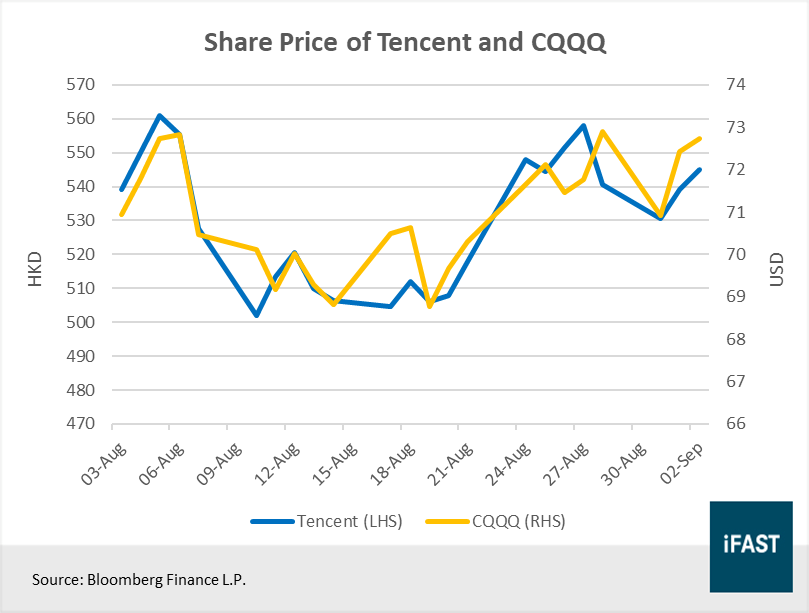
The announcement of the ban added more pressure to the already strained relationship between US and China, sending share prices of most Chinese tech companies tumbling, as investors fear that similar restrictions will soon be imposed on other Chinese tech companies. Tencent (HKEX:700) suffered one of the largest declines, with share prices falling by as much as -10% the day after the order was issued (Figure 1).
Figure 1: Share prices of Chinese tech stocks dived after the ban was announced
Blanket ban on both companies unlikely to materialise
The ban on Bytedance and Tencent today draws many similarities to the Huawei ban back in May 2019, during which the US Commerce Department placed Huawei on the Entity List, restricting US companies from conducting business with it.
Much like before, the scope of the ban today remains extremely vague. At this juncture, it is unclear as to exactly what transactions are covered. Although the wording seems to suggest that the ban will apply to all transactions with both companies including their subsidiaries, we think that this is excessive and thus extremely unlikely to materialise for the following reasons.
First of all, both companies have sizeable investments in many other businesses. Tencent, for instance, is estimated to have stakes in over a few hundred companies, many of them American. Notable names include Riot Games, best known for the multiplayer online battle arena game League of Legends, and Activision Blizzard, one of the largest video game publishers in the US. Cutting off all transactions would have serious consequences for global markets.
Secondly, WeChat is an invaluable medium of communication between China and the rest of the world. US companies, such as Apple and Walmart use the app as a marketing tool to reach Chinese consumers. Walmart even has its own mini-program, which allows customers in China to place orders and make payments all within the app itself. Losing the ability to use WeChat will certainly undermine the ability of US companies from accessing the largest consumer market in the world.
Ultimately, we do not think that there will be a blanket ban on both companies, as the move will indubitably result in severe repercussions for both countries. A more likely scenario could come in the form of softer restrictions, like one which prevents government employees from downloading the app, or one that only applies to sensitive transactions taking place in the US.
Overall impact on China’s tech sector is likely to be limited
However, assuming a worst-case scenario, under which tensions escalate to a point where the US makes the unlikely decision to impose a blanket ban on all Chinese tech companies, we still believe that the impact on China’s tech sector is likely to be limited.
Even though Chinese tech companies have grown to become some of the largest in the world, many of them are still domestically driven. Tencent, for example, generates just 4.4% of its FY2019 revenue from international markets, a fraction of its total revenues. The same is true for Alibaba, as international commerce only accounts for 6.6% of its total revenue in FY2020. This goes to show that the sheer size of China’s population is large enough to support its tech companies, even without relying on foreign markets.
Chinese tech companies today are at the forefront of innovation, developing products and services that cater to the needs of an increasingly digitalised world. Considering their structural importance to the global economy and the competitive advantages possessed by them, we do not see a significant risk to their operations stemming from the rising tensions between US and China at this point in time.
As investors begin to price in an economic recovery and the possibility of a vaccine by the end of the year, valuations of Chinese tech companies have risen steadily over the past couple of months, lowering their upside in the near term.
Nevertheless, we still continue to hold a positive view on China’s tech sector and also our recommended ETF – the Invesco China Technology ETF (NYSE:CQQQ) over the long-term. We are confident that Chinese tech companies, as innovative as they are important, should be able to achieve higher earnings growth and deliver handsome returns for their shareholders.
All materials and contents found in this site are strictly for general circulation and informational purposes only and should not be considered as an offer, or solicitation, to deal in any of the funds or products found/identified in this site. While iFAST Financial Pte Ltd ("IFPL") has tried to provide accurate and timely information, there may be inadvertent delays, omissions, technical or factual inaccuracies and typographical errors. Any opinion or estimate contained in this report is made on a general basis and neither IFPL nor any of its servants or agents have given any consideration to nor have they or any of them made any investigation of the investment objective, financial situation or particular need of any user or reader, any specific person or group of persons. You should consider carefully if the products you are going to purchase are suitable for your investment objective, investment experience, risk tolerance and other personal circumstances. If you are uncertain about the suitability of the investment product, please seek advice from a financial adviser, before making a decision to purchase the investment product. Past performance is not indicative of future performance. The value of the investment products and the income from them may fall as well as rise. Opinions expressed herein are subject to change without notice. In respect of any matters arising from, or in connection with the said research analyses or research reports, recipients of the report are to contact IFPL at 10 Collyer Quay, #26-01 Ocean Financial Centre Building, Singapore 049315, or by telephone at +65 6557 2853. Where the report contains research analyses or research reports from a foreign research house and if the recipient of such research analyses or research reports is not an accredited investor, expert investor, institutional investor or an ex-accredited investor, IFPL accepts legal responsibility for the contents of such analyses or reports to such persons only to the extent as required by law. Please note that only certain security(ies) herein are available to all investors, while the rest are only available for certain persons to invest in, such as Accredited Investors (as defined in the Securities and Futures Act) or one who invests at least S$200,000 (or its equivalent currency) per transaction. To qualify as an Accredited Investor, one needs to submit a declaration form and certain relevant supporting documents, according to iFAST’s prevailing policies and procedures.
Please read our full disclaimers on the website at ( https://secure.fundsupermart.com/fsmone/policies/328125/investment-account-terms-&-conditions).
iFAST Financial Pte Ltd (IFPL) (registered address: 10 Collyer Quay #26-01 Ocean Financial Centre Singapore 049315, Telephone: 6557 2000) holds the Financial Advisers Licence issued by the Monetary Authority of Singapore ('MAS') to conduct regulated activities of advising on securities, marketing of collective investment schemes and arranging of any contract of insurance in respect of life policies, other than a contract of reinsurance and the Capital Markets Services Licence issued by the MAS to conduct regulated activities of dealing in securities and providing custodial services for securities. While IFPL has made every effort to ensure the independence of the report's contents, IFPL's nature of business is such that IFPL and its connected and associated entities together with their respective directors, officers and staff may be involved in providing dealing or investment-related services in the abovementioned securities, and have taken or may take positions in the securities mentioned in this report, and may also act as the principal for any buy or sell trades.