COVID-19 will hurt US bank profitability, but it’s time to buy the banks.

COVID-19 will likely hurt US bank profitability, but we believe the banks are capable of weathering through the current uncertainties. They are in better shape than they were a decade ago and given their current valuations, now is the time to pay some attention to the US banks (NASDAQ:KBWB).

  • |
  • Published on 05 Jun 2020

COVID-19 will hurt US bank profitability, but it’s time to buy the banks. | Open a FREE FSMOne account and manage all your investments conveniently in ONE place
Photo by Alexander on Unsplash

While COVID-19 will likely hurt US bank profitability, we believe the banks are capable of weathering through the current uncertainties.

The US banks are in better shape than they were a decade ago. They are well-capitalised, and this ensures that the banks have enough cushion to absorb losses and still meet their financial obligations.

Profitability will be a challenge in 2020, thanks to the rate cuts and heightened volatility in the market, but an expected increase in trading income and debt underwriting fees will help cushion the impact.

While the economy is likely to remain in a bad shape, investors should pay some attention to the US banks given their current valuations, with an average potential total return of about 13% in the next 1 to 2 years.

While you can certainly invest in each of the individual banks, those who prefer to have a more diversified exposure to the US banking industry can opt for the Invesco KBW Bank ETF (NASDAQ:KBWB)

2020 has been a volatile year for the US banks so far. In a bid to fight the COVID-19 crisis, the US government launched a massive economic stimulus bill, while the Fed slashed interest rates to near-zero within two weeks. However, the implementation of several measures to slow the fast-spreading COVID-19 virus, including travel bans, social distancing restrictions, and business shutdowns, has still dented the US economy.

As a result, US banks suffered a sell-off as investors anticipate that the economic downturn is likely to set off waves of defaults, while the Fed rate cuts will compress net interest margins (NIM). The oil price war between Russia and Saudi Arabia has further exacerbated the impact of the COVID-19 outbreak, raising the risk of bankruptcies across the energy sector (Chart 1). 

Chart 1: US banks recovery lagged behind the broader market


Some of us may recall that during the 2008 global financial crisis, many major banks had to be bailed out by the US government. While there are indeed some similarities between the current COVID-19 crisis and the global financial crisis, such as higher credit costs and NIM compression, we believe the US banks are currently in a much better position than they were in 2008.

The failure of the banking industry back in 2008 was largely due to poor risk management. Since then, however, the US banks have built up stronger balance sheets, become more prudent in their lending business, and their business models have also become more diversified. In other words, they are in a better position to absorb a shock.

In the words of Fed chair Jerome Powell: “After the last financial crisis, the banks more than doubled their capital and liquidity and they’re far more aware and better at managing the risks they’re taking”.

While the COVID-19 fight in the US remains far from over, we believe US banks are capable of weathering through the uncertainties. Once the storm is over, we see strong upside potential in the US banks as they return to their pre-crisis levels. 

US banks are in better shape than they were 10 years ago


While the COVID-19 crisis is likely to set off waves of defaults and a surge in provisions for credit losses is imminent, the US banks today are in better shape than they were 10 years ago (Chart 2). 

Chart 2: Capital ratios have generally improved over the last decade
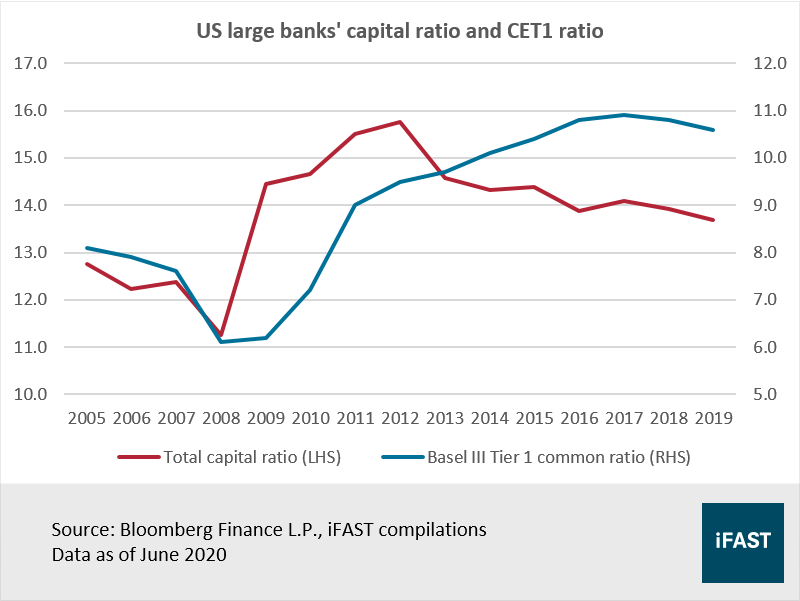

While the banks have, on average, more than tripled their provisions for credit losses in their 1Q20 earnings results, resulting in a decline in their respective CET1 ratios, the big banks remain well-capitalised, with their capital ratios continuing to meet the Fed’s stricter requirements (Table 1). 

Table 1: US banks on more solid footing compared to 10 years ago
CET1 ratio 
(minimum: 4.5%*)
Total capital adequacy
(minimum: 8.0%*)
CET1 ratio
(Fed's requirement^)
Total capital adequacy
(Fed's requirement^)
JP Morgan 11.5% 16.0% 10.5% 14.0%
Citi 11.2% 16.0% 10.0% 13.5%
Bank of America 10.8% 14.8% 9.5% 13.0%
Wells Fargo 10.7% 15.3% 9.0% 12.5%
Source: Company annual and quarterly reports, iFAST compilations
*Minimum requirement is based on Basel III
^Fed’s requirement includes a minimum CET1 requirement, a capital conservation buffer, and a G-SIB surcharge
Note: Total capital adequacy ratio is based on 2019 annual report
Data as of June 2020

Having adequate capital is important because it ensures that the banks have enough cushion to absorb losses and still meet their financial obligations. In the event that a bank does not have sufficient capital in times of crisis, it will eventually lead to either insolvency or share dilution, as in the case of Lehman Brothers and Citigroup back in 2008. As such, it is understandable that many investors are worried that history may repeat itself. 

However, we would like to highlight that the US banking industry has evolved tremendously over the years. Many strict regulations were enforced on the large US banks to make sure that they are not taking on unnecessary risks with their deposits, and as shown in Table 1, the larger US banks today are well-capitalised to meet their financial obligations.

Therefore, the possibility of insolvency or massive share dilution is low as the US banks are on more solid footing with stronger capital positions, allowing them to deal with the turbulence in the current market.

Profitability will likely get hit by COVID-19 in short-term but there are silver linings 


While the US banks are well-capitalised to weather through the current uncertainties, their profitability will likely be affected in 2020 due to lower income generated and higher loan loss provisions. The current near-zero interest rate levels will reduce the banks’ net interest income and we also expect to see downward pressure on fee revenue earned from their asset management and investment banking businesses due to heightened volatility in the market. The drastic increase in loan loss provisions will also take a bite out of the banks’ profits. 

As interest rates are at an all-time low, more companies may also take advantage of this current situation to issue new debt. A total of USD1.01 trillion of debt was issued in US debt capital market in 1Q20, and this is the second-highest volume since 2007.  As you can see in Table 2, the top ten investment banks have underwritten more than half of what they have accomplished in FY2019 in just five months into 2020. Hence, we believe the current interest-rate environment bodes well for banks with capital markets arm involved in the fixed income underwriting business.

Table 2: Global debt capital market (DCM) deal value
Bookrunner Value of DCM deals YTD 2020 (USD bn) Value of DCM deals FY2019 (USD bn)
JPMorgan 310.8 481.9 64.5%
Citi 256.8 433.7 59.2%
BofA Securities 256.4 376 68.2%
Goldman Sachs 173.3 309.8 55.9%
Barclays 168.7 299.1 56.4%
Morgan Stanley 161.3 259 62.3%
HSBC 137.1 241.4 56.8%
Deutsche Bank 134.4 228.3 58.9%
BNP Paribas 133.8 220 60.8%
Wells Fargo Securities 133.7 218 61.3%
Subtotal 1,866.1 3,067.0 60.8%
Total 3,734.8 7,243.3 51.6%
Source: Dealogic, Wall Street Journal, iFAST compilations
Data as of June 2020

Besides, market volatility may also help to drive transaction volumes in the banks’ securities business, which can help to offset some losses in the banks’ non-interest income. The trading desks of the banks have also thrived during this market correction as volatility elevated trading volumes across all products. 

On the other hand, although there has also been a surge in lending, loan provision remains to be a big concern for the big banks. Many of them are still expecting higher loan loss provisions and will continue to build their reserves in the second quarter. While this is largely due to the deterioration in customer credit quality, another reason behind the increasing provisions is the adoption of the new credit loss accounting standard – Current Expected Credit Losses (CECL) – at the start of this year. 

Under the new CECL model, loss estimation is more forward-looking, and is done based on not just past incurred losses, but also future expected losses due to the state of the economy. This requires the banks to set aside additional capital based on future macroeconomic conditions, which explains the jump in provisions as compared to prior years.

While this new accounting standard is likely to lead to an increase in loan provisions in the short-term, the good thing is that investors will not be “caught by surprise” by rising defaults in the next few quarters, as a portion of it would have already been reflected in the reserves set aside for loan losses.

Dividend payments by the US banks are sustainable 


Several big US banks have suspended their share buyback programmes to maintain ample capital and liquidity amid the COVID-19 pandemic. However, the US banks continue to have decent dividend yields of about 2.1% (after dividend withholding tax). 

That being said, many investors are worried about the sustainability of the banks’ dividends due to the increased reserves which may lead to less capital available for dividends. First, we are not ruling out the possibility of a dividend cut especially if the economy continues to worsen, but if we look at the banks’ 2019 dividends, paying common dividends will only affect the banks’ equity capital base by about 40-70bps. Therefore, the US banks still have adequate capital to maintain their dividends at this juncture. On top of that, various management teams have also guided that they will stay committed to paying their dividend which should further support the sustainability of the US banks’ dividend payments.  

Badly beaten US banks may signal a buying opportunity 


The share prices of US banks have been badly beaten over the last two months. While the economy is likely to remain in a bad shape, the US banks are currently trading at attractive valuations (Chart 3).

Chart 3: Valuations of US banks have fallen drastically 


Relative to their last traded price, the top three US commercial banks have an average potential total return of about 13% in the next 1 to 2 years. Our valuation methodology is built on a fair PB ratio derived from the Gordon Growth Model (Table 3).

Table 3: Top 3 commercial banks in the US offering decent upside potential
PB ratio Target price (USD) Current price (USD) Upside potential Dividend yield
JPMorgan (NYSE:JPM) 1.6 119.1 106.4 11.9% 3.2%
Citibank (NYSE:C) 0.8 61.7 55.6 11.0% 3.5%
Bank of America (NYSE:BAC) 1.1 28.8 26.7 7.9% 2.5%
Average: 10.3% 3.0%
Source: Bloomberg Finance L.P., iFAST estimations
Data as of June 2020

Unlike its international peers, the business models of these larger US banks are also more diversified. They generally derive about 40% – 50% of their total net revenue from non-interest income, while its international peers, like Singapore and Chinese banks, derive approximately 15% – 30% from non-interest income. Hence, this could suggest a level of support for the US banks’ net revenue as the current situation bodes well for trading and fixed income underwriting fees, which represent roughly 20% of the US banks’ total net revenue.

While the US banks face short-term headwinds, investors who take a longer-term view and can stomach wild swings in the market can consider investing in US banks through the Invesco KBW Bank ETF (NASDAQ:KBWB), which tracks the performance of 24 leading banks and thrifts that are publicly-traded in the US.

The ETF consists of three types of banks – banks with both investment and commercial banking operations, custodian banks and pure-play commercial banks. Banks that derive their revenues largely from investment banking or insurance are omitted from this index (Table 4).

Table 4: Top ten holdings of Invesco KBW Bank ETF 
Name Weight Type of bank
Bank of America Corp 8.5% Investment and commercial bank
JPMorgan Chase & Co 8.1% Investment and commercial bank
Citigroup Inc 7.7% Investment and commercial bank
US Bancorp 7.5% Pure-play commercial bank
Wells Fargo & Co 6.4% Investment and commercial bank
First Republic Bank/CA 5.2% Pure-play commercial bank
Bank of New York Mellon Corp/The 4.5% Custodian banks
State Street Corp 4.4% Custodian banks
Northern Trust Corp 4.4% Custodian banks
PNC Financial Services Group Inc/The 4.3% Pure-play commercial bank
Source: Bloomberg Finance L.P., iFAST compilation
Data as of June 2020

Therefore, investors who prefer a diversified option should consider the Invesco KBW Bank ETF (NASDAQ:KBWB), which is our preferred choice to gain exposure to the US commercial banks based on our selection methodology. With an expense ratio of 0.35%, we believe this ETF is also able to help investors get exposure to this industry without eating away their returns. 

Chart 4: KBW Nasdaq Bank Index vs. its book value


Declaration:

For specific disclosure, at the time of publication of this report, IFPL (via its connected and associated entities) and the analyst who produced this report hold a NIL position in the abovementioned securities.

All materials and contents found in this site are strictly for general circulation and informational purposes only and should not be considered as an offer, or solicitation, to deal in any of the funds or products found/identified in this site. While iFAST Financial Pte Ltd ("IFPL") has tried to provide accurate and timely information, there may be inadvertent delays, omissions, technical or factual inaccuracies and typographical errors. Any opinion or estimate contained in this report is made on a general basis and neither IFPL nor any of its servants or agents have given any consideration to nor have they or any of them made any investigation of the investment objective, financial situation or particular need of any user or reader, any specific person or group of persons. You should consider carefully if the products you are going to purchase are suitable for your investment objective, investment experience, risk tolerance and other personal circumstances. If you are uncertain about the suitability of the investment product, please seek advice from a financial adviser, before making a decision to purchase the investment product. Past performance is not indicative of future performance. The value of the investment products and the income from them may fall as well as rise. Opinions expressed herein are subject to change without notice. In respect of any matters arising from, or in connection with the said research analyses or research reports, recipients of the report are to contact IFPL at 10 Collyer Quay, #26-01 Ocean Financial Centre Building, Singapore 049315, or by telephone at +65 6557 2853. Where the report contains research analyses or research reports from a foreign research house and if the recipient of such research analyses or research reports is not an accredited investor, expert investor, institutional investor or an ex-accredited investor, IFPL accepts legal responsibility for the contents of such analyses or reports to such persons only to the extent as required by law. Please note that only certain security(ies) herein are available to all investors, while the rest are only available for certain persons to invest in, such as Accredited Investors (as defined in the Securities and Futures Act) or one who invests at least S$200,000 (or its equivalent currency) per transaction. To qualify as an Accredited Investor, one needs to submit a declaration form and certain relevant supporting documents, according to iFAST’s prevailing policies and procedures.

Please read our full disclaimers on the website at ( https://secure.fundsupermart.com/fsmone/policies/328125/investment-account-terms-&-conditions).

iFAST Financial Pte Ltd (IFPL) (registered address: 10 Collyer Quay #26-01 Ocean Financial Centre Singapore 049315, Telephone: 6557 2000) holds the Financial Advisers Licence issued by the Monetary Authority of Singapore ('MAS') to conduct regulated activities of advising on securities, marketing of collective investment schemes and arranging of any contract of insurance in respect of life policies, other than a contract of reinsurance and the Capital Markets Services Licence issued by the MAS to conduct regulated activities of dealing in securities and providing custodial services for securities. While IFPL has made every effort to ensure the independence of the report's contents, IFPL's nature of business is such that IFPL and its connected and associated entities together with their respective directors, officers and staff may be involved in providing dealing or investment-related services in the abovementioned securities, and have taken or may take positions in the securities mentioned in this report, and may also act as the principal for any buy or sell trades.

Ways to Invest with FSM Global
Why FSM Global
Don't have an account with us?
Open an account here
Need Financial Advice?
Make an appointment

We use cookies If you close this message or continue to use this site, you will consent to the use of Cookies, unless you choose to disable them. Click on our Privacy Policy to understand more.