Macro Research

Singapore: High dividend yield in a low-yield environment

Growth has rebounded in Singapore in the third quarter this year, with exports due for a recovery in the coming months ahead, driven by emerging catalysts. We think that it’s time for investors to accumulate exposure to Singapore equities on the cheap, especially when it offers high dividend yield amid the current low-yield environment.

  • |
  • Published on 29 Nov 2019

Singapore: High dividend yield in a low-yield environment | Open a FREE FSMOne account and manage all your investments conveniently in ONE place


  • Singapore economic growth in the third quarter came in better than expected, avoiding a technical recession. While growth remains weak in the present juncture, there is progressively more evidence that conditions are starting to improve.

  • Export growth is due for a recovery in the coming quarters, driven by two key catalysts – global semiconductor upcycle and trade re-direction into Asia – that are progressively emerging across key Asian economies. The revitalisation in exports will be crucial in boosting the economic growth of trade-reliant Singapore.

  • The manufacturing sector has displayed signs of stabilisation in recent months and is on track for a near-term rebound. Leading PMI indicators are starting to bottom, providing greater optimism to a manufacturing and export recovery for Singapore ahead.

  • Singapore equities (STI Index) are cheap at the current juncture, trading at price-earnings ratio of one standard deviation below its ten-year average. With global bond yields set to stay low, we believe Singapore equities will grow increasingly more attractive to investors as an alternative in their search for yields.

  • With an appealing upside potential of 26% by end-2021 and high dividend yield of more than 4%, we maintain our 4.0 stars “Very Attractive” rating for Singapore equities. We think that it’s time for investors to accumulate more exposure on the cheap.

Things are starting to look brighter for Singapore, as the city-state avoided a technical recession in the third quarter, for the second time this year. Corporate earnings have also generally performed better than expected in the latest quarter, shining glimmer of hope on positive earnings re-rating in the months ahead. 

Singapore equities (as measured by STI Index) has returned +4.4% since our last update in end-August this year, driven mainly by the global rally on risk assets, on the back of trade talk progress between US and China – two of Singapore’s major trading partners. 

As signs of improvements are progressively showing up in parts of the Singapore economy, we think it’s time to pay closer attention to its inexpensive equity market. The appealing combination of high dividend yield with strong capital gain potential renders Singapore as one of the most attractive markets under our coverage in the current juncture.

Economic growth in the third quarter beats expectation, Singapore avoided technical recession

Dragged by a slowdown in global demand, as well as the US-China trade conflicts that confounded businesses around the world, the trade-reliant Singapore has seen its economic growth brought to a standstill across this year. Economic conditions appeared especially dire in the second quarter, as the GDP growth contracted severely on a quarter-on-quarter (QoQ) basis, putting in question directly on whether Singapore will slide into a technical recession in the third quarter.

Fast forward three months later, fortunately, our worries were all for naught. Singapore’s economy expanded at a faster pace in the third quarter than earlier estimated. GDP rose 0.5% year-on-year (YoY) in the third quarter, up from an initial estimate of 0.1%. The reading also came up better that economists’ expectation of 0.4% annualised growth (Chart 1). 

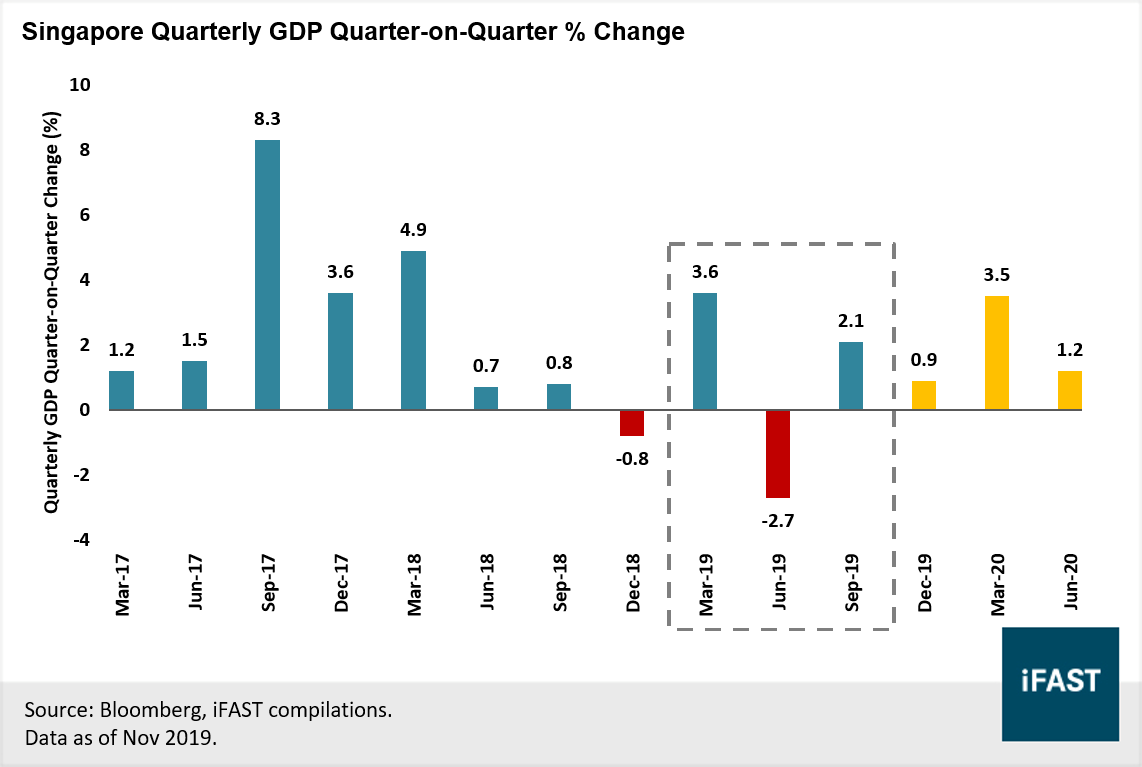
On a quarter-on-quarter seasonally adjusted annualised basis, GDP expanded by 0.6%, rebounding from the previous quarter’s 2.7% drop. This meant that Singapore has avoided a technical recession, defined as two consecutive quarters of QoQ economic contraction (Chart 2).

Looking ahead, we believe that economic growth is primed to accelerate in the coming quarters, driven by two key catalysts – global semiconductor upcycle and trade re-direction – that are progressively emerging across Asia. This view is reinforced by the Ministry of Trade & Industry, which projected a recovery in economic growth to the more optimistic range of 0.5-2.5% next year, compared with the downward-revised growth range of 0.5%-1% this year.

Chart 1: Economic growth in Singapore is projected to rebound next year


Chart 2: Singapore avoided technical recession in the third quarter this year, for the second time. 


Exports slump starting to bottom and is projected to rebound ahead

Singapore economy has been battered down heavily on the external fronts, especially as the electronics industry that hold critical importance to the region slumped across the year. With the nominal value of electronic exports weighing more than half of Singapore’s GDP value in 2018, the sustained contraction in exports year-to-date was key culprit to the lacklustre economic growth. 

To make matters worse, most of Singapore’s trading partners are also heavily involved in the electronics trade, operating across the various segments of the global electronics value chain. As the global semiconductor industry head into a cyclical downturn in late last year, the weakness in export growth was especially pronounced in Asian economies like Singapore, South Korea and Taiwan (Chart 3).

Chart 3: Cyclical downturn in Semiconductor Industry is projected to reverse strongly in the quarters ahead


Moving forward, we believe a rebound in Asian exports is imminent. The recovery in exports growth will be driven mainly by two key catalysts that are progressively emerging in recent months. Firstly, it is the cyclical upswing in global semiconductor industry which we expect to drive up trade activities. Global semiconductor sales, which bottomed out in March this year, is now on an uptrend and we expect double-digit growth in the coming quarters. 

Favourable shift in supply-demand dynamics within the industry – inventory drawdowns and improving demand environment (led by an organic growth in demand from cloud service providers), can be observed from key markets such as Taiwan and South Korea.

This is also suggested by TSMC’s – the world’s largest foundry and industry’s bellwether company – latest plans to expand expansion capacity, which signals confidence of a rebound in chips demand. In the longer-term, the rise of new technological advancements like 5G telecommunication and cloud computing will also support a structural uplift in semiconductor demand.

Secondly, we believe Asian economies are key beneficiaries of the US-China trade conflict. These economies will benefit from the re-direction in new orders into existing production capacity, particularly for well-established markets like Singapore and Taiwan. This is done in order to side-step the impact of tariff and future uncertainties on Chinese goods (Chart 4).

In addition, the imposition of tariffs seems to have accelerated a process that was already underway – the relocation of lower value-added manufacturing from China to Southeast Asia markets like Vietnam and Thailand. Geographically positioned in Southeast Asia, Singapore will also benefit indirectly from the strengthening of these neighbouring economies over the longer-term.

Given the positive growth outlook for Singapore’s key final demand markets in Asia, and the projected recovery in the global electronics cycle in the year ahead, we are optimistic in Singapore’s trade prospects in the ensuing months.

(Related Article – Asia: Export recovery inbound)

Chart 4: The revival in the Electronic trade within the Asian region will drive Singapore exports growth


Manufacturing sector displayed signs of stabilising, lending support to robust economic recovery ahead

The weakness in exports naturally spilled over to the manufacturing sector, which has largely slumped into a recession for the last few quarters. In the third quarter, it is worth noting that conditions have started to improve. Manufacturing output rose 4.0% in October compared to a year ago, marking the largest percentage increase since November last year.

Looking closer into the sector, the silver lining is that weakness in manufacturing activities is not broad-based one. Much of the decline in output is attributable to the electronics and precision engineering clusters, which have more than offset the output expansions in the chemicals, biomedical manufacturing and general manufacturing clusters. This indicates that excluding the electronics subsector, the other manufacturing clusters are still expanding healthily.

As a result, we believe that the impending cyclical upswing in global semiconductor industry in the coming months will alleviate the current downward pressure exerted by the electronics cluster on the broad manufacturing sector. 

In addition, it is also worth noting the manufacturing and electronics PMI, which have historically tracked Singapore non-oil domestic exports (NODX) growth closely, have started to bottom out and are showing signs of improvement. We think this also signal greater optimism to a manufacturing and export recovery for Singapore ahead (Chart 5).

Chart 5: Leading indicators such as manufacturing and electronic PMI have shown signs of bottoming in recent few months


Singapore equities likely to remain resilient, cushioned by a cheap valuation and relatively high dividend yield


On the equity front, we think that performance of Singapore equities will stay rather resilient, even amid the uncertainty in the US-China trade conflicts. The combination of a cheap valuation and relatively high dividend yield will help cushion Singapore equities from any drastic negative price reaction.

In the third quarter, corporate earnings have also performed better than expected, with the overall earnings surprise positively by 3.6%. While revenue still came in lower than expectations, the magnitude of sales misses has improved when compared to the second quarter. With earnings generally surprising to the upside across all three quarters this year, we see a greater likelihood of positive earnings re-rating in the months ahead (Chart 6).

Chart 6: STI corporate earnings have performed better than expected across all three quarters this year


Singapore equity market (as measured by the Straits Times Index) is currently trading at a PE of 13.0X the estimated earnings this year, which is one standard deviation below its ten-year average of 15.0X. This is also far lower than our fair PE ratio of 15.0X allotted to Singapore equities market.

Simultaneously, STI has also faced rather hefty downwards earnings revisions since mid-last year, with EPS for this year and next year adjusted downwards by -6.1% and -9.3%, compared to the same period one year ago. We think that much of the negatives are already priced into the earnings downgrades, and there will be limited room for further downward adjustments ahead (Chart 7).

Chart 7: STI has seen drastic earnings downgrades since April last year, leaving little room for downside adjustments.


More importantly, Singapore equities also offer a high dividends yield at 4.3-4.4% over the next two years, powered by sustainable cash flow from the underlying constituents. Primarily contributed from the local banks and REITs, which are set to benefit from a more favourable earnings environment ahead, we remain confident that the high dividends yield of STI Index is sustainable ahead. 

In addition, it is also worth noting that the spread between the estimated dividend yield of STI and Singapore’s 10-year bond yield has been widening across the year and now hovers near the highest level in this decade. With global bond yields to set to stay low, amid Central banks’ dovish tilt to aid a recovery in global growth, we believe Singapore equities will grow increasingly more attractive to investors as an appealing alternative in their search for yield (Chart 8).

Chart 8: STI’s high dividend yield of above 4% is increasingly more attractive in current low yield environment.


Singapore equities: Appealing combination of high dividend yield with strong capital gain potential

While earnings growth are likely to be disappointingly low this year, STI’s current inexpensive valuation more than makes up for the poor earnings growth rate. With STI currently trading at PE ratio of 13.0X, which is one standard deviation below its ten-year average, we see this as an attractive opportunity for long-term investors to accumulate more exposure on the cheap (Chart 9).

Using our fair PE ratio of 15.0X on the end-2021 EPS of SGD 269 per share, our projected fair value for STI Index is at 4,041 points. This indicates that the upside potential for STI Index now stands at +26% within the next two years, which ranks among one of the highest within the markets under our coverage. The above 4% dividend yield offered by Singapore equities is also one of the highest within the Asian equities (Table 1).

 Singapore Equity Market (STI Index)

FY2018

FY2019

FY2020

FY2021

PE Ratio (X)

13.2

13.0

12.5

11.9

Expected Earnings Growth %YoY

12.3%

1.3%

4.3%

4.8%

Earnings Per Share

243

246

257

269

Projected Fair Price
(Based on 15.0X Fair PE Ratio)

-

-

-

4,041

Projected Dividend Yield (%)

4.4%

4.1%

4.3%

4.4%

Potential Upside from Today (%)

-

-

-

26%

Source: Bloomberg, iFAST estimates. Data as of Nov 2019.


Looking further ahead, we can expect the broad Singapore equity market to trend upwards with the organic growth in corporate earnings in FY2020-21 (Chart 10). We see the current valuation hovering at an attractively low level, while simultaneously offering comparatively high dividend yield for value-seeking investors. Thus, we maintain our 4.0 stars “Very Attractive” rating for Singapore equities.

Investors seeking an actively-managed solution should definitely consider our recommended fund for Singapore, Nikko AM Singapore Dividend Equity SGD. This fund invest primarily in equities listed on SGX that offers attractive and sustainable dividend payments.

Investors seeking a more passive option can consider the SPDR Straits Times Index ETF (SGX: ES3) listed on SGX, which seeks to track performance of STI closely.

Chart 9: Inexpensive valuation – STI is currently trading one standard deviation below its ten-year average


Chart 10: STI is projected to trend upwards with its underlying EPS over the next two years


All materials and contents found in this site are strictly for general circulation and informational purposes only and should not be considered as an offer, or solicitation, to deal in any of the funds or products found/identified in this site. While iFAST Financial Pte Ltd ("IFPL") has tried to provide accurate and timely information, there may be inadvertent delays, omissions, technical or factual inaccuracies and typographical errors. Any opinion or estimate contained in this report is made on a general basis and neither IFPL nor any of its servants or agents have given any consideration to nor have they or any of them made any investigation of the investment objective, financial situation or particular need of any user or reader, any specific person or group of persons. You should consider carefully if the products you are going to purchase are suitable for your investment objective, investment experience, risk tolerance and other personal circumstances. If you are uncertain about the suitability of the investment product, please seek advice from a financial adviser, before making a decision to purchase the investment product. Past performance is not indicative of future performance. The value of the investment products and the income from them may fall as well as rise. Opinions expressed herein are subject to change without notice. In respect of any matters arising from, or in connection with the said research analyses or research reports, recipients of the report are to contact IFPL at 10 Collyer Quay, #26-01 Ocean Financial Centre Building, Singapore 049315, or by telephone at +65 6557 2853. Where the report contains research analyses or research reports from a foreign research house and if the recipient of such research analyses or research reports is not an accredited investor, expert investor, institutional investor or an ex-accredited investor, IFPL accepts legal responsibility for the contents of such analyses or reports to such persons only to the extent as required by law. Please note that only certain security(ies) herein are available to all investors, while the rest are only available for certain persons to invest in, such as Accredited Investors (as defined in the Securities and Futures Act) or one who invests at least S$200,000 (or its equivalent currency) per transaction. To qualify as an Accredited Investor, one needs to submit a declaration form and certain relevant supporting documents, according to iFAST’s prevailing policies and procedures.

Please read our full disclaimers on the website at ( https://secure.fundsupermart.com/fsmone/policies/328125/investment-account-terms-&-conditions).

iFAST Financial Pte Ltd (IFPL) (registered address: 10 Collyer Quay #26-01 Ocean Financial Centre Singapore 049315, Telephone: 6557 2000) holds the Financial Advisers Licence issued by the Monetary Authority of Singapore ('MAS') to conduct regulated activities of advising on securities, marketing of collective investment schemes and arranging of any contract of insurance in respect of life policies, other than a contract of reinsurance and the Capital Markets Services Licence issued by the MAS to conduct regulated activities of dealing in securities and providing custodial services for securities. While IFPL has made every effort to ensure the independence of the report's contents, IFPL's nature of business is such that IFPL and its connected and associated entities together with their respective directors, officers and staff may be involved in providing dealing or investment-related services in the abovementioned securities, and have taken or may take positions in the securities mentioned in this report, and may also act as the principal for any buy or sell trades.

Ways to Invest with FSM Global
Why FSM Global
Don't have an account with us?
Open an account here
Need Financial Advice?
Make an appointment

We use cookies If you close this message or continue to use this site, you will consent to the use of Cookies, unless you choose to disable them. Click on our Privacy Policy to understand more.