Macro Research

Hong Kong: Beaten down by overblown fears

Embattled with waves of protests lately, Hong Kong has fallen victim to a slew of earnings downgrades and market sell-offs. Here’s why we think concerns are overblown and that HK equities are looking very attractive right now.

  • |
  • Published on 28 Sep 2019

Hong Kong: Beaten down by overblown fears | Open a FREE FSMOne account and manage all your investments conveniently in ONE place


  • Hong Kong, one of Asia’s most prominent financial centre, has been embattled with waves of protests and public demonstrations in the past three month.

  • While the protests remain the biggest drag on sentiment, we believe their impact on Hong Kong’s economy and its underlying corporate earnings are fairly limited. Current weakness in Hong Kong’s equities are better explained by the soft macroeconomic conditions within the Greater China region, evident via a moderating GDP growth.

  • Across this year, China has started to ramp up efforts in boosting liquidity, retail consumption and industrial output. Looking ahead, we expect to see signs of improvement in economic data for the Greater China region in the next few quarters, which in turn will progressively lend support to greater optimism ahead.

  • We think investors’ concerns for the current political unrest and its impact on Hong Kong equities are overblown. The combination of an attractive valuation (currently near its historical low), easing trade tensions and stimulus measure from Beijing will help lift the Hang Seng Index (HSI). 

  • The risk-reward ratio of an investment in Hong Kong stocks is currently skewed towards the upside, with HSI presenting potential upsides of about 22% and 31% by end-2020 and end-2021 respectively.

  • Thus, we maintain our star ratings of 4.5 stars “Very Attractive” rating for Hong Kong equity market.

In the past three months, Hong Kong, one of Asia’s most prominent financial centre, has been embattled with waves of protests and public demonstrations, in reaction to the now-withdrawn extradition bill proposed by its administrative government. 

These large-scale demonstrations have spiralled into chaotic violent clashes between the police and protestors, where an arsenal of petrol bombs, tear gas and water cannons were often utilised. 

With the social unrest in Hong Kong dominating the headlines, investors have grown increasingly pessimistic about Hong Kong stocks. The confluence of local unrest and the trade war tensions have taken a toll on sentiments of both investors and consumers alike, raising the prospects of massive capital flight from the Asian financial centre. 

To make matters worse, a range of indicators weakened sharply over the last two months, signalling a possibility of dipping into recession ahead. 

While the protests remain the biggest drag on sentiment, we believe their impact on Hong Kong’s economy and its underlying corporate earnings are fairly limited. As Hong Kong stocks faced the reality of a sell-off, valuation of Hang Seng Index took a beating and is currently trading at near its historical low.

Overall, we think that attractive valuations, easing trade tensions and stimulus measure from Beijing will help lift the Hang Seng Index. Despite handing investors one of the globally worst returns this quarter to date (3Q2019), we believe that the risk-reward ratio of an investment in Hong Kong stocks is currently skewed towards the upside. 

Political uncertainty tainted macro outlook


Hong Kong’s economy has been hurt by a slew negative developments which resulted in a weaker-than-expected economic slowdown. Forecasted year-on-year GDP growth for FY 2019 is expected to come in at a meagre 0.6%, declining sharply from a robust 3% in FY 2018, before rebounding to a forecasted 1.6% in FY 2020. 

Hong Kong’s economic slowdown has been primarily driven by a combination of political and macro factors. Politically, the recent political controversy stemming from the extradition law has incited mass waves of protest. The impact of social unrest will be visible through: 

(i) A dampening of consumer confidence and thus weakening domestic demand which is reflected by moderating retail sales (Chart 1);
(ii) Decline in business investments as companies lose confidence in Hong Kong’s prospects; 
(iii) Fall in tourist arrivals and consequently a contraction in tourism-oriented sales. 

Chart 1: Retail sales suffered due to social unrest


Aside from the recent political turmoil, the re-ignited US-China trade-war concerns have continued to weigh on business and investors’ sentiments in Hong Kong, despite the expected high-level trade talks commencing in October. The presence of the deteriorating confidence is best reflected in the contraction in the city’s gross fixed capital investments since November 2018 (Chart 2).

Consumption to remain resilient in the face of headwinds


However, Hong Kong’s consumers remain relatively resilient throughout the trade conflict and the recent political uncertainty. 

The tight labour market as reinforced by a recent uptick in real wages and sustained low unemployment rate suggests that disposable income (ability to spend) still remains robust. This can be seen from an improvement in private consumption on a year-on-year basis in the latest quarter (Chart 2).

However, we think a weaker appetite to spend is likely in the near term (as a result of protest violence), as the general populace continues to avoid shopping in the high-street malls, which are typically chosen as gathering points for demonstrations. 

Chart 2: Investments have also decelerated but consumption remains resilient


Given private consumption’s outsized contribution to Hong Kong’s GDP (around 70%), we believe a resilient consumption will still keep Hong Kong’s economy afloat. However, we recognise that the ongoing threats of protest will remain the main headwind to domestic demand, which will therefore pose a viable threat to it if it continues to escalate.

Chart 3: Quarterly GDP growth fell and is expected to remain muted


Impact of social unrest largely isolated to tourism-oriented industries


With the Hong Kong protests extending beyond 100-days mark this year so far, investors have grown increasingly pessimistic about Hong Kong stocks. The confluence of local unrest and the trade war tensions have taken a toll on sentiments of both investors and consumers alike, raising the prospects of a massive capital flight from one of Asia’s top financial centres. 

While the protests remain the biggest drag on sentiment, beyond the attention-grabbing headlines of the social unrest, we believe their impacts on Hong Kong’s economy and its underlying corporate earnings are fairly limited.

Across industries, the brunt of the negative impact of the current political situation will likely be borne by the tourism-oriented ones, such as retailers, retail landlords and hospitality players. Fortunately, they only account for a minor segment in both the Hang Seng Index and the overall Hong Kong’s GDP (Chart 4).

Chart 4: Real Estate and Consumer Discretionary sector account for total weightage of 15% in Hang Seng Index.


Within Hang Seng Index, we think that the companies that are most adversely affected are from the retail and hospitality REIT sector, especially Wharf REIC and Link REIT. High-street retail rents plunged to five-year low as protests scare off tourists – primarily Chinese ones – as Chinese tour groups fell 90% from a year ago. 

To make matters worse, retailers are also being hit by US-China trade war and the weakening yuan – which makes shopping in Hong Kong more expensive for mainland tourists. Evidently, the vacancy rate in the city’s major shopping districts rose to 6.5% in August, up 0.9 percentage points from a year earlier.
As a result, stock prices of retail mall operators have been heavily beaten down since the start of the protests. Wharf REIC, which owns the city’s biggest shopping centre, Harbour City in Tsim Sha Tsui, is among one of the worst performing stocks in HSI. The mall is highly popular among mainland tourists (Chart 5). 

We think negative rental reversion in the near-term is likely, with street-front rent forecasted to fall by 10-15%, as tenants are increasing concerned over drastic decline in footfall.    

Chart 5: Share prices of Hong Kong retail mall operators were badly beaten down since start of the protests.


Limited impact of social unrest on overall corporate earnings


Despite the pessimism surrounding the social unrest, we believe the negative impact on the overall corporate earnings underlying Hang Seng Index (HSI) is fairly limited. 

While HSI is used as a proxy for Hong Kong equity market, it does not reflect the general health of Hong Kong’s economy, considering that the majority of listed corporates derive much of their revenue outside of Hong Kong. 

Upon a closer examination of HSI revenue by geography, we note that only 11% of the underlying revenue is generated within Hong Kong. The substantial portion (more than seventy percent) of the index’s underlying revenue and earnings actually comes from Mainland China market, which is largely unaffected by political situation in Hong Kong.

Furthermore, Hong Kong wholesale and retail only accounts for 4% of GDP, while accommodation and F&B account only for 3.3%. Therefore, the demonstrations itself should not cause much impact to the economy. 

At the current juncture, we think that the worst case scenario would be if Hong Kong loses its reputation and status as a world-class financial centre. Financial sector not only accounts for much of its GDP, it is the largest sector (approximately half) of its equity market. In our view, we believe the likelihood of the worst case scenario remains low, and that a positive resolution of the unrest will provides impetus for a rebound in HSI market valuations. 

Chart 6: Majority of HSI’s underlying revenue is derived from Mainland China region


Therefore, we think investors’ concerns for the current political unrest and its impact on Hong Kong equities are overblown. Current weakness in Hong Kong’s equities are better explained by the soft macro condition within the Greater China region, as evident via a moderating GDP growth.

Across this year, China has started to ramp up efforts in boosting liquidity, retail consumption and industrial output. Looking ahead, we are starting to see signs of improvements showing up in various leading indicators (credit impulse, PMI and consumer confidence). We expect economic data for the Greater China region in the next few quarters to progressively lend support to greater optimism ahead. 


At the same time, the earnings underlining HSI have seen substantial negative revisions by analysts. The projected EPS for this year and next year have since been downgraded by 7.3% and 10.1% compared to values one year ago. Thus, we think that much of the negatives surrounding the political unrest and the soft macro conditions have already been priced in, leaving limited room for any further drastic downgrades (Chart 7). 

Earnings growth, like most of the Asian economies are likely to contract this year, but largely expected to rebound in FY2020 and FY2021 by 6% and 8% year-on-year respectively. 

Chart 7: The substantial earnings downgrades meant that negatives are mostly priced in


Beaten down valuation offers attractive upside potential for Hong Kong equities


HSI estimated forward PE ratio tumbles to just 10.4X currently, which is also one of the lowest levels in history. It currently hovers at below one standard deviation level from its ten-year average. 

We think that any further downside risks are cushioned by the safety of the low valuation, while presenting ample upside potential as valuation recovers back to its fair PE level.

Chart 8: HSI Index is currently trading at one standard deviation below its ten-year average. 
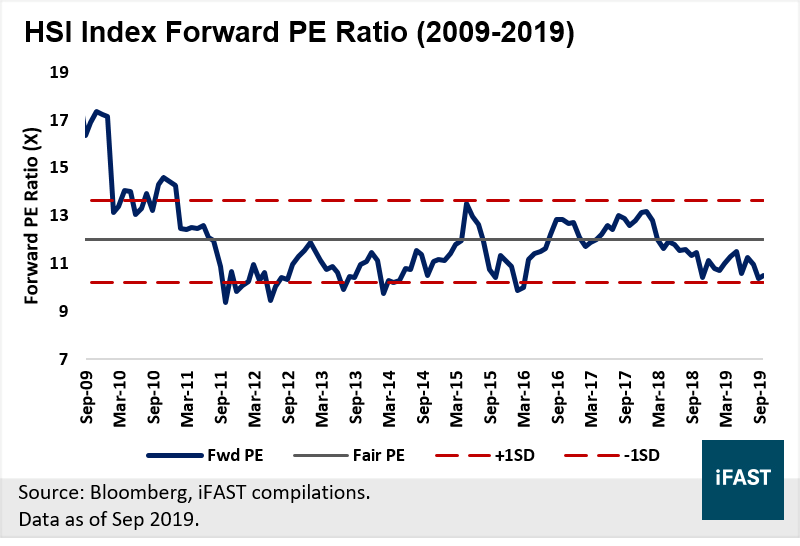


Looking ahead, we believe that positive catalysts such as a resolution of the public unrest or easing of the US-Sino trade tensions can provide impetus for a near-term rebound in market valuations.

Using our fair PE ratio of 12X on index earnings, Hong Kong equity market offers a promising upside potential of 22% and 31% for FY2020 and FY2021 respectively. 

Table 1 details the end-2020 and end-2021 potential upsides of an investment in Hong Kong equity market from today. 

Table 1: Upside Potential of Hang Seng Index

   Hang Seng Index

FY2018

FY2019

FY2020

FY2021

  12M Forward PE Ratio (X)

10.8

10.4

9.9

9.1

  Expected Earnings Growth YoY

8%

4%

6%

8%

  Earnings Per Share (EPS)

2398

2501

2663

2879

  Projected Fair Price (HKD)

-

-

31,957

34,545

  Potential Upside from Today (%)

-

-

+22%

+31%

Source: Bloomberg, iFAST compilations.

Despite the presence of near-term risks, amid a challenging external environment, we think that the negatives have been factored in the drastic earnings downgrade this year so far. 

We think HSI 3-year earnings CAGR of 6% for this year and next two years is highly achievable via the resilience in its underlying sectors. 

Overall, we think that attractive valuations, easing trade tensions and stimulus measures from China will help lift the Hang Seng Index over the next two years. 

We maintain our star rating of 4.5 stars “Very Attractive” for Hong Kong equity market.

Take part in the attractive upsides offered by Hong Kong equity market!


Investors seeking an actively-managed solution for exposure to the Hong Kong equity market can consider the Allianz Hong Kong Equity AT Acc SGD.

Investors seeking a generic exposure to China H-share can consider our recommended fund, Fidelity China Focus A-USD.

Investors who want an exposure to Hong Kong equity market via a passive option can consider the Tracker Fund of Hong Kong (HKEX: 2800).

Chart 9: Resiliency in HSI earnings lend support to a near-term recovery in HSI index performance 


The Research Team is part of iFAST Financial Pte Ltd.    

All materials and contents found in this site are strictly for general circulation and informational purposes only and should not be considered as an offer, or solicitation, to deal in any of the funds or products found/identified in this site. While iFAST Financial Pte Ltd ("IFPL") has tried to provide accurate and timely information, there may be inadvertent delays, omissions, technical or factual inaccuracies and typographical errors. Any opinion or estimate contained in this report is made on a general basis and neither IFPL nor any of its servants or agents have given any consideration to nor have they or any of them made any investigation of the investment objective, financial situation or particular need of any user or reader, any specific person or group of persons. You should consider carefully if the products you are going to purchase are suitable for your investment objective, investment experience, risk tolerance and other personal circumstances. If you are uncertain about the suitability of the investment product, please seek advice from a financial adviser, before making a decision to purchase the investment product. Past performance is not indicative of future performance. The value of the investment products and the income from them may fall as well as rise. Opinions expressed herein are subject to change without notice. In respect of any matters arising from, or in connection with the said research analyses or research reports, recipients of the report are to contact IFPL at 10 Collyer Quay, #26-01 Ocean Financial Centre Building, Singapore 049315, or by telephone at +65 6557 2853. Where the report contains research analyses or research reports from a foreign research house and if the recipient of such research analyses or research reports is not an accredited investor, expert investor, institutional investor or an ex-accredited investor, IFPL accepts legal responsibility for the contents of such analyses or reports to such persons only to the extent as required by law. Please note that only certain security(ies) herein are available to all investors, while the rest are only available for certain persons to invest in, such as Accredited Investors (as defined in the Securities and Futures Act) or one who invests at least S$200,000 (or its equivalent currency) per transaction. To qualify as an Accredited Investor, one needs to submit a declaration form and certain relevant supporting documents, according to iFAST’s prevailing policies and procedures.

Please read our full disclaimers on the website at ( https://secure.fundsupermart.com/fsmone/policies/328125/investment-account-terms-&-conditions).

iFAST Financial Pte Ltd (IFPL) (registered address: 10 Collyer Quay #26-01 Ocean Financial Centre Singapore 049315, Telephone: 6557 2000) holds the Financial Advisers Licence issued by the Monetary Authority of Singapore ('MAS') to conduct regulated activities of advising on securities, marketing of collective investment schemes and arranging of any contract of insurance in respect of life policies, other than a contract of reinsurance and the Capital Markets Services Licence issued by the MAS to conduct regulated activities of dealing in securities and providing custodial services for securities. While IFPL has made every effort to ensure the independence of the report's contents, IFPL's nature of business is such that IFPL and its connected and associated entities together with their respective directors, officers and staff may be involved in providing dealing or investment-related services in the abovementioned securities, and have taken or may take positions in the securities mentioned in this report, and may also act as the principal for any buy or sell trades.

Ways to Invest with FSM Global
Why FSM Global
Don't have an account with us?
Open an account here
Need Financial Advice?
Make an appointment

We use cookies If you close this message or continue to use this site, you will consent to the use of Cookies, unless you choose to disable them. Click on our Privacy Policy to understand more.