


• NVIDIA’s spectacular rally has seen its allocation within the VanEck Semiconductor ETF rise to more than 26% today. The ETF’s high allocation to a single stock raises the issue of concentration risk.
• Investors who are looking to reduce concentration risk can consider the Invesco PHLX Semiconductor ETF. This ETF has a single stock cap of 8% and a total of 30 holdings. Another major selling point is its expense ratio of 0.19%, one of the lowest among its peer group.
• However, those who believe that AI will lead to a massive structural increase in demand for chips should stick with the VanEck Semiconductor ETF, as NVIDIA will likely turn out to be the biggest winner among the lot.
Ask any investor about NVIDIA and most would tell you that 2024 is going to be their year.
As of 5 March 2024, NVIDIA’s shares have surged more than 70% year-to-date, making it one of the best performing stocks in the world (Figure 1). The company is also the best performing constituent of the VanEck Semiconductor ETF (our recommended ETF for exposure to the semiconductor sector), beating the second-best performer Taiwan Semiconductor Manufacturing Company by a margin of nearly 40%.
Figure 1: In a span of two months, NVIDIA’s shares have surged more than 70%.
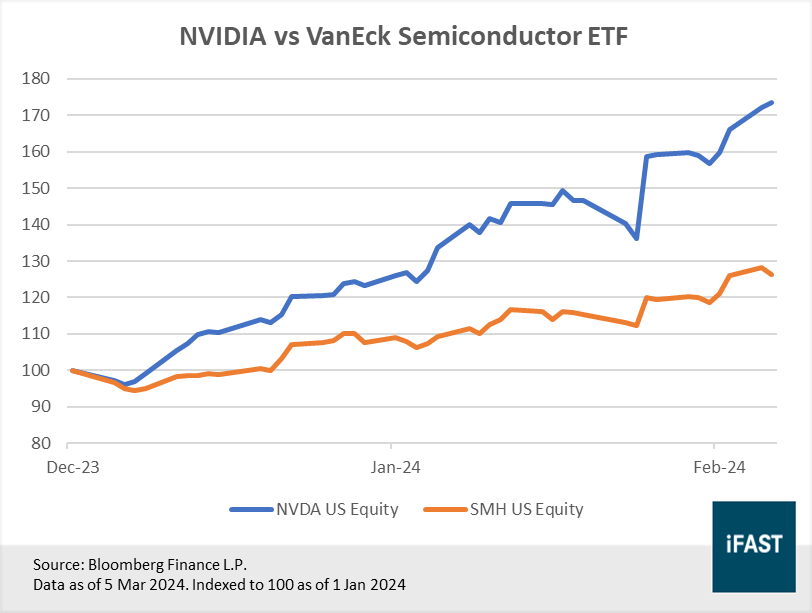
While the sharp rally in NVIDIA’s shares has certainly made its investors very happy, it has also spawned a new problem – concentration risk. The stock now makes up more than 26% of the VanEck Semiconductor ETF, compared to just 8.3% at the beginning of 2023 (Table 1). With such a high allocation to NVIDIA, some investors are starting to get concerned about the potential risks associated with this ETF, especially if NVIDIA’s share price were to see a significant correction.
If you are one of them, fret not as we have identified two ETFs that you can consider as alternatives to SMH.
Table 1: NVIDIA now makes up more than 26% of the VanEck Semiconductor ETF
|
Company |
Weight |
|
NVIDIA |
26.82% |
|
Taiwan Semiconductor Manufacturing Company |
9.31% |
|
Advanced Micro Devices |
6.23% |
|
Broadcom |
5.79% |
|
ASML |
4.97% |
|
Applied Materials |
4.58% |
|
Lam Research |
4.43% |
|
Qualcomm |
3.97% |
|
Intel |
3.71% |
|
Texas Instruments |
3.49% |
|
Source: VanEck Data as of 5 Mar 2024 |
|
Alternative semiconductor ETFs to consider in lieu of SMH
Table 2: Comparison between three semiconductor ETFs
|
VanEck Semiconductor ETF (NASDAQ:SMH) |
VanEck Semiconductor UCITS ETF (LSE:SMH) |
Invesco PHLX Semiconductor ETF (NASDAQ:SOXQ) |
|
|
Assets under management (USD millions) |
16,959 |
1,651 |
294 |
|
Expense ratio |
0.35% |
0.35% |
0.19% |
|
90 Day Average Daily Volume |
8,059,426 |
78,951 |
127,203 |
|
3-year tracking difference |
-0.65% |
-1.22% |
-0.49% (since inception) |
|
Underlying index |
MVIS® US Listed Semiconductor 25 Index |
MVIS® US Listed Semiconductor 10% Capped ESG Index |
PHLX Semiconductor Sector Index |
|
Single stock cap |
20% |
10% |
8% |
|
Rebalancing frequency |
Quarterly in Mar, Jun, Sep, Dec |
Quarterly in Mar, Jun, Sep, Dec |
Quarterly in Mar, Jun, Sep, Dec |
|
Number of holdings |
25 |
25 |
30 |
|
NVIDIA allocation (as of 5 Mar 2024) |
26.8% |
13.0% |
10.6% |
|
Source: Bloomberg Finance L.P., VanEck, iShares, Invesco, iFAST Compilations Data as of 5 Mar 2024 |
|||
1. VanEck Semiconductor UCITS ETF (LSE:SMH)
The first ETF investors can consider is the VanEck Semiconductor UCITS ETF (LSE:SMH). This is the UCITS compliant version of our recommended ETF listed on the London Stock Exchange.
UCITS ETFs are subjected to the 5/10/40 rule, which states that funds are not allowed to invest more than 10% of their assets into a single security, and holdings more than 5% cannot exceed 40% of the fund’s total assets. Because of these limitations, the UCITS version is a lot more diversified than its US listed counterpart, with only a 13% allocation to NVIDIA as of 5 March 2024.
Although the underlying index for both ETFs are different, the top 10 holdings are virtually the same as they both employ the same methodology. The main difference lies in the weight of their constituents. Both ETFs also have the exact same expense ratio (0.35%) and number of holdings (25).
Related Article: You can now buy London Stock Exchange ETFs on our iFAST platforms!
2. Invesco PHLX Semiconductor ETF (NASDAQ:SOXQ)
The second ETF investors can consider is the Invesco PHLX Semiconductor ETF (NASDAQ:SOXQ). It seeks to track the PHLX Semiconductor Sector Index, a modified market capitalisation weighted index composed of the 30 largest US listed semiconductor companies.
This ETF is even more diversified than the one above, as the underlying index has an 8% limit for single securities and only the top five largest constituents may exceed 4% each. As of 5 March 2024, this ETF has a 10.6% allocation to NVIDIA.
Another major selling point about the Invesco PHLX Semiconductor ETF is its expense ratio of 0.19%, which is significantly lower than its peer group as shown in Table 1. Expense ratio is an important criteria of our ETF selection process as it can have a sizeable impact on returns, especially when they are compounded over an extended period.
Positives aside, this ETF has a much lower AUM and liquidity compared to its peers. Having only been listed in June 2021, it is still relatively new and hence does not have an established track record unlike most of its peers.
Which ETF should investors’ pick?
So which ETF should investors pick?
The answer to this question depends on how comfortable investors are with an outsized exposure to NVIDIA and their outlook for the company. Those who are worried about concentration risk or believe that NVIDIA’s shares are overvalued should switch to the Invesco PHLX Semiconductor ETF (NASDAQ:SOXQ), which is the most diversified among the three ETFs and has the lowest allocation to NVIDIA.
On the other hand, those who hold a more optimistic view and believe that this is only the beginning of a multi-year megatrend with NVIDIA being one of the main beneficiaries should stick with our current recommendation, the VanEck Semiconductor ETF (NASDAQ:SMH).
In our previous article, we mentioned that the semiconductor industry is likely to be on the cusp of a new revolution, powered by the rapid adoption of AI. And just like how the PC and mobile revolutions led to heavy demand for chips, we foresee that this time will be no different, and chipmakers will see a massive structural increase in demand over the next decade. NVIDIA, which by some estimates control more than 80% of the AI chip market, is arguably in the best position to reap the benefits of this megatrend.
Related Article: Chip sales to top 40% year-on-year by 2Q25. Here’s how you can capitalise on this opportunity
While NVIDIA’s share price has risen significantly, it is justified by its revenue growth, which more than doubled compared to a year ago propelled by its data center segment. Looking forward, the firm should continue to experience exponential growth as hyperscalers such as the likes of Amazon’s AWS and Google Cloud ramp up their capex.
The company is also immensely profitable, commanding a net profit margin of close to 50% for FY 2024 – one of the highest across the entire industry. In the same year, its bottom line grew nearly seven-fold year-on-year. In terms of valuations, NVIDIA is currently trading at 27X 2026 estimated earnings, which is relatively cheap compared to its historical average of roughly 40X. Taking all these factors into consideration, its current share price may be justifiable after all.
Figure 2: Share price appreciation supported by earnings growth

Lastly, it is also worth noting that the VanEck Semiconductor ETF will be rebalanced on a quarterly basis with the next one slated to occur on 15 March 2024. Post rebalancing, NVIDIA’s weight will be calibrated down to 20% or less, which should alleviate some concerns about concentration risk. Regular rebalancing helps to improve diversification by returning the ETF to its target weight. It also helps to lock in profits by selling assets with relatively more expensive valuations and buying cheaper assets (buy low sell high).
Ultimately, we think that investors should not be overly worried about their choice of ETF. Afterall, given the small universe of large cap semiconductor stocks, the constituents are more or less the same. However, if you share our view of a brighter future for the semiconductor industry powered by AI, then you may as well stick with the VanEck Semiconductor ETF (NASDAQ:SMH), as NVIDIA stands a fairly good chance of becoming one of the biggest winners among the lot.
Declaration:
For specific disclosure, at the time of publication of this report, IFPL (via its connected and associated entities) holds a NIL position in the abovementioned securities. The analyst who produced this report holds a position in the VanEck Semiconductor ETF.
All materials and contents found in this site are strictly for general circulation and informational purposes only and should not be considered as an offer, or solicitation, to deal in any of the funds or products found/identified in this site. While iFAST Financial Pte Ltd ("IFPL") has tried to provide accurate and timely information, there may be inadvertent delays, omissions, technical or factual inaccuracies and typographical errors. Any opinion or estimate contained in this report is made on a general basis and neither IFPL nor any of its servants or agents have given any consideration to nor have they or any of them made any investigation of the investment objective, financial situation or particular need of any user or reader, any specific person or group of persons. You should consider carefully if the products you are going to purchase are suitable for your investment objective, investment experience, risk tolerance and other personal circumstances. If you are uncertain about the suitability of the investment product, please seek advice from a financial adviser, before making a decision to purchase the investment product. Past performance is not indicative of future performance. The value of the investment products and the income from them may fall as well as rise. Opinions expressed herein are subject to change without notice. In respect of any matters arising from, or in connection with the said research analyses or research reports, recipients of the report are to contact IFPL at 10 Collyer Quay, #26-01 Ocean Financial Centre Building, Singapore 049315, or by telephone at +65 6557 2853. Where the report contains research analyses or research reports from a foreign research house and if the recipient of such research analyses or research reports is not an accredited investor, expert investor, institutional investor or an ex-accredited investor, IFPL accepts legal responsibility for the contents of such analyses or reports to such persons only to the extent as required by law. Please note that only certain security(ies) herein are available to all investors, while the rest are only available for certain persons to invest in, such as Accredited Investors (as defined in the Securities and Futures Act) or one who invests at least S$200,000 (or its equivalent currency) per transaction. To qualify as an Accredited Investor, one needs to submit a declaration form and certain relevant supporting documents, according to iFAST’s prevailing policies and procedures.
Please read our full disclaimers on the website at ( https://secure.fundsupermart.com/fsmone/policies/328125/investment-account-terms-&-conditions).
iFAST Financial Pte Ltd (IFPL) (registered address: 10 Collyer Quay #26-01 Ocean Financial Centre Singapore 049315, Telephone: 6557 2000) holds the Financial Advisers Licence issued by the Monetary Authority of Singapore ('MAS') to conduct regulated activities of advising on securities, marketing of collective investment schemes and arranging of any contract of insurance in respect of life policies, other than a contract of reinsurance and the Capital Markets Services Licence issued by the MAS to conduct regulated activities of dealing in securities and providing custodial services for securities. While IFPL has made every effort to ensure the independence of the report's contents, IFPL's nature of business is such that IFPL and its connected and associated entities together with their respective directors, officers and staff may be involved in providing dealing or investment-related services in the abovementioned securities, and have taken or may take positions in the securities mentioned in this report, and may also act as the principal for any buy or sell trades.