


- For investors looking to limit their exposure to China within their portfolios, the pain point lies in the fact that China typically occupies a substantial portion of traditional regional indices.
- The good news is that more “ex-China” products have hit the market in recent times. One can consider the iShares MSCI Emerging Markets ex China ETF (NASDAQ:EMXC).
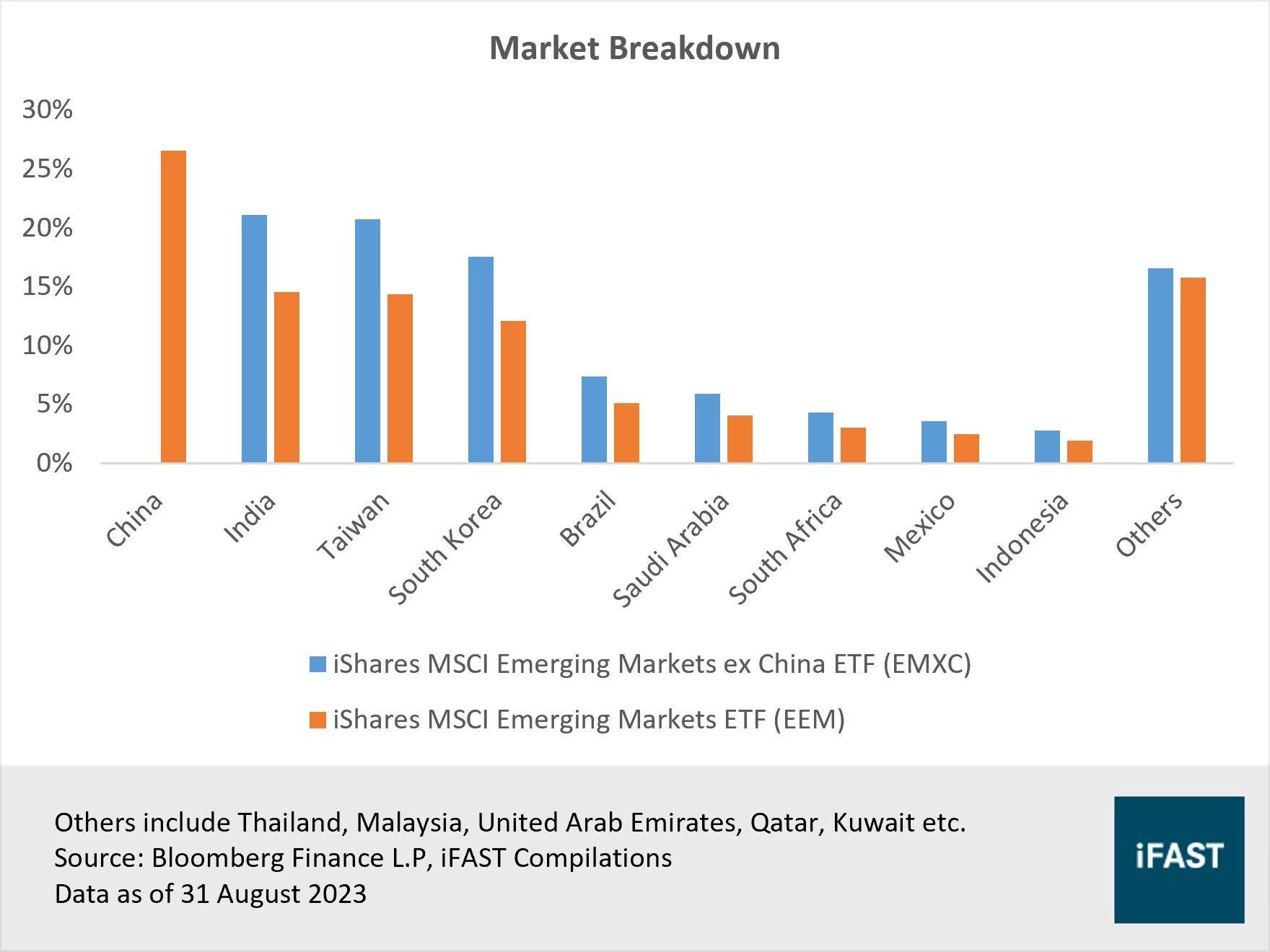
- The exclusion of China means that markets like India, Taiwan, and South Korea are given larger weights compared to traditional EM ETFs. The largest holdings include TSMC, Samsung, and SK Hynix.
- Investing in EM ex China has its advantages, such as the reduction of exposure to China-specific risks. EM ex China strategies like the EMXC ETF have also delivered stronger returns over the longer term.
- Looking beyond China, we see better long-term growth opportunities in other major EM markets especially South Korea.
We have consistently reiterated our view that China is no longer an attractive market for investment. China’s challenges run deep, stemming from the economic malaise and persistent long-term structural issues, such as the embrace of a top-down state-controlled economic growth model and the shifting geopolitics.
(Related article: Is China’s stock market finally too cheap to be ignored?)
As such, we think investors should exercise caution by limiting their exposure to China within their portfolios. The pain point, however, lies in the fact that China typically occupies a substantial portion of traditional regional indices due to the sheer size of its economy and stock market. For some perspective, consider that within the emerging markets (EM) region, China constitutes a sizable 30% of the MSCI Emerging Markets Index.
But fear not! In recent times, more “ex-China” products have hit the market. On our platform, investors can gain access to a selection of “ex-China” ETFs.
Here are the range of EM ex China ETFs on our platform
For investors seeking passive instruments, our platform currently offers four passive EM ex China ETFs (Table 1). We examine them across some metrics below.
Assets under management (AUM): The largest EM ex China ETF is the iShares MSCI Emerging Markets ex China ETF (NASDAQ:EMXC), boasting an impressive USD 5.22 billion in AUM. In comparison, its peers have AUMs ranging from USD 31.67 million to USD 373.46 million, making EMXC more than 10 times larger. Generally, a higher AUM correlates with lower expense ratios and higher liquidity.
Average daily volume (ADV): Unsurprisingly, EMXC also leads in ADV, with over 806 million shares traded daily. This indicates its high liquidity, allowing investors to enter and exit positions swiftly with minimal price impact.
Expense ratio: Among these ETFs, the Columbia EM Core ex China ETF (NYSE:XCEM) stands out with the lowest expense ratio of just 0.16%. A lower expense ratio is desirable as lower costs can potentially lead to better long-term performance. While EMXC is not the cheapest ETF, with an expense ratio of 0.25%, it remains a reasonably cost-effective option. Its higher liquidity could also make up for this slightly higher cost.
In addition to these metrics, we also note that there are some differences in the ETFs. For example, EMXC and the KraneShares MSCI Emerging Markets ex China Index ETF (NYSE:KEMX) track the same index (MSCI Emerging Markets ex China Index) but hold different numbers of securities. The latter likely employs a sampling methodology, holding a subset of the index's constituents to replicate its performance.
Table 1: Comparison of passive EM ex China ETF
|
ETF Name |
AUM (USD Million) |
ADV (‘000) |
Expense Ratio |
Number of Holdings |
|
iShares MSCI Emerging Markets ex China ETF (NASDAQ:EMXC) |
5,219.97 |
806,924 |
0.25% |
666 |
|
Columbia EM Core ex China ETF (NYSE:XCEM) |
373.46 |
115,410 |
0.16% |
304 |
|
Strive Emerging Markets Ex-China ETF (NYSE:STXE) |
152.74 |
29,495 |
0.32% |
698 |
|
KraneShares MSCI Emerging Markets ex China Index ETF (NYSE:KEMX) |
31.57 |
6,795 |
0.23% |
316 |
|
Source: Bloomberg Finance L.P, iFAST Compilations Data as of 31 August 2023 |
||||
Introducing the iShares MSCI Emerging Markets ex China ETF
Based on our in-house ETF selection methodology, we consider the iShares MSCI Emerging Markets ex China ETF (NASDAQ:EMXC) as the best-in-class EM ex China ETF. EMXC aims to replicate the investment results of the MSCI Emerging Markets ex China Index which consists of large- and mid-capitalisation EM equities, excluding China. As of 31 August 2023, the ETF holds a diversified portfolio of 666 securities.
The exclusion of China means that markets like India, Taiwan, and South Korea feature more prominently compared to traditional EM ETFs (Figure 1). India, Taiwan, and South Korea collectively take up around 60% of EMXC. The ETF also holds markets from Latin America and Europe, the Middle East, and Africa such as Brazil (7%) and Saudi Arabia (6%).
Figure 1: Markets like Taiwan, India, and South Korea have a stage to shine
On a sectoral level, EMXC has a substantial weightage of 27% in information technology (IT), higher than traditional EM ETFs (Figure 2). This is mainly because China’s tech giants, such as Tencent (HKEX:700), Alibaba (HKEX:9988), and Meituan (HKEX:3690), are classified in the consumer discretionary or communication sectors. Within the IT sector, EMXC’s largest holdings are semiconductor plays, such as TSMC (NYSE:TSM), Samsung, and SK Hynix.
Meanwhile, the second-largest sector is financials, with a sizable weightage of 25%. The ETF holds a diversified exposure to banks in the EM region; notable examples include major Indian private-sector banks like ICICI Bank and HDFC Bank, as well as Al Rajhi Bank, which is the world’s largest Islamic bank headquartered in Saudi Arabia.
Figure 2: The largest sector is IT

Table 2: Top 10 holdings of EMXC
|
Name |
Sector |
Market |
Weight |
|
TSMC |
Information Technology |
Taiwan |
9.02% |
|
Samsung Electronics |
Information Technology |
South Korea |
5.14% |
|
Reliance Industries |
Energy |
India |
1.88% |
|
ICICI Bank |
Financials |
India |
1.26% |
|
Infosys |
Information Technology |
India |
1.22% |
|
HDFC Bank |
Financials |
India |
1.13% |
|
SK Hynix |
Information Technology |
South Korea |
1.07% |
|
Vale S.A. |
Materials |
Brazil |
0.95% |
|
Hon Hai Precision Industry |
Information Technology |
Taiwan |
0.89% |
|
Al Rajhi Bank |
Financials |
Saudi Arabia |
0.80% |
|
Total |
- |
-
|
23.36% |
|
Source: iShares, iFAST Compilations Data as of 31 August 2023 |
|||
Benefits of investing in EM ex China
Investing in EM ex China offers distinct advantages.
Most notably, investors can reduce their exposure to China-specific risks including the shifting geopolitics, regulatory changes, and economic uncertainties. Sentiment surrounding Chinese tech giants, which are heavyweights in traditional EM indices, has remained negative due to a slowing economic recovery and weak consumption. China’s underperformance has become a major detractor in EM, underscoring the traditional overreliance on China in the EM investable universe and the concentration risk faced by investors.
Meanwhile, EM ex China strategies like the EMXC ETF have demonstrated better performance over the longer term (Figure 3). Apart from the absence of China as a detracting factor, the robust performance of EMXC has been lifted by resilient markets like India, Taiwan, and South Korea which hold substantial weights in the portfolio.
Figure 3: EM ex China has outperformed

Furthermore, when we shift the focus away from China, we see better long-term growth opportunities in other major EM markets, with South Korea emerging as a standout. South Korea is poised to leverage on its technological capabilities and innovation. This, coupled with a highly educated and skilled workforce, positions the country to become the technology powerhouse in Asia. South Korea also stands to benefit from the imminent rebound of the semiconductor cycle, owing to the pivotal roles played by major corporations like Samsung and SK Hynix in the global semiconductor industry.
(Related article: The Shifting Geopolitics and The New Asian Tigers)
Turning the attention to India, we find that it may benefit from the “China Plus One” strategy as it seeks to position itself as an alternative manufacturing hub to China. This opens doors for growth in areas such as manufacturing, assembly of goods and exports, which is set to be bolstered by a young and growing population.
Meanwhile, Taiwan boasts its status as the world’s semiconductor powerhouse, with TSMC being the number one go-to foundry for cutting-edge chips. Moreover, the long-term structural factors driving semiconductor demand remain robust, supported by the generative artificial intelligence (AI) craze and ongoing technological innovations.
Final thoughts
For those looking to reduce their exposure to China within their portfolios, we believe the iShares MSCI Emerging Markets ex China ETF (NASDAQ:EMXC) stands out among the passive investment instruments, in terms of its liquidity and expense ratio.
China typically commands a significant share of traditional regional indices. The exclusion of China means greater weights are assigned to markets like India, Taiwan, and South Korea when compared to traditional EM ETFs. On a security level, EMXC’s top holdings include leaders in the semiconductor industry such as TSMC, Samsung, and SK Hynix.
By opting for strategies like the EMXC ETF, investors not only can mitigate China-specific risks, but also potentially benefit from greater long-term opportunities. Looking beyond China, we find compelling growth prospects in other major EM markets with South Korea standing out as a prime example.
All in all, as the world grows to become less reliant on China whose challenges run deep, we believe investing in EM ex China will be a winning strategy moving forward.
Declaration:
For specific disclosure, at the time of publication of this report, IFPL (via its connected and associated entities) and the analyst who produced this report hold a NIL position in the abovementioned securities.
All materials and contents found in this site are strictly for general circulation and informational purposes only and should not be considered as an offer, or solicitation, to deal in any of the funds or products found/identified in this site. While iFAST Financial Pte Ltd ("IFPL") has tried to provide accurate and timely information, there may be inadvertent delays, omissions, technical or factual inaccuracies and typographical errors. Any opinion or estimate contained in this report is made on a general basis and neither IFPL nor any of its servants or agents have given any consideration to nor have they or any of them made any investigation of the investment objective, financial situation or particular need of any user or reader, any specific person or group of persons. You should consider carefully if the products you are going to purchase are suitable for your investment objective, investment experience, risk tolerance and other personal circumstances. If you are uncertain about the suitability of the investment product, please seek advice from a financial adviser, before making a decision to purchase the investment product. Past performance is not indicative of future performance. The value of the investment products and the income from them may fall as well as rise. Opinions expressed herein are subject to change without notice. In respect of any matters arising from, or in connection with the said research analyses or research reports, recipients of the report are to contact IFPL at 10 Collyer Quay, #26-01 Ocean Financial Centre Building, Singapore 049315, or by telephone at +65 6557 2853. Where the report contains research analyses or research reports from a foreign research house and if the recipient of such research analyses or research reports is not an accredited investor, expert investor, institutional investor or an ex-accredited investor, IFPL accepts legal responsibility for the contents of such analyses or reports to such persons only to the extent as required by law. Please note that only certain security(ies) herein are available to all investors, while the rest are only available for certain persons to invest in, such as Accredited Investors (as defined in the Securities and Futures Act) or one who invests at least S$200,000 (or its equivalent currency) per transaction. To qualify as an Accredited Investor, one needs to submit a declaration form and certain relevant supporting documents, according to iFAST’s prevailing policies and procedures.
Please read our full disclaimers on the website at ( https://secure.fundsupermart.com/fsmone/policies/328125/investment-account-terms-&-conditions).
iFAST Financial Pte Ltd (IFPL) (registered address: 10 Collyer Quay #26-01 Ocean Financial Centre Singapore 049315, Telephone: 6557 2000) holds the Financial Advisers Licence issued by the Monetary Authority of Singapore ('MAS') to conduct regulated activities of advising on securities, marketing of collective investment schemes and arranging of any contract of insurance in respect of life policies, other than a contract of reinsurance and the Capital Markets Services Licence issued by the MAS to conduct regulated activities of dealing in securities and providing custodial services for securities. While IFPL has made every effort to ensure the independence of the report's contents, IFPL's nature of business is such that IFPL and its connected and associated entities together with their respective directors, officers and staff may be involved in providing dealing or investment-related services in the abovementioned securities, and have taken or may take positions in the securities mentioned in this report, and may also act as the principal for any buy or sell trades.