With attractive dividend yields and longer-term catalysts, China’s Big Four banks are hard to ignore

Since our last update, there has been a couple of negative developments in the Chinese banking industry. However, we continue to hold a positive view on China’s Big Four banks (HKEX:3143).

  • |
  • Published on 14 Aug 2021

With attractive dividend yields and longer-term catalysts, China’s Big Four banks are hard to ignore | Open a FREE FSM account and manage all your investments conveniently in ONE place
Photo by Mitchell on Unsplash

Chinese banks have continued to lag behind their international peers due to a couple of negative developments in this industry. This includes new loan curbs, uncertainty over Huarong’s debt situation, and increasing competition in the industry. 

While the latest property loan curbs are likely to result in slower property-related loan growth, the overall impact would be manageable as there are several other sectors, including infrastructure and manufacturing, that are expected to support growth in loan volumes.

While the Huarong saga will translate to higher loan loss provisions and investment losses, we believe that the impact on their balance sheets should not be material. Besides, the Big Four banks are well-capitalised to withstand any potential shocks.

While the opening up of China’s financial sector could lead to increased competition, efforts to create domestic banking behemoths could lead to new revenue streams for Chinese banks.

Trading at less than 0.5X price-to-book ratio, the valuations of the Big Four banks are near their historical lows. With an average dividend yield of about 8.5%, they are also attractive yield-plays for income-seeking investors.

While most global banks have had a great run since late last year, Chinese banks have continued to lag behind their international peers due to a couple of negative developments in the industry since our last update.

New loan curbs: Since August 2020, new financing rules were imposed on real estate developers as the regulators look to further deleverage the real estate sector. Shortly after, the Chinese regulators took another step to clamp down on the real estate credit market by setting limits on the banks’ lending to the real estate sector. By March 2021, the PBOC expressed concerns over China’s credit market during a meeting once again, urging the country’s major lenders to keep loan growth at roughly the same level as 2020, further reinforcing investor doubts over the ability of Chinese banks to grow their loan portfolio in the coming years.


Increasing competition: In April 2021, China officially lifted foreign ownership caps that were previously imposed on financial institutions in the securities industry. This gives foreign companies the green light to set up wholly-owned units in China, instead of only joint-ventures, paving the way for increased competition in the Chinese financial sector.

Huarong debt crisis: Finally, in the same month, it was also reported that Huarong Asset Management, a state-owned distressed debt management company in China, has failed to release its FY2020 annual results before the 31 March deadline, causing investors to be concerned about its credit health. Given the sheer size of Huarong, investors were concerned over the risk of wider spill-overs in China’s credit market.  


Despite these negative developments, we continue to hold a positive view on China’s Big Four banks.

Chinese banks are still expected to deliver double-digit loan growth


In an attempt to cool China’s real estate market, the sector has seen increased regulations over the years, with the latest one being the “Three Red Lines”. Under the latest regulation, developers are categorised based on how many “red lines” they violate, and their debt growth per annum will be capped accordingly (Table 1). On top of that, regulators have also placed a cap on the Big Four banks lending to property and mortgage lending at 40% and 32.5% respectively, effective 1 Jan 2021.

As China’s Big Four banks have substantial exposure to the real estate sector, the latest regulations are likely to result in slower property-related loan growth. However, we believe that the overall impact would be manageable.

The latest regulation, “Three Red Lines”, is targeted only at the highly leveraged developers, and is not a crackdown on the entire sector. Based on our findings, almost 90% of the developers are still allowed to grow their debt by double-digits. Besides, loans extended by the Big Four banks to property developers currently make up about 6% of their outstanding loans, suggesting that there is still some room for the Big Four banks to increase their lending to the developers. 

Table 1: Most large developers do not breach the red lines 
Number of red lines violated Colour code Debt growth allowed per annum % of developers*
Zero Green 15% 57%
One Yellow 10% 30%
Two Orange 5% 6%
Three Red 0% 7%
Source: Bloomberg Finance L.P., iFAST compilations
*Based on MSCI China Real Estate index
Data as of FY2020 or 1H21 reports

Besides, the slack left behind by property-related loans could also be picked up by several other sectors, including infrastructure and manufacturing. In the 14th Five Year Plan (FYP), the Chinese government announced that it has plans to build 30 new airports and thousands of kilometres of new railways and highways in the next five years. At the same time, it will also focus on building up China into a manufacturing powerhouse by upgrading current industrial and supply chains, all of which are expected to support growth in loan volumes. 

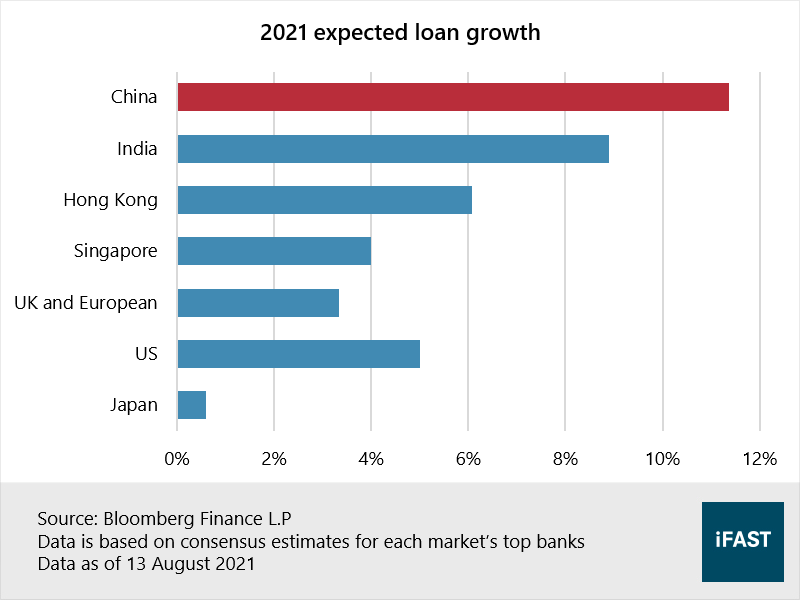
As such, our forecasted double-digit loan growth of about 11.4% for Chinese banks this year remains a realistic possibility. This is a figure that not only surpasses the estimated loan growth of its international peers in 2021 (Chart 1) but is also a key earning driver of the Big Four banks. 

Chart 1: China banks can still expect double-digit loan growth for 2021
 

Big Four banks are well-capitalised to withstand Huarong shock 


Fears of the credit health of China Huarong Asset Management has also rattled investors over the past few months. As part of the support measures to stabilise Huarong’s cash flows, the Chinese government has requested some banks not to withhold lending to Huarong. Specifically, ICBC was asked to support Huarong to ensure that it can repay its debt at least six months from May this year. According to Bloomberg, Huarong has about RMB 26 billion worth of notes maturing by this year, and we believe it is highly likely that the other Big Four banks will also step in to help Huarong finance its debt (Chart 2).

Chart 2: Huarong’s onshore and offshore bonds maturing this year
 
If the Chinese government does step in to recapitalise Huarong, this means that the current financing forked out by ICBC and the other banks will likely be viewed as just a “transitory arrangement” to help stabilise Huarong’s near-term cash flow problems. Using the restructuring of Baoshang Bank and Bank of Jinzhou as reference cases, we can expect the Chinese government to take over Huarong’s assets at a deep discount. Meanwhile, debtholders (including the banks) are likely to bear the brunt of this restructuring, receiving a fraction of what they have initially lent to Huarong. 

Therefore, we can expect the Chinese banks to write down their loans to Huarong. According to JPMorgan, the banks’ loan exposure to Huarong is about RMB 766 billion, which is equivalent to only about 0.4% of the Chinese banks’ total RMB loans. It was also estimated that the Chinese banks may have about RMB 170 billion exposure to Huarong bonds, and this will likely be reflected as marked-to-market investment losses on their income statements.

While the slightly higher loan loss provisions and investment losses will likely weigh on the banks’ 2021 earnings recovery, the impact on their balance sheets should not be material. Besides, the Big Four banks are very well-capitalised and this should provide some buffer for them to tide through the bad loan provisions from Huarong (Table 2). The fact that the Chinese government is willing to let Huarong go to the brink – a scenario that was near unthinkable just a few years back – is also a reflection of the government’s confidence that the banking sector is now strong enough to withstand a shock.

Table 2: Capital adequacy of the Big Four banks remain strong
Company CET1 Ratio *Minimum CET1 ratio
Industrial and Commercial Bank of China (HKEX:1398) 13.3% 9.0%
China Construction Bank (HKEX:939) 13.4% 9.0%
Bank Of China (HKEX:3988) 11.1% 9.0%
Agricultural Bank Of China (HKEX:1288) 11.0% 8.5%
Source: Bloomberg Finance L.P., iFAST compilations
*minimum requirement is based on CBRC requirement plus a capital conservation buffer and a GSIB buffer
Data as of 1Q21 reports

New revenue streams represent potential catalysts in the longer term


While the opening up of its financial sector could lead to increased competition, China’s securities regulator intends to grant securities licenses to large commercial banks as part of its efforts to create industry behemoths that can better compete with foreign firms.

Currently, investment banking and other securities services are off-limits to most Chinese banks as the government wants to minimise risk across different parts of the financial system. As such, China’s desire to break the wall between commercial and investment banking could lead to new revenue streams, a potential catalyst that could lead to a re-rating in the longer term.

While we have previously highlighted that ICBC (HKEX:1398) and China Construction Bank (HKEX:939) are the two likely banks that will kick-start this trial, we can also expect other commercial banks to receive the relevant licenses if the trial turns out to be successful.  

Therefore, even though competition is expected to increase, we believe the opening up of the China financial market will not only translate to new opportunities for foreign financial institutions, but also for Chinese financial institutions. On top of that, we can also expect the business models of Chinese banks to be more diversified as they will no longer depend on just net interest income.

Re-rating opportunity might get delayed but we still expect very attractive upside potential


Chinese banks are currently trading at less than 0.5X price to book ratio, near its historical lows, and the discount to its international peers is also at its steepest in the last five years, implying a high degree of pessimism about their future prospects. Given that Chinese banks are now on a stronger footing, with strong buffers that better prepare them for bumps ahead, and the presence of longer-term catalysts, we believe there is more upside potential than downside risks at this point (Chart 3). 

Chart 3: Big Four banks trading at historical lows 
 
While we have also decided to downgrade the fair PB ratios of the Big Four banks’ given the near-term headwinds, we can still expect huge upside potential from them. With an average dividend yield of about 8.5%, the Big Four banks are also very attractive yield-plays for income-seeking investors.

Table 3: Immense upside potential in the long-run 
Company Name PB ratio (X) Target price (HKD) Current price (HKD) Upside Potential Average dividend yield
Industrial and Commercial Bank of China (HKEX:1398) 0.85 8.9 4.4 101.7% 8.1%
China Construction Bank (HKEX:939) 0.85 10.0 5.6 78.7% 7.3%
Bank Of China (HKEX:3988) 0.75 6.3 2.7 133.0% 8.9%
Agricultural Bank Of China (HKEX:1288) 0.75 5.7 2.6 118.1% 9.2%
Average 107.9% 8.4%
Source: Bloomberg Finance L.P., iFAST estimations
Data as of 13 August 2021

For a more diversified approach, investors can consider the ChinaAMC Hong Kong Banks ETF (HKEX:3143), which has an exposure of almost 45% to the Big Four banks. Another alternative would be the Global X MSCI China Financials ETF (NYSE:CHIX), which allows you to ride the long-term trend of China’s financials sector. CHIX includes not just the Big Four banks (27.9%), but also other banks and financial institutions, such as insurance companies and diversified financials.

Declaration:

For specific disclosure, at the time of publication of this report, IFPL (via its connected and associated entities) holds a NIL position in the abovementioned securities. The analyst who produced this report holds a position in ChinaAMC Hong Kong Banks ETF (HKEX:3143).

All materials and contents found in this site are strictly for general circulation and informational purposes only and should not be considered as an offer, or solicitation, to deal in any of the funds or products found/identified in this site. While iFAST Financial Pte Ltd ("IFPL") has tried to provide accurate and timely information, there may be inadvertent delays, omissions, technical or factual inaccuracies and typographical errors. Any opinion or estimate contained in this report is made on a general basis and neither IFPL nor any of its servants or agents have given any consideration to nor have they or any of them made any investigation of the investment objective, financial situation or particular need of any user or reader, any specific person or group of persons. You should consider carefully if the products you are going to purchase are suitable for your investment objective, investment experience, risk tolerance and other personal circumstances. If you are uncertain about the suitability of the investment product, please seek advice from a financial adviser, before making a decision to purchase the investment product. Past performance is not indicative of future performance. The value of the investment products and the income from them may fall as well as rise. Opinions expressed herein are subject to change without notice. In respect of any matters arising from, or in connection with the said research analyses or research reports, recipients of the report are to contact IFPL at 10 Collyer Quay, #26-01 Ocean Financial Centre Building, Singapore 049315, or by telephone at +65 6557 2853. Where the report contains research analyses or research reports from a foreign research house and if the recipient of such research analyses or research reports is not an accredited investor, expert investor, institutional investor or an ex-accredited investor, IFPL accepts legal responsibility for the contents of such analyses or reports to such persons only to the extent as required by law. Please note that only certain security(ies) herein are available to all investors, while the rest are only available for certain persons to invest in, such as Accredited Investors (as defined in the Securities and Futures Act) or one who invests at least S$200,000 (or its equivalent currency) per transaction. To qualify as an Accredited Investor, one needs to submit a declaration form and certain relevant supporting documents, according to iFAST’s prevailing policies and procedures.

Please read our full disclaimers on the website at ( https://secure.fundsupermart.com/fsmone/policies/328125/investment-account-terms-&-conditions).

iFAST Financial Pte Ltd (IFPL) (registered address: 10 Collyer Quay #26-01 Ocean Financial Centre Singapore 049315, Telephone: 6557 2000) holds the Financial Advisers Licence issued by the Monetary Authority of Singapore ('MAS') to conduct regulated activities of advising on securities, marketing of collective investment schemes and arranging of any contract of insurance in respect of life policies, other than a contract of reinsurance and the Capital Markets Services Licence issued by the MAS to conduct regulated activities of dealing in securities and providing custodial services for securities. While IFPL has made every effort to ensure the independence of the report's contents, IFPL's nature of business is such that IFPL and its connected and associated entities together with their respective directors, officers and staff may be involved in providing dealing or investment-related services in the abovementioned securities, and have taken or may take positions in the securities mentioned in this report, and may also act as the principal for any buy or sell trades.

Ways to Invest with FSM Global
Why FSM Global
Don't have an account with us?
Open an account here
Need Financial Advice?
Make an appointment

We use cookies If you close this message or continue to use this site, you will consent to the use of Cookies, unless you choose to disable them. Click on our Privacy Policy to understand more.