


- In 2020, sustainable fixed income funds beat their traditional peers in both risk and return performance metrics.
- However, in the longer term, results are inconclusive, likely a result of stricter investment mandates and a smaller variety of investment offerings.
- With a likely record ESG bond issuance in 2021, this should go some way to alleviating the latter issue.
- At present, we believe the optimal approach is to incorporate some ESG positive funds to supplement your existing portfolio, and investors can begin by considering some of the funds recommended below.
“Doing well by doing good” is an intriguing phrase often bandied about when ESG investing is brought up. It summarizes the appeal of ESG investing – investors can do well (generate returns for themselves) by doing good (in generating positive environmental and social impact), and this can be done by simply integrating ESG into their investment choices. Does this mantra hold up when it comes to fixed income investing?
(See: ESG – Latest developments in a rapidly growing investment theme)
Well, yes (to some extent)
In an article published last year, we looked into multiple studies to see if sustainable investing brings about benefits and higher returns to a portfolio. The conclusion drawn then, was that firms with high ESG scores tend to deliver higher returns, perform better during downturns, and show better risk characteristics. However, these firms also tend to be larger firms, which are of inherently higher quality, which could mean that the lower volatility and higher returns may not be a result of the ESG factor.
(See: ESG may be good for the world, but is it good for your portfolio?)
A more recent study1 conducted by Morgan Stanley came to similar conclusions. In 2020, sustainable fixed income funds beat their non-sustainable counterparts by 0.9%, and had lower downside deviation by 0.4%.
However, after taking a step back and looking at a longer horizon, results are inconclusive. From both risk and return characteristics (Chart 1 & 2), there has not been a clear and consistent outperformer historically.
Chart
1: Historical Performance of Sustainable vs Traditional Fixed Income Funds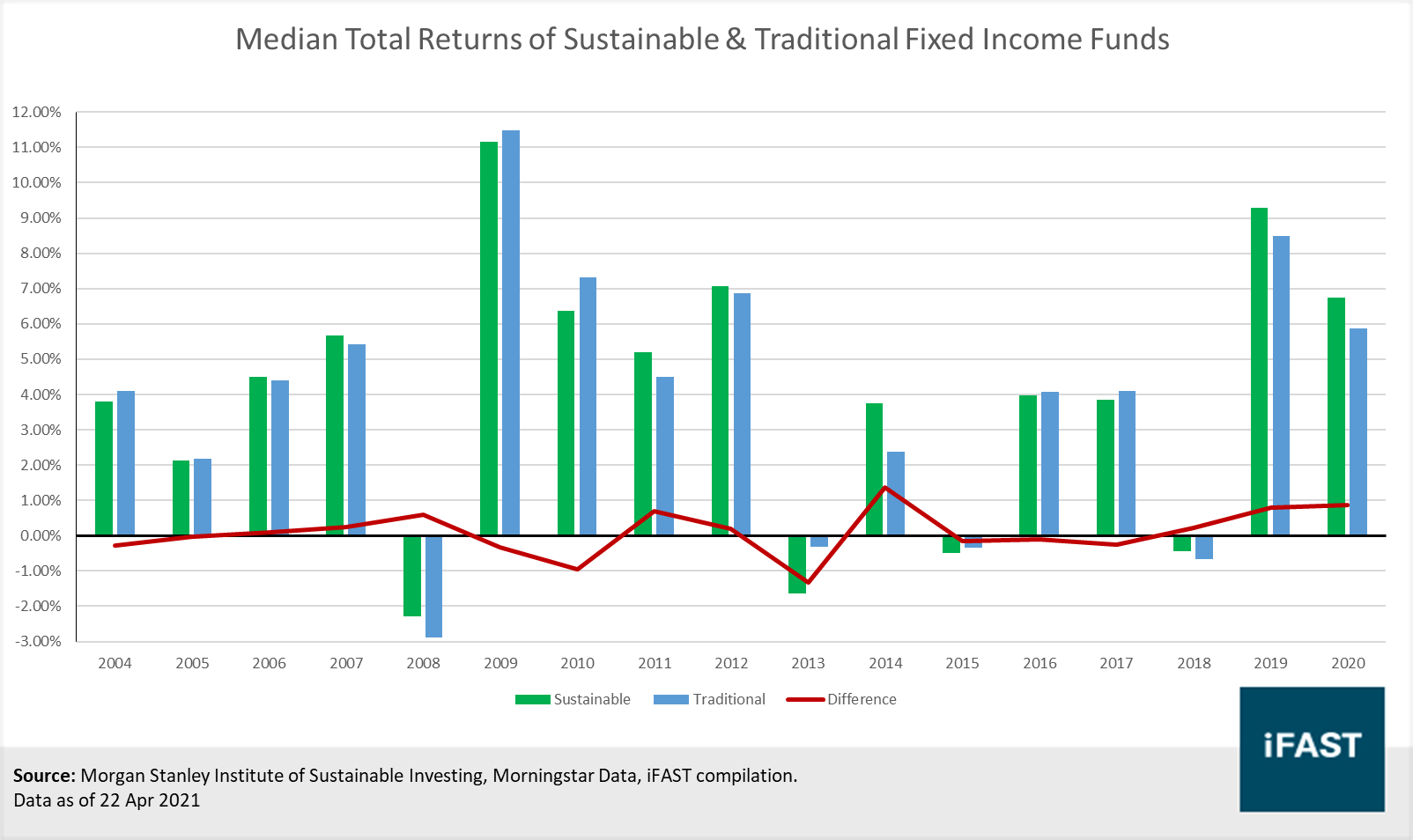
Chart 2: Historical Downside Deviation of
Sustainable vs Traditional Fixed Income Funds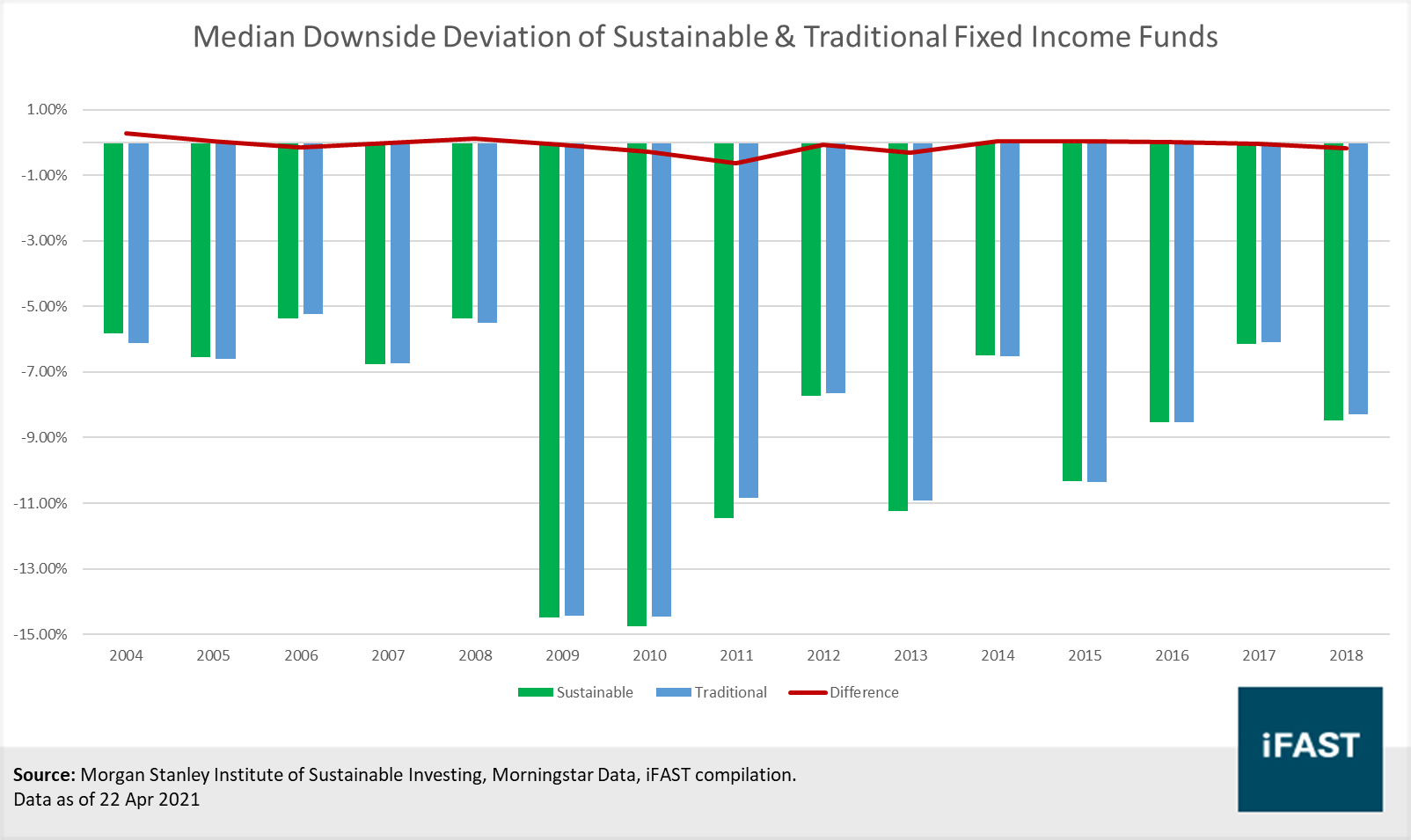
A quick glance under the hood reveals why that is the case. The ESG investment universe, particularly for fixed income, is still incredibly limited by the variety of offerings. In a report2 published by CAMRADATA, an analytics firm, fund managers highlighted a lack of variety in ESG fixed income products, specifically in duration. Combined with a stricter investment mandate, this could have likely affected the ability of fund managers to manage the fund’s duration effectively, leading to poorer performance during periods of rising yields. This is also a concern given the current economic climate in the US, with rising yields looming as economic recovery and inflation picks up steam.
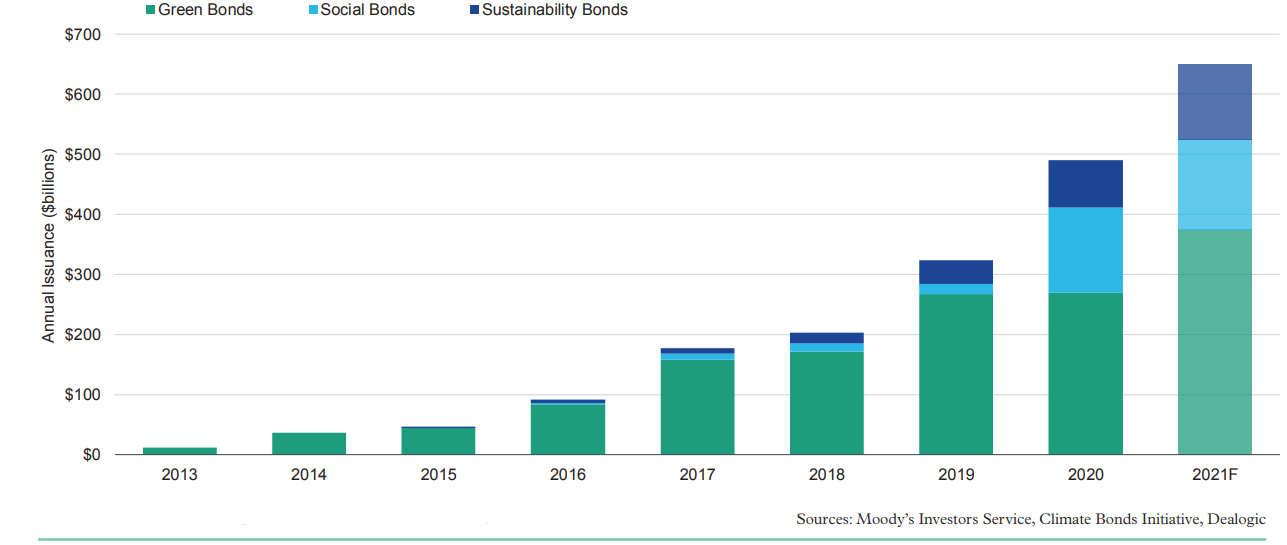
However, there are positive developments in this space that should help to ease some of the aforementioned headwinds. ESG bonds had a record issuance in 2020, fuelled by the increase in social bonds issued to combat the fallout caused by the pandemic. Social bonds finance projects that aim to address or mitigate specific social issues or achieve positive social outcomes. In 2020, the European Commission increased their social bond issuance to record levels to address pandemic related issues, mainly to support employment generation and increase provision of healthcare equipment.
ESG bonds issuance is projected to grow another ~30% in 2021, driven by the prevailing pandemic situation and the pickup in climate change initiatives. This should help increase the investment universe available for fund managers, potentially alleviating some concerns about offering variety.
Chart 3: ESG Bond Issuance set to hit 650 billion in 2021
Source: Sustainable Bonds Insight 2021 - Environmental Finance, 2021
Fundamentally, ESG investing in fixed income makes plenty of sense. Governance is already a core aspect of fixed income analysis, and incorporating additional qualitative factors into credit analysis is beneficial. Furthermore, with global policy heading towards greater emphasis on ESG, they should continue to serve as guiding lights and provide a supportive global environment for more ESG assets.
However, in the present, rather than having a full ESG fixed income portfolio, we believe the optimal approach is to incorporate some ESG positive funds to supplement your current existing portfolio. We highlight some of these funds below, as well as compare their performance to that of our recommended funds.
Asia Bonds: Eastspring Investments – Asia Sustainable Bond Fund
For Asian bonds, we take a look at the Eastspring Investments - Asia Sustainable Bond A USD. The fund uses a top-down approach to identify opportunities in the Asian fixed income space, before applying an ESG overlay to determine which company to invest in. The ESG overlay is a two-part process - consisting of identifying key ESG issues and then determining whether a company is prepared to deal with them, which is used to determine if a company faces excessive ESG risk. The fund also invests in green bonds, with about 20% of its portfolio invested. However, portfolio yield targets, bond ratings and diversification remains the overriding priority for the fund, and the ESG analysis should be viewed as a complementary to these factors.
The fund has done quite well since its inception, and has outperformed both of the recommended funds on our platform. It has remained resilient despite the looming spectre of inflation and potential rate hikes ahead, likely due to its short duration and increased High Yield allocation vs its peers. Furthermore, perhaps due to its ESG overlay, the risk metrics look better than its peers despite its allocation to High Yield.
Chart 4:
Eastspring Asia Sustainable Bond Funds vs Recommended Funds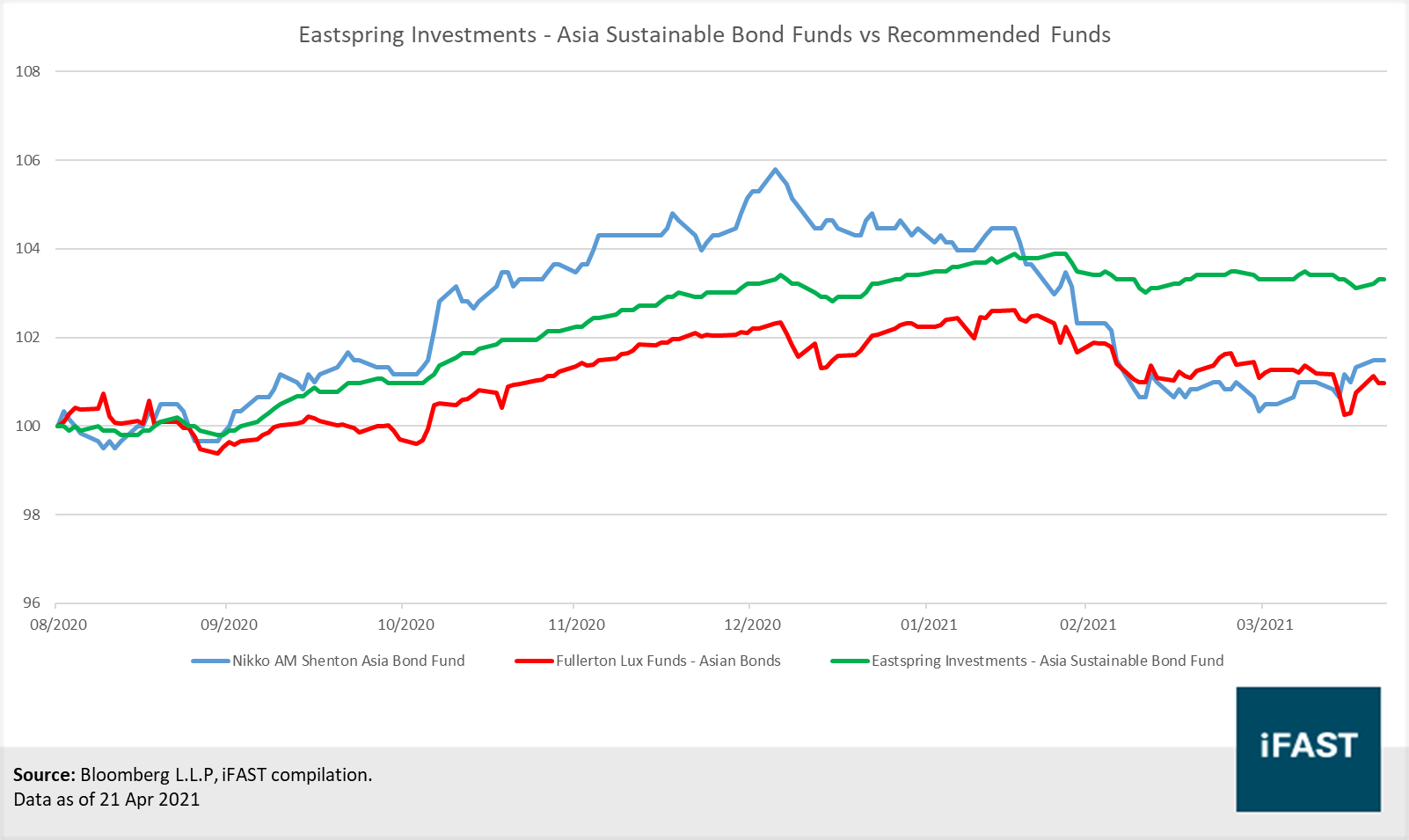
| Fund | 1Y Max Drawdown | 1Y Downside Vol |
| Eastspring Investments - Asia Sustainable Bond | -0.8% | 0.5% |
| Fullerton Lux Funds - Asian Bonds | -2.3% | 1.6% |
| Nikko AM Shenton Asia Bond Fund | -5.3% | 1.9% |
Despite the fund’s short history, the fund remains an attractive proposition, especially in a geographical segment that is still in the nascent stages of integrating ESG into fixed income investing.
Singapore Bonds: Pinebridge Singapore Bond Fund
Similarly to the aforementioned Eastspring Asia Sustainable Bond Fund, the PineBridge Singapore Bond Fund SGD incorporates ESG to complement traditional investment and credit selection processes despite not having ESG in its name. However, this fund strictly invests only in investment grade fixed income, and mainly focuses on capital preservation.
While the fund has slightly underperformed our recommended fund, it also has slightly better risk management characteristics, perhaps due to its ESG-centric investment processes.
Chart 5: Pinebridge Singapore Bond Fund vs Recommended Fund
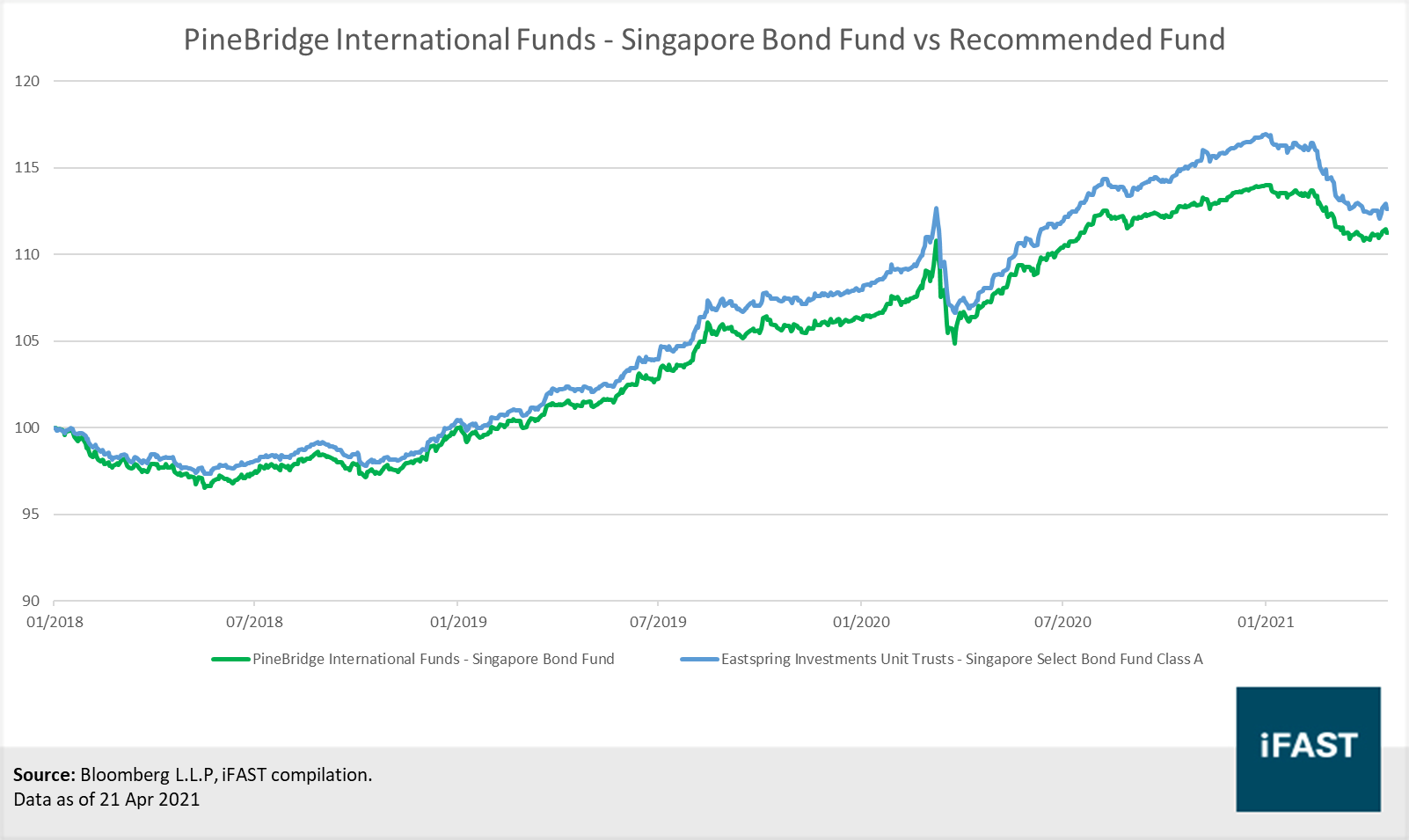
| Fund | 3Y Max Drawdown | 3Y Downside Vol |
| PineBridge International Funds - Singapore Bond Fund | -9.5% | 2.9% |
| Eastspring Investments Unit Trusts - Singapore Select Bond Fund | -9.8% | 2.8% |
Generally, the fund exhibits very
similar risk-return characteristics to its peer, and is certainly a viable
choice for investors seeking to increase the ESG focus of their portfolio.
Global Bonds: Fidelity Sustainable Strategic Bond Fund
For investors who prefer to invest in global bonds, the Fidelity Sustainable Strategic Bond A-ACC-USD stands out. Similar to the PineBridge Singapore Bond Fund, it focuses primarily on investment grade bonds, making it a good choice as part of a well balanced portfolio.
On a 3Y basis, the fund has a very similar return to another Fidelity fund, the Fidelity Global Bond A-USD. On the other hand, it has outperformed the other recommended fund, the Blackrock Fixed Income Global Opportunities A5 SGD-H, quite significantly, due to its significantly better performance during the pandemic selloff in March 2020.
Compared to the Fidelity Global Bond A-USD, the fund has remained resilient in the recent spike in the 10Y Treasury Yields, while the former registered a ~5% drop. This is due to Fidelity Sustainable Strategic Bond A-ACC-USD’s shorter duration profile, suggesting that there are increasingly more options when it comes to selecting ESG bond funds with shorter duration exposures that were previously unavailable.
Chart 6: Fidelity Sustainable Strategic Bond Fund vs Recommended Funds
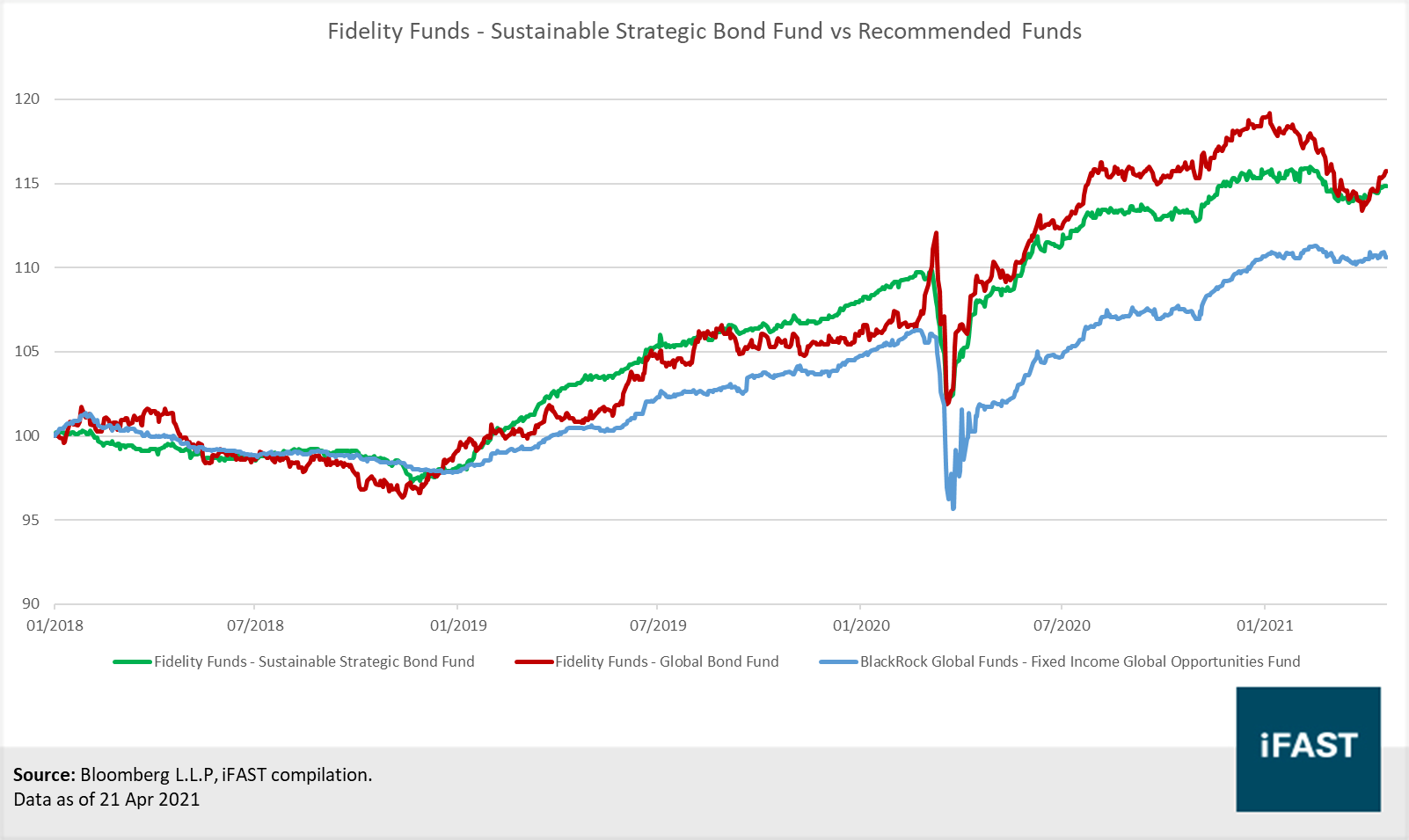
| Fund | 3Y Max Drawdown | 3Y Downside Vol |
| Fidelity Sustainable Strategic Bond Fund | -7.5% | 1.6% |
| Fidelity Global Bond Fund | -9.1% | 2.5% |
| Blackrock Fixed Income Global Opportunities Fund | -15.6% | 3.6% |
With similar returns and excellent risk management, the Fidelity Sustainable Strategic Bond Fund is definitely a viable choice as an ESG focused, quality focused fixed income fund.
Closing thoughts
Despite its recent growth, the ESG fixed income space still lags its equity counterpart in terms of size and importance. However, we have noticed the green shoots of change sprouting up, with further ESG bond issuance globally, as well as new funds to invest in these assets. We opted not to cover the Manulife Global Fund - Sustainable Asia Bond AA (G) MDIST USD and the JPMorgan Funds - Global Bond Opportunities A (acc) USD this time due to their short history, but they could be worth keeping an eye on moving forward.
In our next article, we will look to cover some ESG equity funds compare their performance against our recommended funds.
Footnotes:
All materials and contents found in this site are strictly for general circulation and informational purposes only and should not be considered as an offer, or solicitation, to deal in any of the funds or products found/identified in this site. While iFAST Financial Pte Ltd ("IFPL") has tried to provide accurate and timely information, there may be inadvertent delays, omissions, technical or factual inaccuracies and typographical errors. Any opinion or estimate contained in this report is made on a general basis and neither IFPL nor any of its servants or agents have given any consideration to nor have they or any of them made any investigation of the investment objective, financial situation or particular need of any user or reader, any specific person or group of persons. You should consider carefully if the products you are going to purchase are suitable for your investment objective, investment experience, risk tolerance and other personal circumstances. If you are uncertain about the suitability of the investment product, please seek advice from a financial adviser, before making a decision to purchase the investment product. Past performance is not indicative of future performance. The value of the investment products and the income from them may fall as well as rise. Opinions expressed herein are subject to change without notice. In respect of any matters arising from, or in connection with the said research analyses or research reports, recipients of the report are to contact IFPL at 10 Collyer Quay, #26-01 Ocean Financial Centre Building, Singapore 049315, or by telephone at +65 6557 2853. Where the report contains research analyses or research reports from a foreign research house and if the recipient of such research analyses or research reports is not an accredited investor, expert investor, institutional investor or an ex-accredited investor, IFPL accepts legal responsibility for the contents of such analyses or reports to such persons only to the extent as required by law. Please note that only certain security(ies) herein are available to all investors, while the rest are only available for certain persons to invest in, such as Accredited Investors (as defined in the Securities and Futures Act) or one who invests at least S$200,000 (or its equivalent currency) per transaction. To qualify as an Accredited Investor, one needs to submit a declaration form and certain relevant supporting documents, according to iFAST’s prevailing policies and procedures.
Please read our full disclaimers on the website at ( https://secure.fundsupermart.com/fsmone/policies/328125/investment-account-terms-&-conditions).
iFAST Financial Pte Ltd (IFPL) (registered address: 10 Collyer Quay #26-01 Ocean Financial Centre Singapore 049315, Telephone: 6557 2000) holds the Financial Advisers Licence issued by the Monetary Authority of Singapore ('MAS') to conduct regulated activities of advising on securities, marketing of collective investment schemes and arranging of any contract of insurance in respect of life policies, other than a contract of reinsurance and the Capital Markets Services Licence issued by the MAS to conduct regulated activities of dealing in securities and providing custodial services for securities. While IFPL has made every effort to ensure the independence of the report's contents, IFPL's nature of business is such that IFPL and its connected and associated entities together with their respective directors, officers and staff may be involved in providing dealing or investment-related services in the abovementioned securities, and have taken or may take positions in the securities mentioned in this report, and may also act as the principal for any buy or sell trades.