Earnings recovery and new re-rating catalysts to boost share prices of China’s Big Four banks

While China’s Big Four banks continue to trade at much lower valuations compared to their international peers, we see several potential re-rating catalysts that will support the share prices and earnings of the Big Four banks.

  • |
  • Published on 18 Mar 2021

Earnings recovery and new re-rating catalysts to boost share prices of China’s Big Four banks | Open a FREE FSMOne account and manage all your investments conveniently in ONE place
Photo by Eric on Unsplash

Looking ahead in 2021, we continue to favour the Big Four banks for their strong position in the industry and cheap valuations. Double-digit loan growth rates and easing loan loss provisions will help to support their earnings growth this year.

The Big Four banks have consistently traded at a much lower valuation as compared to their international peers, due to reasons such as a lack of research coverage, a lack of market transparency in China, as well as a lack of diversified revenue streams.

As China opens up its financial market, this could drive a potential re-rating of the Big Four banks’ shares.

China’s Big Four banks continue to offer attractive upside potential of more than 60% on average while offering investors an annual dividend yield of more than 6% in the next two years.

Investors who wish to have a more diversified approach may consider the BMO Hong Kong Banks ETF (HKEX:3143), which has an exposure of almost 45% to the Big Four banks. Another alternative would be the Global X MSCI China Financials ETF (NYSE:CHIX), which allows you to ride the long-term growth of China’s financials sector.

While China’s economy has largely rebounded from COVID-19, the financial impact on China’s banking sector has lingered throughout 2020. For FY2020, the Big Four Chinese banks are expected to register about a 10% fall in their net profits, largely due to a rise in loan loss provisions. 

However, as China stays on track to become the world’s largest economy, we see numerous catalysts that will support the Big Four banks’ share prices and earnings. We continue to favour the Big Four banks for their strong position in the industry and cheap valuations. Therefore, investors should take this opportunity to scoop up some of their shares before it’s too late. 


Easing loan loss provisions to drive earnings recovery in 2021


Looking ahead to 2021, we are expecting an earnings recovery across the Big Four banks. As mentioned earlier, pressure from bad loans will drag on the banks’ FY2020 earnings given that they had to set aside a huge amount of reserves for possible loan losses arising from the pandemic. 

However, we believe that non-performing loans are generally under control. We observed that their loan loss provisions have slightly tapered off in 3Q20, which is in line with most global banks which have front-loaded their credit reserves in the first half of 2020.

Therefore, as their loan loss provisions return to normal levels in the next two years, this will help to support the banks’ overall earnings. 

Chart 1: Easing loan loss provisions


Double-digit loan growth to support net interest income


Meanwhile, we also expect loan growth to help support the banks’ net interest income, while net interest margins are expected to remain flat. 

PBOC has kept its Loan Prime Rate (LPR) steady for the ninth straight month and we are expecting minimal movements in this benchmark interest rate in 2021 given how the PBOC has recently mentioned that “current interest rate levels are appropriate”. Therefore, we are probably not going to see any meaningful movements in the net interest margins (NIM) of the banks.

However, we believe that the loan growth would be a factor that will help offset the impact of a flattish NIM, providing support to the banks’ net interest income. As of 3Q20, the Big Four banks expanded their loan books by 10% year-on-year. Given how loan growth is usually a function of GDP, we are expecting double-digit loan growth rates across these four banks in the next two years (Chart 2). 

Chart 2: Double-digit loan growth across the Big Four banks


New re-rating catalysts for the Big Four banks


From a longer-term perspective, we also believe that possible new re-rating catalysts might be underway for the China Big Four banks.

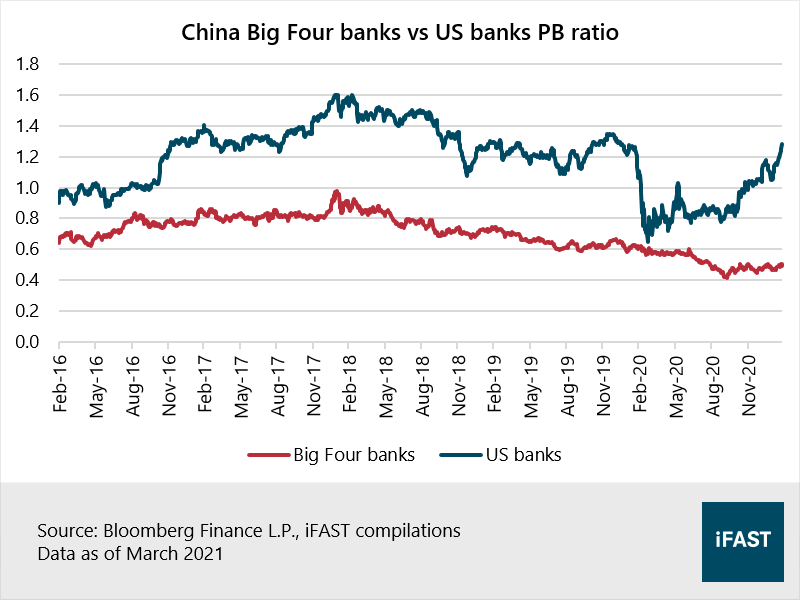
Over the last five years, the Big Four banks have consistently traded at a much lower valuation as compared to their international peers due to a couple of reasons, such as a lack of research coverage, a lack of market transparency in China, as well as a lack of diversified revenue streams (Chart 3). However, as China commits to open up its financial market, we believe this valuation gap should start to narrow.

Chart 3: China Big Four banks valuations have consistently been lower than its US peers

For more than two decades, investment banking services and other securities services in China were off-limits to most commercial banks. This was put in place by the 1995 Commercial Bank Law, which was implemented as the government wanted to minimise the risk across different parts of the financial system.

However, to better prepare its domestic firms to compete against foreign banks as China opens up its financial markets, Chinese regulators are planning to start a trial to break down this wall separating the banks and the securities firms. Caixin reported that Chinese regulators may grant at least two securities license to the large commercial banks, with ICBC (HKEX:1398) and China Construction Bank (HKEX:939) likely to be the two banks that will kick-start this trial.  

Besides, securities firms in China pale in comparison to their foreign rivals by most measures, be it their total assets or revenue (Table 1). This is likely one of the reasons why Chinese regulators are starting to allow the banks to offer securities services since they are the only ones who can compete with their foreign rivals on the same level. 

Table 1: Top four securities firm in China vs. potential top four foreign rivals
China top four securities firm Top four foreign rivals
Combined revenue 22,941 151,493
Combined assets 488,404 4,155,061
Source: Bloomberg Finance L.P., iFAST compilations
China top four securities firms: CITIC, Guotai Junan, Haitong and Huatai
Top four foreign rivals: Goldman Sachs, UBS, Morgan Stanley, Credit Suisse
Data as of 3Q20 reports and FY2020 reports; in USD millions

When such reform is pushed through, we expect a rerating in the Big Four banks’ share prices. Not only will their business model become more diversified thanks to the additional revenue streams, but the opening up of China’s financial market will also improve market transparency, attracting more investors who were previously uncomfortable with this issue. 

60% upside expected from the Chinese banks 


As per previous articles, our valuation methodology is built on a fair PB ratio derived from the Gordon Growth Model. 

Table 2: Big Four banks' valuations
PB ratio Target price (HKD) Current price (HKD) Upside Potential Average dividend yield*
Industrial and Commercial Bank of China (HKEX:1398) 0.95X 8.9 5.5 60.1% 5.9%
China Construction Bank (HKEX:939) 0.9X 9.7 6.6 47.7% 5.7%
Bank Of China (HKEX:3988) 0.8X 4.8 2.9 65.5% 6.3%
Agricultural Bank Of China (HKEX:1288) 0.8X 5.7 3.2 76.0% 7.1%
Average: 62.3% 6.2%
Source: Bloomberg Finance L.P., iFAST estimations
*Average dividend yield refers to the average of 2021E and 2022E dividend yield
Data as of March 2021


Based on our fair PB ratio, the China Big Four banks are offering very attractive upside potential of more than 60% on average. At the same time, they are also very attractive yield-plays for income-seeking investors given their average annual dividend yield of more than 6%.

Investors should know that despite the fall in profits for FY2020, the Big Four banks continued to maintain healthy capital levels as of 3Q20. They will be announcing their annual dividends by mid-March but based on our estimated dividend payout ratio, dividends paid will only affect the banks’ CET1 capital base by approximately 40bps on average. 

Based on their current capital levels, they have more than sufficient buffer to continue their payouts (Table 3).

Table 3: Attractive dividends and healthy capital ratios 
CET1 Ratio Minimum CET1 ratio 2020 dividend yield*
Industrial and Commercial Bank of China (HKEX:1398) 12.8% 9.0% 4.5%
China Construction Bank (HKEX:939) 13.2% 9.0% 4.3%
Bank Of China (HKEX:3988) 10.9% 9.0% 5.9%
Agricultural Bank Of China (HKEX:1288) 10.9% 8.5% 5.5%
Source: Respective companies' 3Q20 reports
*2020 dividend yield is calculated assuming payout ratio will fall by 10%
Data as of March 2021

Overall, while it may take years for China to fully open up its market, we believe investors who like the long-term growth story of China should consider scooping up some of their shares while valuations are still cheap. 

Investors who wish to have a more diversified approach may consider the BMO Hong Kong Banks ETF (HKEX:3143) which has an exposure of almost 45% to the Big Four banks. Another alternative would be the Global X MSCI China Financials ETF (NYSE:CHIX), which will allow you to ride the long-term trend of China’s financials sector. This ETF includes not just the Big Four banks (26.7%), but also other banks and financial institutions from different industries such as the insurance companies and the diversified financials. 

Join our FSMOne Research Telegram channel today and stay up to date with our latest investment ideas!

Declaration:

For specific disclosure, at the time of publication of this report, IFPL (via its connected and associated entities) and the analyst who produced this report hold a NIL position in the abovementioned securities.

All materials and contents found in this site are strictly for general circulation and informational purposes only and should not be considered as an offer, or solicitation, to deal in any of the funds or products found/identified in this site. While iFAST Financial Pte Ltd ("IFPL") has tried to provide accurate and timely information, there may be inadvertent delays, omissions, technical or factual inaccuracies and typographical errors. Any opinion or estimate contained in this report is made on a general basis and neither IFPL nor any of its servants or agents have given any consideration to nor have they or any of them made any investigation of the investment objective, financial situation or particular need of any user or reader, any specific person or group of persons. You should consider carefully if the products you are going to purchase are suitable for your investment objective, investment experience, risk tolerance and other personal circumstances. If you are uncertain about the suitability of the investment product, please seek advice from a financial adviser, before making a decision to purchase the investment product. Past performance is not indicative of future performance. The value of the investment products and the income from them may fall as well as rise. Opinions expressed herein are subject to change without notice. In respect of any matters arising from, or in connection with the said research analyses or research reports, recipients of the report are to contact IFPL at 10 Collyer Quay, #26-01 Ocean Financial Centre Building, Singapore 049315, or by telephone at +65 6557 2853. Where the report contains research analyses or research reports from a foreign research house and if the recipient of such research analyses or research reports is not an accredited investor, expert investor, institutional investor or an ex-accredited investor, IFPL accepts legal responsibility for the contents of such analyses or reports to such persons only to the extent as required by law. Please note that only certain security(ies) herein are available to all investors, while the rest are only available for certain persons to invest in, such as Accredited Investors (as defined in the Securities and Futures Act) or one who invests at least S$200,000 (or its equivalent currency) per transaction. To qualify as an Accredited Investor, one needs to submit a declaration form and certain relevant supporting documents, according to iFAST’s prevailing policies and procedures.

Please read our full disclaimers on the website at ( https://secure.fundsupermart.com/fsmone/policies/328125/investment-account-terms-&-conditions).

iFAST Financial Pte Ltd (IFPL) (registered address: 10 Collyer Quay #26-01 Ocean Financial Centre Singapore 049315, Telephone: 6557 2000) holds the Financial Advisers Licence issued by the Monetary Authority of Singapore ('MAS') to conduct regulated activities of advising on securities, marketing of collective investment schemes and arranging of any contract of insurance in respect of life policies, other than a contract of reinsurance and the Capital Markets Services Licence issued by the MAS to conduct regulated activities of dealing in securities and providing custodial services for securities. While IFPL has made every effort to ensure the independence of the report's contents, IFPL's nature of business is such that IFPL and its connected and associated entities together with their respective directors, officers and staff may be involved in providing dealing or investment-related services in the abovementioned securities, and have taken or may take positions in the securities mentioned in this report, and may also act as the principal for any buy or sell trades.

Ways to Invest with FSMOne
Why FSM
Don't have an account with us?
Open an account here
Need Financial Advice?
Make an appointment

We use cookies If you close this message or continue to use this site, you will consent to the use of Cookies, unless you choose to disable them. Click on our Privacy Policy to understand more.