Ping An Bank’s success in digital transformation to ignite future growth

When it comes to digitalisation, Ping An Bank (PAB) is probably one of the most aggressive banks in town. With its retail-oriented banking structure, technology capabilities, and strong support from its parent group, Ping An Insurance (HKEX:2318), we see great potential in Ping An Bank to grow in the next decade.

  • |
  • Published on 16 Feb 2021

Ping An Bank’s success in digital transformation to ignite future growth  | Open a FREE FSM account and manage all your investments conveniently in ONE place
Photo by Joshua on Unsplash

Ping An Bank (PAB), which has a more retail-oriented loan mix, will be one of the main beneficiaries as China continues its transition to a domestic-consumption driven economy.

The driver behind this fast growth is PAB’s technology capabilities, which have helped to improve its efficiency and cost-saving ability.

One of the biggest competitive advantages PAB has is the Ping An ecosystem. PAB is able to acquire corporate deposits more easily than its peers thanks to the support from its parent group – Ping An Insurance (HKEX:2318)

Leveraging on the Ping An ecosystem, PAB is also able to gain rapid access to new clients at lower acquisition costs, driving faster business growth and higher profitability for its retail business.

While you may certainly invest directly into PAB, investors who are convinced by the Ping An ecosystem strategy should consider investing in Ping An Insurance (HKEX:2318) to gain exposure to the entire ecosystem it has created.  

Using the sum-of-the-parts (SOTP) valuation methodology, we arrived at our 2022E target price of HKD131.0, which translates to an upside potential of more than 40%

Technology is becoming increasingly important to all forms of business and one key area is the banking industry. It has become a case of “you snooze you lose” in the current market, where banks that are slow at adopting new technologies are likely to be left behind. 

When it comes to digitalisation, Ping An Bank (PAB) is probably one of the most aggressive banks in town. It has made remarkable progress since it embarked on its digital transformation strategy in 2016 and has recently been named the World’s Best Digital Bank 2020 by Euromoney, the first Chinese institution to win this award. 

With its retail-oriented banking structure and strong support from its parent group, Ping An Insurance (HKEX:2318), we see great potential in Ping An Bank to grow in the next decade. 

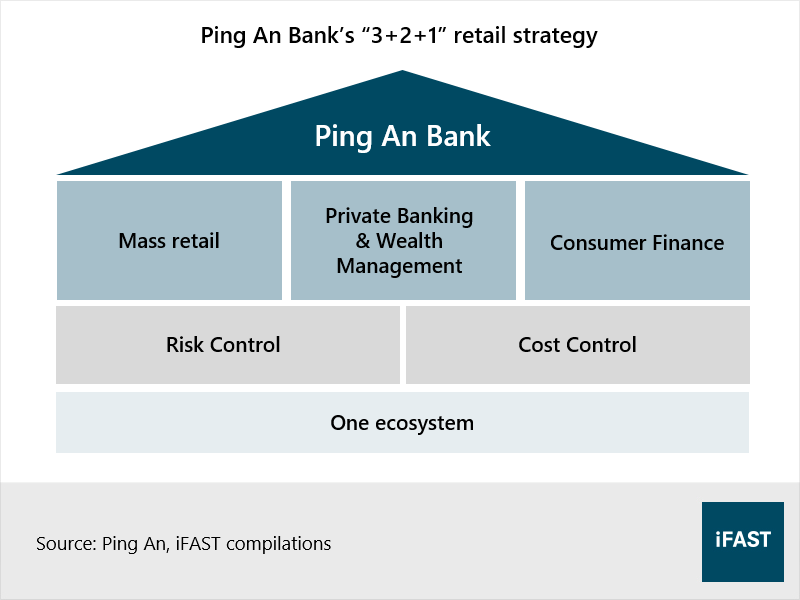
Ping An Bank’s “3+2+1” retail strategy

 
Over the last five years, PAB has put significant effort into developing its retail business, which focuses on three key business segments: consumer finance, retail services for the mass affluent, as well as private banking and wealth management for the high-net-worth individuals (HNWI). Part of the retail strategy includes improving its two core capabilities of ‘risk control’ and ‘cost control’, which ensures that the bank will grow healthily without taking on unnecessary risk and optimising its cost-to-income at the same time (Chart 1).

Chart 1: PAB’s “3+2+1” retail strategy
  
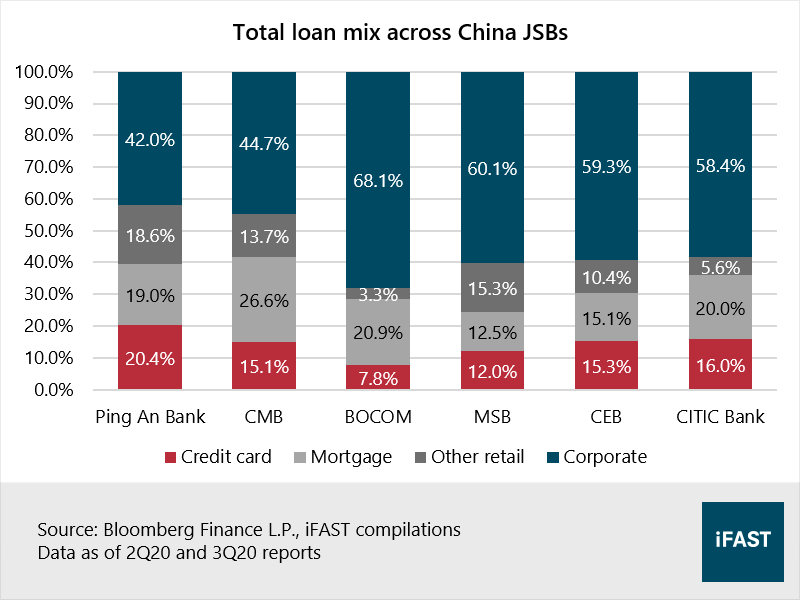
Consumer finance: Today, almost 60% of PAB’s total loans are extended to retail customers, as compared to a mere 36% five years ago. PAB also has the highest proportion of retail loans across its peers, and out of which, credit card loans took up the majority of its retail loan mix, followed by mortgage loans and other retail loans like automotive loans. (Chart 2).

Chart 2: PAB has a more retail-oriented loan mix compared to its peers
  
Given how credit card loans are usually a function of the consumption level in an economy, we believe there are significant opportunities within the retail banking space as China continue its transition to a domestic-consumption driven economy. 

Besides, we also found out that 75% of China’s population of age 18 or above did not own any credit cards as of the end of 2019. During the same period, it was also reported that the ratio of consumer credit balance to cash and deposits was only 14% in China, which pales in comparison to the 33% ratio in the United States. 

Meanwhile, we expect China’s property and auto demand to grow as China’s urbanisation rate continues to be on the rise. A house or car are big-ticket items and they usually require buyers to fund these purchases through bank loans.

Therefore, both trends suggest that there is huge untapped potential within the consumer credit space and going forward, we believe that the rising consumption expenditure and increasing willingness to use credit for consumption will drive the consumer finance segment. PAB, which has a more retail-oriented loan mix, will be one of the main beneficiaries to capitalise on this trend.   

Wealth management for mass retail and HNWIs: The disposable income and personal savings of the Chinese households have also been on the rise and these wealthy investors are constantly looking for more avenues to park and grow their assets. As of end 2019, it was reported by Oliver Wyman that 58% of the Chinese’s personal investable assets were invested in cash and deposits, as opposed to just 12% in the United States. 

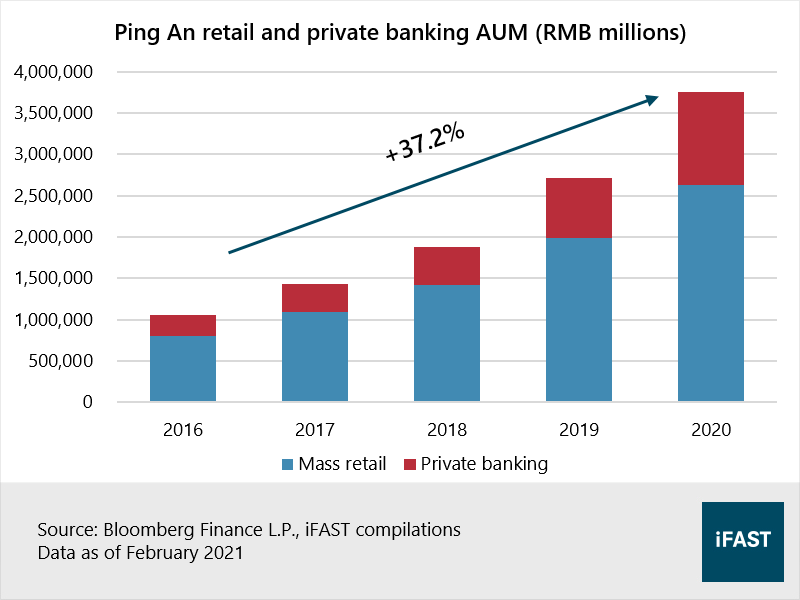
Both trends suggest that there is plenty of room for wealth management in China to grow in the years ahead. On top of that, PAB management even further guided for its private banking AUM to double in the next two years. Given PAB’s strong growth track record, we believe the growth in its wealth management segment will be a key earnings driver to PAB’s retail business (Chart 3). 

Chart 3: PAB’s strong growth track record (AUM)
 

PAB’s strong technology capabilities 


To quote PAB’s chairman, “Those who focus on technologies will be the winners”. PAB remarkable progress over the past five years has proven his words right, as the driver behind this fast growth was largely attributed to its technology capabilities. 

Leveraging on its parent group’s resources, PAB upgraded and digitalised itself using technologies such as artificial intelligence (AI), big data, cloud computing and biological recognition. It focused on strengthening its online capabilities over the past five years and therefore, while some of its peers are struggling to keep up with the new norm of safe distancing and remote working during the COVID-19 pandemic, PAB reported that this pandemic had a limited impact on its business since it already has the online tools which ensured minimal business interruptions. In fact, while most of the banks around the globe are likely to register double-digits negative growth in their FY2020 earnings, PAB has just reported a 2.6% year-on-year growth in its FY2020 earnings. 

By investing in technology capabilities, this also helped to improve PAB’s efficiency and its cost-saving ability. For instance, the usage of AI has reduced the amount of manual workload needed, enabling PAB to serve more customers with fewer employees and also within a shorter period of time. In 1H20, it was reported that AI accounted for about 90% of PAB’s customer services, helping the bank to serve 5X the number of customers per month as compared to 2019. During the same period, PAB also reported that nearly 90% of credit cards issued were approved and issued using AI. 

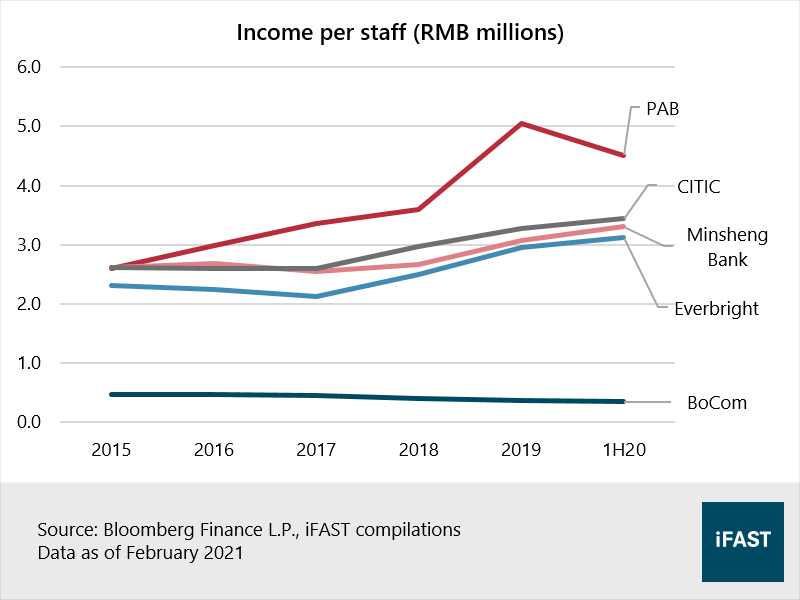
Evidently, the usage of such technologies has enabled PAB to scale its business at a faster pace. Revenue is no longer limited by its number of employees, thanks to the accelerated adoption of digital channels. As observed in Chart 4, not only does PAB have the highest income per staff, it is also increasing at a faster pace than its peers. PAB’s new scalable platform has also helped to lower PAB’s overall cost structure, with its cost-to-income ratio falling from 31.3% in 2015 to 27.5% in 3Q20. 

Chart 4: PAB has the highest and fastest growth rate when it comes to income per staff
 

Leveraging on the Ping An ecosystem


In a world of ecosystems, PAB’s parent group, Ping An Insurance (HKEX:2318), is without a doubt one of the most successful companies to implement an ecosystem strategy. Not only does it create value for Ping An Insurance’s customers, but this ecosystem strategy also generates synergy for its subsidiaries across the Group. 

In the case of PAB, it benefits from the ecosystem strategy through cooperation with its parent group, with Ping An Insurance helping to channel corporate deposits to PAB, while PAB focuses on its retail banking business. Given how the cost of corporate deposits are generally lower than retail deposits, and how retail loans have higher yields than corporate loans, this has helped to provide a level of support for PAB’s net interest margin in today’s low-interest-rate environment. 

Cross-selling is also another way PAB can benefit from the Ping An ecosystem. We know that Ping An Insurance’s strategy is all about developing a relationship with its customers first, and subsequently cross-selling its main financial products to them. Therefore, through Ping An’s Internet businesses, such as Autohome and Haofang, both of which are online platforms that focus on automobiles and real estate respectively, Ping An Insurance can channel these customers to take on auto and mortgage loans with PAB. 

This will help PAB to gain rapid access to new clients at lower acquisition costs, driving faster business growth and higher profitability for its retail business.

How to participate in the growth of PAB 


Looking ahead, we see tremendous growth potential within the Chinese banking space and we believe PAB will emerge as one of the biggest winners. While you may certainly invest directly into PAB, investors who love the Ping An ecosystem strategy should consider investing in Ping An Insurance (HKEX:2318), to gain exposure to the entire ecosystem it has created.  

Table 1: Valuations of Ping An Insurance
Business segment Shareholding Valuation Valuation methodology Multiple Weighted valuation
Life & Health 99.5% 380,795 P/B 3.0 1,142,384
P&C 99.5% 117,582 P/B 2.0 232,363
Banking 58.0% 462,249 Market cap 1.0 267,919
Fintech & Health-tech Disclosed 260,812 Disclosed Valuation - 260,812
Securities 97% 32,463 Peers P/B 2.0 64,926
Trust 100% 4,000 Peers P/E 15.0 60,000
Others 100% 45,380 Book value 1.0 45,380
Total 2,073,785
# of shares 18,280
End 2022 target price (RMB) 113.4
End 2022 target price (HKD) 131.0
Current share price (HKD) 90.5
Upside potential 44.7%
Source: Bloomberg Finance L.P., Ping An annual reports, iFAST estimations
Data as of February 2021

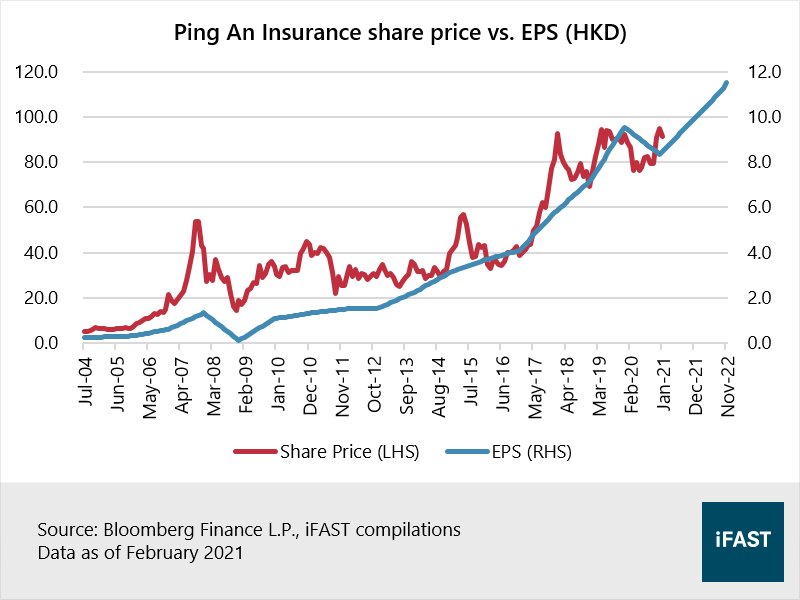
Using the sum-of-the-parts (SOTP) valuation methodology, we arrived at our 2022E target price of HKD 131.0. Due to the recent pullback in Ping An Insurance’s share price, our target price translates to an upside potential of more than 40%. 


Ping An Insurance remains a fast-growing stock that investors should consider, especially as it continues to monetise its ecosystem through cross-selling in the coming years. 

Chart 5: Ping An share price vs. EPS


Join our FSMOne Research Telegram channel today and stay up to date with our latest investment ideas!

Declaration:

For specific disclosure, at the time of publication of this report, IFPL (via its connected and associated entities) hold a NIL position in the abovementioned securities. The analyst who produced this report has a position in Ping An Insurance.

All materials and contents found in this site are strictly for general circulation and informational purposes only and should not be considered as an offer, or solicitation, to deal in any of the funds or products found/identified in this site. While iFAST Financial Pte Ltd ("IFPL") has tried to provide accurate and timely information, there may be inadvertent delays, omissions, technical or factual inaccuracies and typographical errors. Any opinion or estimate contained in this report is made on a general basis and neither IFPL nor any of its servants or agents have given any consideration to nor have they or any of them made any investigation of the investment objective, financial situation or particular need of any user or reader, any specific person or group of persons. You should consider carefully if the products you are going to purchase are suitable for your investment objective, investment experience, risk tolerance and other personal circumstances. If you are uncertain about the suitability of the investment product, please seek advice from a financial adviser, before making a decision to purchase the investment product. Past performance is not indicative of future performance. The value of the investment products and the income from them may fall as well as rise. Opinions expressed herein are subject to change without notice. In respect of any matters arising from, or in connection with the said research analyses or research reports, recipients of the report are to contact IFPL at 10 Collyer Quay, #26-01 Ocean Financial Centre Building, Singapore 049315, or by telephone at +65 6557 2853. Where the report contains research analyses or research reports from a foreign research house and if the recipient of such research analyses or research reports is not an accredited investor, expert investor, institutional investor or an ex-accredited investor, IFPL accepts legal responsibility for the contents of such analyses or reports to such persons only to the extent as required by law. Please note that only certain security(ies) herein are available to all investors, while the rest are only available for certain persons to invest in, such as Accredited Investors (as defined in the Securities and Futures Act) or one who invests at least S$200,000 (or its equivalent currency) per transaction. To qualify as an Accredited Investor, one needs to submit a declaration form and certain relevant supporting documents, according to iFAST’s prevailing policies and procedures.

Please read our full disclaimers on the website at ( https://secure.fundsupermart.com/fsmone/policies/328125/investment-account-terms-&-conditions).

iFAST Financial Pte Ltd (IFPL) (registered address: 10 Collyer Quay #26-01 Ocean Financial Centre Singapore 049315, Telephone: 6557 2000) holds the Financial Advisers Licence issued by the Monetary Authority of Singapore ('MAS') to conduct regulated activities of advising on securities, marketing of collective investment schemes and arranging of any contract of insurance in respect of life policies, other than a contract of reinsurance and the Capital Markets Services Licence issued by the MAS to conduct regulated activities of dealing in securities and providing custodial services for securities. While IFPL has made every effort to ensure the independence of the report's contents, IFPL's nature of business is such that IFPL and its connected and associated entities together with their respective directors, officers and staff may be involved in providing dealing or investment-related services in the abovementioned securities, and have taken or may take positions in the securities mentioned in this report, and may also act as the principal for any buy or sell trades.

Ways to Invest with FSM Global
Why FSM Global
Don't have an account with us?
Open an account here
Need Financial Advice?
Make an appointment

We use cookies If you close this message or continue to use this site, you will consent to the use of Cookies, unless you choose to disable them. Click on our Privacy Policy to understand more.