


- Amidst the grim outlook faced by the global tourism industry, China has been a rare bright spot. With a resurgence in COVID-19 cases across the world, Chinese tourists have been opting for domestic destinations, fuelling a rebound in the country’s tourism industry.
- The COVID-19 pandemic has wreaked havoc on the profitability of Trip.com. While the company recorded a loss in 2Q 2020, the results were much better than expected.
- Trip.com derives its revenue mainly from China’s domestic travel market. The rebound in China’s domestic travel market, therefore, is a huge positive for Trip.com. A pricing recovery could be a major catalyst for Trip.com’s domestic business.
- While international travel could take longer to recover, there are reasons to remain optimistic, with the deployment of cheaper, faster large-scale COVID-19 testing methods, and establishment of travel bubbles potentially allowing international travel to resume.
- We upgrade our target price for Trip.com to USD 37, based on a 25X fair PE multiple to our revised FY2021 estimated earnings per share of USD 1.48. This represents an attractive upside potential of close to 22%.
Airplanes grounded. Borders closed. Hotels shuttered.
From empty airports to deserted hotels, the COVID-19 pandemic has dealt an unprecedented blow to global tourism. According to estimates released by the World Travel and Tourism Council (WTTC), nearly 200 million jobs in the travel industry could be lost worldwide due to the COVID-19 pandemic. In addition, up to USD 5.5 trillion could be shaved from global gross domestic product (GDP) this year – that’s about the size of Japan’s economy.
Amidst the grim outlook faced by the global tourism industry, China has been a rare bright spot. With a resurgence in COVID-19 cases across the world, travel restrictions, and quarantine requirements making international travel all but impossible, Chinese tourists have been opting for domestic destinations, fuelling a rebound in the country’s tourism industry.
Against this backdrop, we continue to like Trip.com (NASDAQ:TCOM). We believe the company will not only benefit from the recent rebound in China’s domestic travel market, but also from the exciting long-term growth potential of China’s tourism industry.
(Related article: As China's travel industry gets back on its feet from COVID-19, Trip.com will be a major beneficiary)
Recorded a quarterly loss but results were better-than-expected
The COVID-19 pandemic has wreaked havoc on the profitability of Trip.com, as evident from its 2Q 2020 earnings report, with revenue plummeting -64% year-on-year. None of its four major business segments were spared. Its packaged tours segment, which made up 12.7% of Trip.com’s 2019 full-year revenue, was the hardest-hit, with revenue for the segment plunging -88% year-on-year.
Unsurprisingly, net loss attributable to Trip.com’s shareholders was USD 67 million in 2Q 2020. It is worth noting, however, that Trip.com’s 2Q 2020 results were much better than market expectations. Trip.com reported losses per share of USD 0.11 on revenue of USD 448 million, while Wall Street was bracing for losses per share of USD 0.53 on revenue of USD 344 million.
To add on, Trip.com’s second quarter was also better than its international competitors, Booking Holdings (NASDAQ:BKNG) and Expedia Group (NASDAQ:EXPE), in most respects. While Trip.com’s 2Q 2020 revenue dipped -64% year-on-year, the revenues of Booking and Expedia fell by much larger magnitudes of -84% and -82% respectively. Expedia’s net losses stood at USD 753 million for the quarter, and while Booking recorded a profit, it was mainly due to a one-time gain in stock investments of USD 835 million, the absence of which would have resulted in a net loss.
Due to the continued fall-out from the pandemic, Trip.com has guided for its 3Q 2020 revenue to decline by 47-52% year-on-year. That said, the management struck an optimistic tone on the company’s outlook. Its domestic business remains “well on track towards full recovery”, with several product lines in China, including accommodation and air ticketing, already returning to pre-COVID levels. While pricing remains significantly depressed compared to the same period last year, the decline has been moderating on a monthly sequential basis.
Significant rebound in China’s domestic travel market
If you need evidence that China’s travel market has been recovering, look no further than this year’s Golden Week holiday: some 637 million people travelled within China during the eight-day holiday, generating RMB 466.56 billion in tourism revenue. While it is still less than the 782 million tourists who travelled during Golden Week last year, the resurgence in travel is in stark contrast to the rest of the world, where countries continue to grapple with rising infection rates.
Since the first outbreak of COVID-19 in Wuhan, China’s travel industry has been recovering progressively, driven by a substantial pick-up in domestic travel demand. As the government eased restrictions on movement following the swift containment of the pandemic, including the reopening of cross-province group tourism, China’s air passenger traffic has been recovering rapidly.
Based on statistics released by the Civil Aviation Administration of China (CAAC), China’s total air passenger traffic stood at 46 million in August 2020 – that’s about 85% of levels seen at the same time last year – with domestic flights leading the recovery (Figure 1). International traffic, however, remains suppressed as ongoing travel restrictions have greatly limited demand.
Figure 1: China domestic passenger volume has been recovering strongly
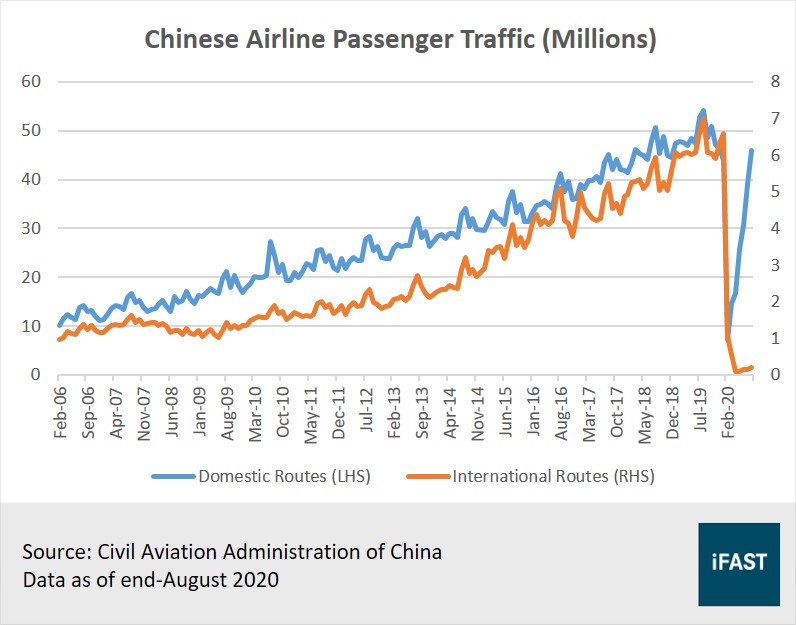
While Trip.com has exposure to the international travel market, its revenue is derived mainly from China’s domestic travel market, which makes up about 75% of its revenue. The rebound in China’s domestic travel market, therefore, is a huge positive for Trip.com. While pricing remains significantly depressed due to merchants offering deep discounts to stimulate demand, we believe pricing could recover amidst the pick-up in consumer confidence and travel demand, and that could be a major catalyst for Trip.com’s domestic business.
Eventual resumption of international travel bodes well for Trip.com
China’s travel industry recovery ends at its borders, with demand for outbound international travel remaining largely subdued as the pandemic continues its spread outside of China. Consumers continue to prefer travelling on domestic route as developments in international travel remain uncertain.
The International Air Transport Association (IATA) noted in a recent press release that air passenger traffic will not return to pre-COVID levels until 2024, a year later than what was previously projected, as demand for international travel remains virtually non-existent.
While international travel could take longer to recover, there are reasons to remain optimistic.
As evident in Figure 2, demand for international travel has already bottomed out, and while the strength of the recovery has been weaker-than-expected, demand has been heading on an upward trajectory. In August 2020, industry-wide international revenue passenger-kilometres (RPK) was down by an eye-popping -88.3% year-on-year, but the decline has been easing since April 2020.
Figure 2: International travel remains far from pre-COVID levels but has been recovering
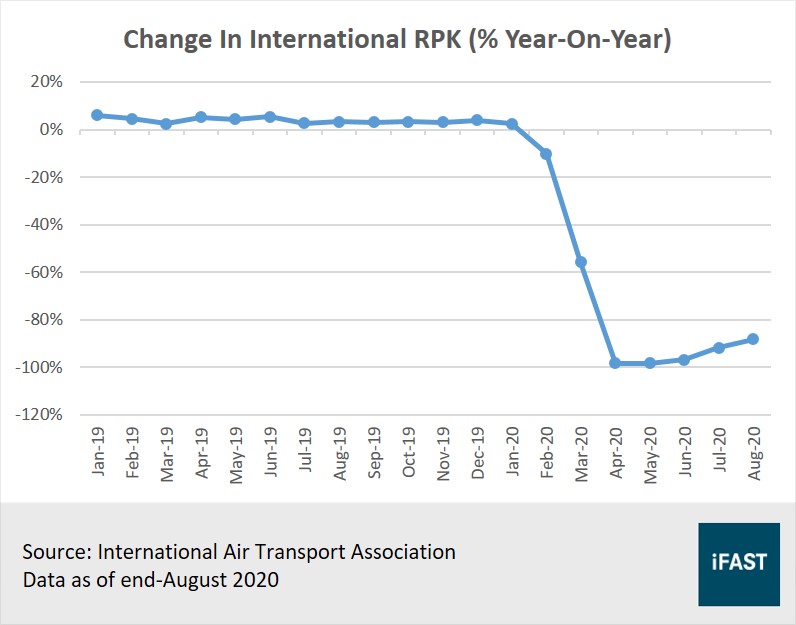
A lack of fast, inexpensive, and convenient testing methods, as well as compulsory quarantines have so far been the main factors hindering the recovery of international volumes.
But that could change in the near-future.
The current gold-standard for COVID-19 testing is based on a technique called the polymerase chain reaction (PCR). While highly accurate, PCR tests can be costly, and takes up to a few days to deliver a result. Researchers across the globe have been developing new rapid-testing techniques, some of which have been deployed in certain countries, as alternatives to PCR, enabling large-scale, rapid testing that will eventually allow international travel to resume.
The establishment of travel bubbles is also a positive development for international travel, as travellers under the bubble are not subject to quarantine requirements if they are tested negative for COVID-19. Hong Kong and Singapore are currently the first regions in the world to open a reciprocal air travel bubble, with other governments also expressing interest in negotiating similar deals.
Long-term drivers of China’s travel industry remain intact
In the longer-term, the prospects of China’s travel industry remain bright.
Consider this: only 13% of mainland Chinese residents – around 182 million people – possess a passport, a relatively small figure compared to 45% for the US and 76% for the UK. As such, China’s 1.4 billion-strong population – already the world’s largest – remains under-travelled, and the travel market’s potential for future growth is staggering.
On top of that, the industry has experienced a paradigm shift towards online booking over the years. China’s online travel market is currently worth CNY 1.8 trillion (Figure 3), growing at a whopping 33.4% CAGR over the past five years.
Figure 3: Strong growth in China’s online travel market
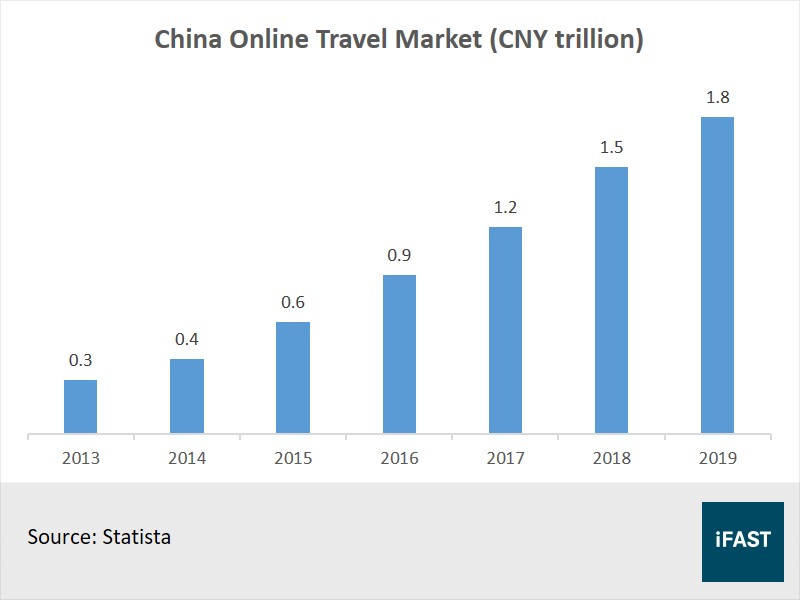
Despite the strong growth, some 70% of travel bookings are still made offline in China, largely due to a lack of Internet access, especially in the lower-tier cities. As China ramps up resources to speed up the construction of its digital infrastructure, we expect its Internet population to increase in the years ahead, and this bodes well for the future of Trip.com, which currently has a dominant position in China’s online travel agency (OTA) market.
At this point, it is worth noting that Trip.com also operates a vast network of physical stores across China. With about 8,000 stores, Trip.com is one of the largest players even in the offline space.
The company’s offline strategy looks to capture the market segments that may have been missed by online services, including senior consumers and areas with a lower Internet penetration. The sheer reach of its physical stores allows Trip.com to expand into these untapped segments, converting offline users into new online customers. In particular, consumers from lower-tier cities will likely be the main growth driver for Trip.com in the years to come.
Share price remains attractive despite recent rally
Since our last update, the share price of Trip.com has risen by more than 30%. At its current share price, the company is trading at a PE ratio of about 20.5X, based on its estimated earnings for FY2021, lower than some its Internet peers like Meituan Dianping, Tencent and Alibaba.
Table 1: Valuation of Trip.com relative to its peers
|
Company Name |
*PE Ratio |
PB Ratio |
Div Yield (%) |
|
Trip.com |
20.54 |
1.24 |
0.00 |
|
Meituan Dianping |
81.74 |
14.16 |
0.00 |
|
Tongcheng eLong |
12.99 |
1.86 |
0.00 |
|
Tencent |
31.98 |
9.00 |
0.30 |
|
Alibaba |
32.44 |
5.73 |
0.00 |
|
Source: Bloomberg Finance L.P., iFAST estimates Data as of 26 October 2020 *Based on FY2021 estimated earnings |
|||
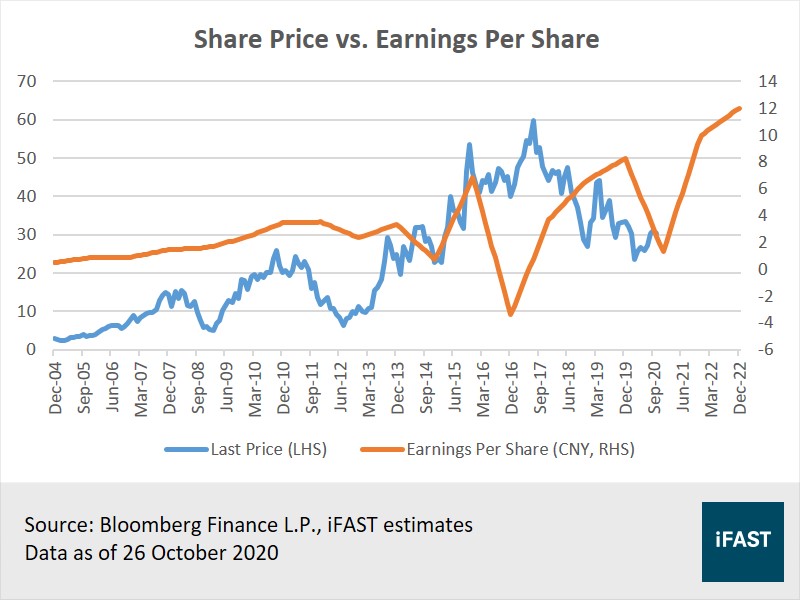
We upgrade our target price for Trip.com to USD 37, based on a 25X fair PE multiple to our revised FY2021 estimated earnings per share of USD 1.48. This represents an attractive upside potential of close to 22% based on its last traded price of USD 30.36 as of 26 October 2020.
Given the exciting growth prospects of China’s travel market and Trip.com’s unassailable lead in the OTA space, we believe the company will emerge stronger after the COVID-19 dust settles.
Figure 4: Trip.com’s share price tracks earnings per share
Declaration:
For specific disclosure, at the time of publication of this report, IFPL (via its connected and associated entities) and the analyst who produced this report hold a NIL position in the abovementioned securities.
All materials and contents found in this site are strictly for general circulation and informational purposes only and should not be considered as an offer, or solicitation, to deal in any of the funds or products found/identified in this site. While iFAST Financial Pte Ltd ("IFPL") has tried to provide accurate and timely information, there may be inadvertent delays, omissions, technical or factual inaccuracies and typographical errors. Any opinion or estimate contained in this report is made on a general basis and neither IFPL nor any of its servants or agents have given any consideration to nor have they or any of them made any investigation of the investment objective, financial situation or particular need of any user or reader, any specific person or group of persons. You should consider carefully if the products you are going to purchase are suitable for your investment objective, investment experience, risk tolerance and other personal circumstances. If you are uncertain about the suitability of the investment product, please seek advice from a financial adviser, before making a decision to purchase the investment product. Past performance is not indicative of future performance. The value of the investment products and the income from them may fall as well as rise. Opinions expressed herein are subject to change without notice. In respect of any matters arising from, or in connection with the said research analyses or research reports, recipients of the report are to contact IFPL at 10 Collyer Quay, #26-01 Ocean Financial Centre Building, Singapore 049315, or by telephone at +65 6557 2853. Where the report contains research analyses or research reports from a foreign research house and if the recipient of such research analyses or research reports is not an accredited investor, expert investor, institutional investor or an ex-accredited investor, IFPL accepts legal responsibility for the contents of such analyses or reports to such persons only to the extent as required by law. Please note that only certain security(ies) herein are available to all investors, while the rest are only available for certain persons to invest in, such as Accredited Investors (as defined in the Securities and Futures Act) or one who invests at least S$200,000 (or its equivalent currency) per transaction. To qualify as an Accredited Investor, one needs to submit a declaration form and certain relevant supporting documents, according to iFAST’s prevailing policies and procedures.
Please read our full disclaimers on the website at ( https://secure.fundsupermart.com/fsmone/policies/328125/investment-account-terms-&-conditions).
iFAST Financial Pte Ltd (IFPL) (registered address: 10 Collyer Quay #26-01 Ocean Financial Centre Singapore 049315, Telephone: 6557 2000) holds the Financial Advisers Licence issued by the Monetary Authority of Singapore ('MAS') to conduct regulated activities of advising on securities, marketing of collective investment schemes and arranging of any contract of insurance in respect of life policies, other than a contract of reinsurance and the Capital Markets Services Licence issued by the MAS to conduct regulated activities of dealing in securities and providing custodial services for securities. While IFPL has made every effort to ensure the independence of the report's contents, IFPL's nature of business is such that IFPL and its connected and associated entities together with their respective directors, officers and staff may be involved in providing dealing or investment-related services in the abovementioned securities, and have taken or may take positions in the securities mentioned in this report, and may also act as the principal for any buy or sell trades.