


- With COVID-19 set to negatively impact China’s travel industry, Trip.com (NASDAQ:TCOM) saw its share price fall by more than -40% from its high this year.
- With the epidemic now brought under control, China’s travel industry has seen a nascent recovery, and this bodes well for Trip.com.
- In the longer-term, the prospects of China’s travel industry remains bright. Global air transport passenger numbers could reach 8.2 billion by 2037, and China will also displace the US as the world’s largest aviation market.
- Trip.com will also benefit from the travel industry’s paradigm shift towards online booking.
- Our target price of USD 34.50 for Trip.com represents an attractive upside potential of more than 50% based on its last traded price of USD 22.51 as of 30 March 2020. We believe the company will emerge stronger after the COVID-19 dust settles.
For the 11-million population in the Chinese city of Wuhan, however, it was not to be this year.
An outbreak of a novel coronavirus – now known as the COVID-19 – that started in Wuhan has put Chinese health authorities on high alert. The city was swiftly put under lockdown, with the restrictions progressively expanded to include neighbouring cities in the central province of Hubei.
Flights and hotel bookings were cancelled, while travellers exercised increased caution on their travel plans. With the novel coronavirus set to negatively impact China’s travel industry, travel-related stocks – from airlines, hotels to retailers – saw significant drops in their share prices.
Trip.com (NASDAQ:TCOM), previously known as Ctrip and is China’s largest online travel agency (OTA), was also one of the casualties, with its share price falling by as more than -40% since its highest point this year. For investors who are willing to look beyond the short-term disruption to China’s travel industry, this may be an opportune time to take a closer look at Trip.com.
Trip.com: Dominant player in China’s OTA market
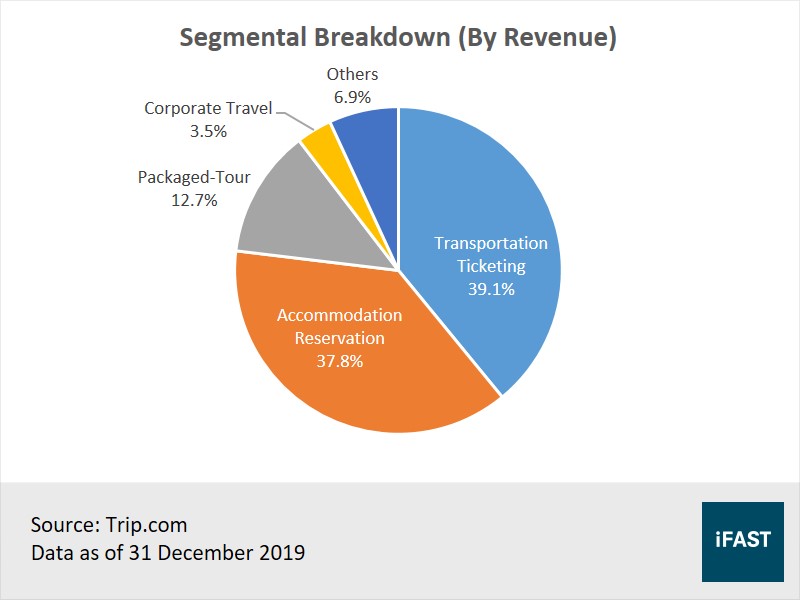
Trip.com is China’s leading OTA, providing travellers with a one-stop platform for travel services, including accommodation reservation, transportation ticketing, packaged tours and corporate travel management. It derives the bulk of its revenue from the transportation ticketing and accommodation reservation segments (Figure 1).
Figure 1: Transportation ticketing and accommodation reservation are Trip.com’s largest segments
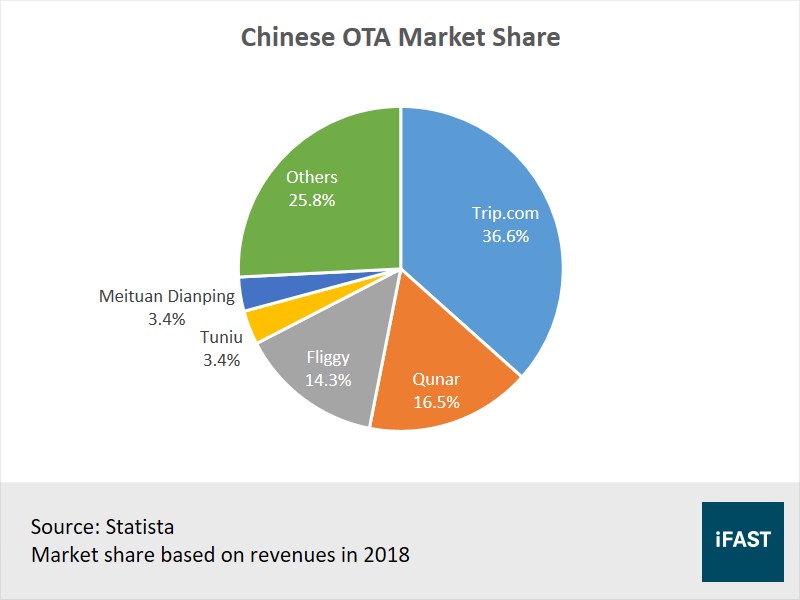
The company’s major brands include Ctrip, Trip.com, Qunar and Skyscanner. Trip.com is the dominant player in China’s OTA market, with a market share of about 36.6% (Figure 2). If we include the 16.5% market share held by Qunar, Trip.com lays claim to more than half of China’s OTA market, a position that is considered near-unassailable.
Figure 2: Trip.com dominates China’s OTA market
Travel demand to recover as virus worry recedes
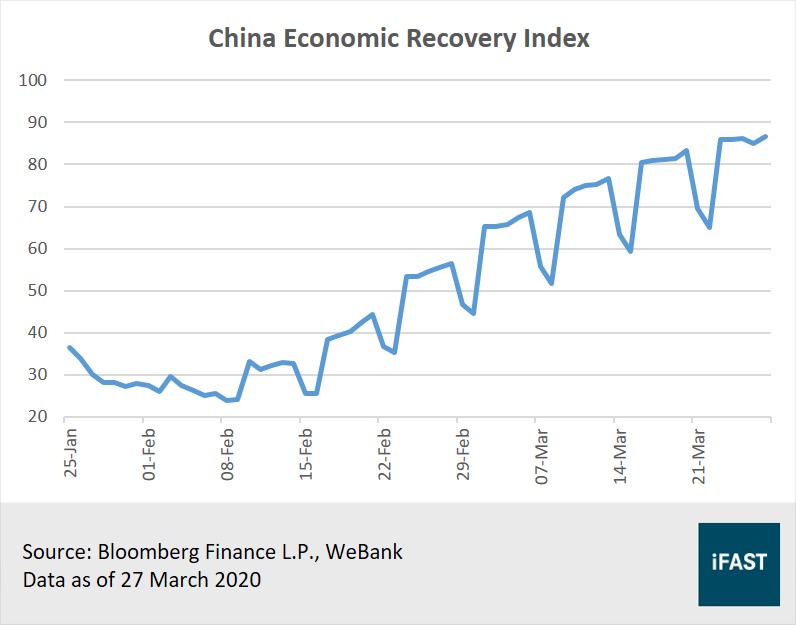
While the number of confirmed COVID-19 cases worldwide has been on the rise, China has seen a stabilisation in new infections. In fact, Europe has now replaced China as the epicentre of the COVID-19 outbreak. With the epidemic now brought under control, China’s economy is getting back on its feet, running at close to 90% of its normal level as of 27 March 2020 (Figure 3).
Figure 3: China’s economy slowly getting back on its feet
More recently, Chinese authorities have also announced an easing of travel restrictions in Hubei province. In particular, the lockdown on Wuhan – the city where the COVID-19 outbreak began – will be lifted on 8 April, marking a significant milestone in China’s battle against the deadly virus. With the latest development, travel demand in China is expected to recover gradually.
Already, Chinese OTAs are starting to see green shoots of recovery.
Trip.com is likely to record a net loss in 1Q 2020, but the company expects a quick and strong recovery in domestic travel, and has encouragingly seen an increase in domestic travel bookings in recent weeks. Alibaba-backed Fliggy has also seen a 70% rebound in bookings from last week. Meanwhile, online travel company Tongcheng-Elong (HKEX:780) saw a recent surge in reservations for domestic flights and hotels in China, indicating an improvement in consumer confidence.
Make no mistake about this: the world’s battle with COVID-19 is far from over. However, if China and South Korea’s experience with the outbreak is of any indication, the slowdown in new infections offers a sliver of hope that the global outbreak can eventually be controlled.
In any case, with CNY 43 billion cash and CNY 30.5 billion of short-term debt sitting on its balance sheet, Trip.com has sufficient liquidity to tide through this period.
Prospects of China’s travel industry remains bright
In the longer-term, the prospects of China’s travel industry remains bright.
In 2008, Chinese tourists made just 45.8 million overseas trips. Fast forward to 2018 and the figure is 162 million – that’s close to a four-fold increase over the past ten years.
Now consider this: only 13% of mainland Chinese residents – around 182 million people – possess a passport, a relatively small figure compared to 45% for the US and 76% for the UK. As such, China’s 1.4 billion-strong population – already the world’s largest – remains under-travelled, and the travel market’s potential for future growth is staggering.
Based on estimates provided by the International Air Transport Association (IATA), global air transport passenger numbers could reach 8.2 billion by 2037, representing a 3.5% compounded annual growth rate (CAGR) from 2018-2037 (Figure 4). The Asia-Pacific region will be the biggest growth driver, with more than half the total number of new passengers over the next 20 years coming from these markets. China will also displace the US as the world’s largest aviation market.
Figure 4: The global air travel industry has proven resilient
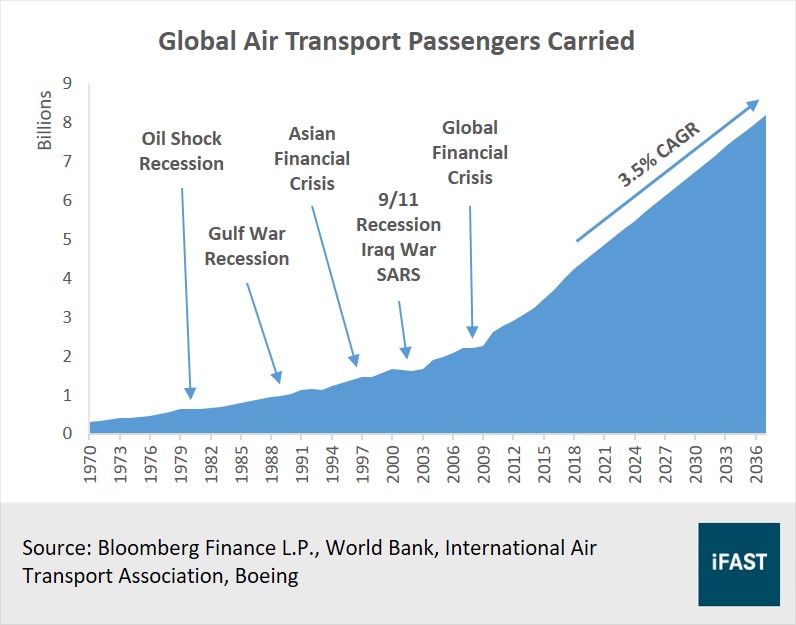
As the world goes on lockdown, the COVID-19 outbreak has threatened to bring the global travel industry to a grinding halt. However, it is worth noting that the global air travel market has proven to be a resilient market over the past decades, surviving various crises, including the likes of the global financial crisis, SARS, as well as the Asian financial crisis.
It is unlikely that COVID-19 will deal significant structural damage to the global air travel industry.
Paradigm shift to online travel booking
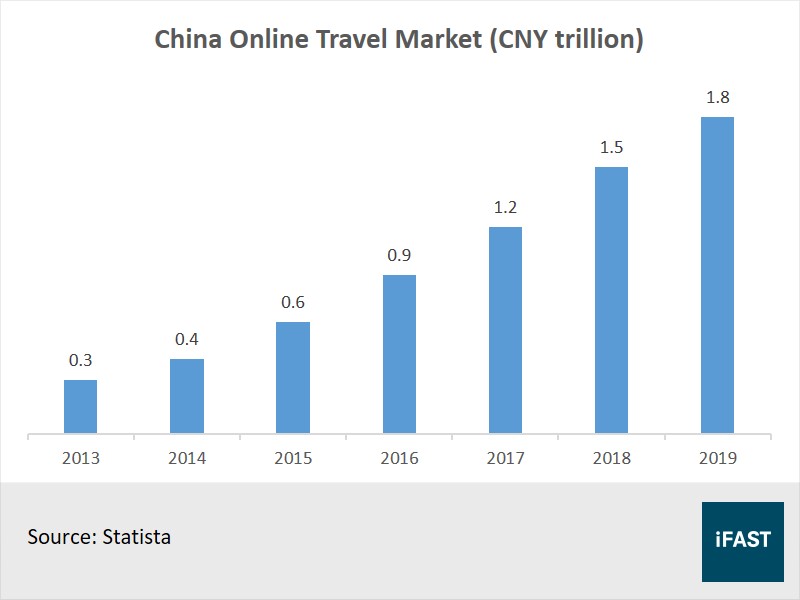
When the Chinese first began to travel overseas, it was the state-run brick-and-mortar travel agencies that dominated the market. Over the years, however, the industry has experienced a paradigm shift towards online booking. China’s online travel market is currently worth CNY 1.8 trillion (Figure 5), growing at a whopping 33.4% CAGR over the past five years.
Figure 5: Strong growth in China’s online travel market
Despite the strong growth, some 70% of travel bookings are still made offline in China. As China ramps up resources to speed up the construction of its digital infrastructure, we expect its Internet population to increase in the years ahead, and this bodes well for the future of Trip.com, which currently has a dominant position in China’s OTA market.
Key investment risks
Possible second wave of COVID-19 in China: While China has seen a stabilisation in the number of new infections, there has been a growing number of imported cases, fanning fears of a second wave of infections, especially if the easing of lockdown measures prove to be premature.
Should the virus situation re-escalate in China, we expect lockdown measures and travel restrictions to be implemented once again, and this will certainly delay the recovery of China’s travel market.
Intense competition amongst China’s OTAs: Trip.com may be the dominant player in China’s OTA market, but it faces intense competition ahead, with both Tencent and Alibaba taking aim at the fast-growing travel market.
Trip.com’s closest competitor, Fliggy, is backed by Alibaba and has a market share of about 14.3%. Fliggy is able to leverage on Alibaba’s eco-system, drawing on a user base of more than 750 million active users. Meanwhile, Tencent-backed Meituan Dianping (HKEX:3690) went from industry minnows to one of China’s top OTA players in a just a few years.
Having said that, Trip.com is no stranger to competition. Over the years, it has seen off foreign competitors such as Expedia (NASDAQ:EXPE), which has struggled to enter the market through acquisitions, while snapping up domestic competitors to control China’s OTA market. Even with Fliggy and Meituan entering the fray, Trip.com has tremendous recognition amongst Chinese tourists – a competitive advantage that could help it fend off its strongest competitors.
Share price offers adequate margin of safety
Since its highest point this year, Trip.com has fallen by more than -40%, reflecting the headwinds that the global travel industry is facing. At its current share price, the company is trading at a PE ratio of about 16.3X, based on its estimated earnings for FY2021, lower than some its Internet peers like Meituan Dianping, Tencent and Alibaba.
Table 1: Valuation of Trip.com relative to its peers
|
Company Name |
PE Ratio |
PB Ratio |
Div Yield (%) |
|
Trip.com |
16.27 |
0.91 |
0.00 |
|
Meituan Dianping |
33.96 |
4.72 |
0.00 |
|
Tongcheng eLong |
11.39 |
1.62 |
0.00 |
|
Tuniu |
5.57 |
0.31 |
0.00 |
|
Tencent |
23.78 |
7.58 |
0.41 |
|
Alibaba |
23.36 |
4.89 |
0.00 |
|
Source: Bloomberg Finance L.P., iFAST
estimates Data as of 30 March 2020
|
|||
Our target price of USD 34.50 for Trip.com is based on a 25X fair PE multiple to our FY2021 estimated earnings per share of USD 1.38. This represents an attractive upside potential of more than 50% based on its last traded price of USD 22.51 as of 30 March 2020.
Given the exciting growth prospects of China’s travel market and Trip.com’s unassailable lead in the OTA space, we believe the company will emerge stronger after the COVID-19 dust settles.
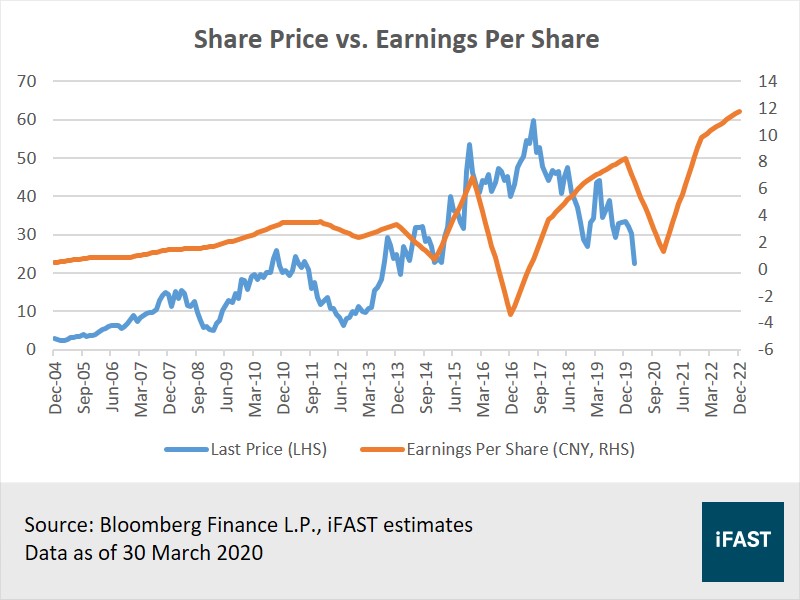
Figure 6: Trip.com’s share price tracks earnings per share
For specific disclosure, at the time of publication of this report, IFPL (via its connected and associated entities) and the analyst who produced this report hold a NIL position in the abovementioned securities.
All materials and contents found in this site are strictly for general circulation and informational purposes only and should not be considered as an offer, or solicitation, to deal in any of the funds or products found/identified in this site. While iFAST Financial Pte Ltd ("IFPL") has tried to provide accurate and timely information, there may be inadvertent delays, omissions, technical or factual inaccuracies and typographical errors. Any opinion or estimate contained in this report is made on a general basis and neither IFPL nor any of its servants or agents have given any consideration to nor have they or any of them made any investigation of the investment objective, financial situation or particular need of any user or reader, any specific person or group of persons. You should consider carefully if the products you are going to purchase are suitable for your investment objective, investment experience, risk tolerance and other personal circumstances. If you are uncertain about the suitability of the investment product, please seek advice from a financial adviser, before making a decision to purchase the investment product. Past performance is not indicative of future performance. The value of the investment products and the income from them may fall as well as rise. Opinions expressed herein are subject to change without notice. In respect of any matters arising from, or in connection with the said research analyses or research reports, recipients of the report are to contact IFPL at 10 Collyer Quay, #26-01 Ocean Financial Centre Building, Singapore 049315, or by telephone at +65 6557 2853. Where the report contains research analyses or research reports from a foreign research house and if the recipient of such research analyses or research reports is not an accredited investor, expert investor, institutional investor or an ex-accredited investor, IFPL accepts legal responsibility for the contents of such analyses or reports to such persons only to the extent as required by law. Please note that only certain security(ies) herein are available to all investors, while the rest are only available for certain persons to invest in, such as Accredited Investors (as defined in the Securities and Futures Act) or one who invests at least S$200,000 (or its equivalent currency) per transaction. To qualify as an Accredited Investor, one needs to submit a declaration form and certain relevant supporting documents, according to iFAST’s prevailing policies and procedures.
Please read our full disclaimers on the website at ( https://secure.fundsupermart.com/fsmone/policies/328125/investment-account-terms-&-conditions).
iFAST Financial Pte Ltd (IFPL) (registered address: 10 Collyer Quay #26-01 Ocean Financial Centre Singapore 049315, Telephone: 6557 2000) holds the Financial Advisers Licence issued by the Monetary Authority of Singapore ('MAS') to conduct regulated activities of advising on securities, marketing of collective investment schemes and arranging of any contract of insurance in respect of life policies, other than a contract of reinsurance and the Capital Markets Services Licence issued by the MAS to conduct regulated activities of dealing in securities and providing custodial services for securities. While IFPL has made every effort to ensure the independence of the report's contents, IFPL's nature of business is such that IFPL and its connected and associated entities together with their respective directors, officers and staff may be involved in providing dealing or investment-related services in the abovementioned securities, and have taken or may take positions in the securities mentioned in this report, and may also act as the principal for any buy or sell trades.