
Macro Research

India: Exciting growth potential hamstrung by its expensive market

India has strong potential to outpace both global and Asian markets in terms of economic and earnings growth ahead. However, its current macro headwinds alongside an overheated valuation limit the attractiveness of its equity market.

  • |
  • Published on 07 Sep 2019

India: Exciting growth potential hamstrung by its expensive market | Open a FREE FSM account and manage all your investments conveniently in ONE place


India’s latest YoY GDP growth fell short of expectations, driven by significant weakness in key drivers - private consumption and investments, which contributes 57% and 33% to GDP respectively.  This highlights a weakening domestic economy and thus, an aversion to commit to investments.

Its current economic slowdown is expected to be cyclical in nature. We think a cyclical recovery in India can materialise as early as FY2020, with the accommodative easing and hefty fiscal stimulus from its policymakers.

While earnings growth of Indian equities is set to outpace majority of the global and Asian markets, we see earnings headwinds ahead for the major sectors within Sensex index. This sets up room for further negative earnings revisions, which can diminish the attractiveness of Indian equities ahead. 

In addition, the current expensive valuation of the Indian equity index leave little room for meaningful valuation expansion. Not only is the capital gain prospect dull, the projected dividend yield of Sensex index is also modest at about 1.5%-2% for the next two years.
 
In the long-term, however, the immense growth potential of India cannot be understated. While unattractive in current juncture, India is one market we will keep a close watch on ahead. Overall, we maintain our star rating of 3.0 stars “Fairly Attractive” for Indian equity market.

Domestic headwinds crimp economic growth 


India’s GDP of 5% year-on-year growth for the June quarter was an unwelcome shock to policymakers and investors. The reading more than misses its mark as it nosedived from prior month’s 5.8% and strayed far from analyst’s expectations of a 5.7%. 

Not only was June quarter’s bleak GDP reading the lowest growth rate over the past six years, it was also the fifth consecutive quarter of slowing growth (Chart 1). Consequently, this overwhelming surprise unleashed waves of revision where India’s growth forecast was heavily chopped down, as markets forcibly digest the latest GDP numbers.

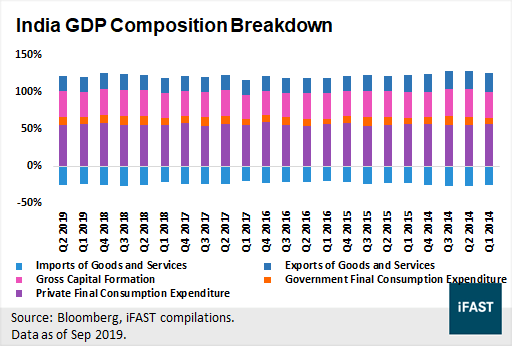
The sharp slowdown was primarily fuelled by significant weakness in key engines of growth - private consumption and investments (gauged by gross fixed capital formation) (Chart 1). Private consumption has been the largest drag of India’s economic growth, exacerbated by its lion’s share contribution (around 57%) to GDP (Chart 2). 

Growing a mere 3.1% year-on-year (lowest since 4Q 2014), private consumption plunged as domestic demand decelerated over the past year. The combination of decelerating consumer confidence, moderating rural purchasing power and a spike in unemployment rate suggest weakness in private consumption will linger. 

While investments growth has rebounded marginally to 4.0% year-on-year, it remains relatively subdued and continues to impinge India’s economic advances. Similarly, the relatively out-sized contribution from investments (around 33%) makes it a drag on the economy (Chart 2). 

Looking ahead, we expect the challenging domestic and external environment to further suppress business confidence, which acts as a dampener to investments.

Chart 1: Private consumption and Investments dragged GDP lower
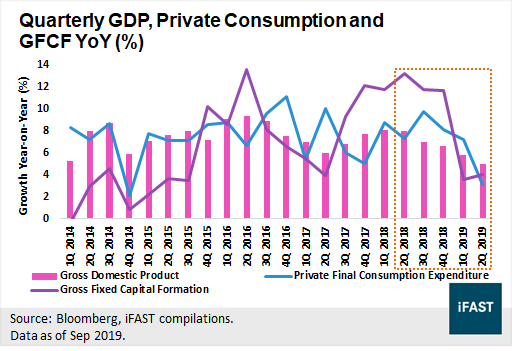

Chart 2: Private consumption and investment makes up lion’s share of GDP


Cyclical slowdown expected to persist but recovery hopes alive


According to the Annual Report by the Reserve Bank of India (RBI), the current economic slowdown is believed to be cyclical in nature, plagued with deep structural issues that requires urgent reforms.

 In a backdrop of feeble external demand coupled with the sharp deceleration from both private consumption and investments, we expect the above concoction of macro forces to curtail and delay India’s economic recovery from its cyclical slump. Consensus expects India’s year-on-year GDP growth to slip from 7.2% in 2018 to 6.7% for both 2019 and 2020 before rebounding to 7.0% in 2021.

Furthermore, Indicators measuring economic activities (such as industrial production, composite index for core industries and manufacturing PMI) have deteriorated and the downtrend shows no sign of abating.

Collectively, the poor economic data reinforces the fact that India’s cyclical slowdown will persist, possibly extending into the next quarter. Therefore, it is challenging to see a pickup in sales and CAPEX (capital expenditure) for Indian corporates, and that will likely stifle earnings growth and the broader equity market (as discussed in sections below). 

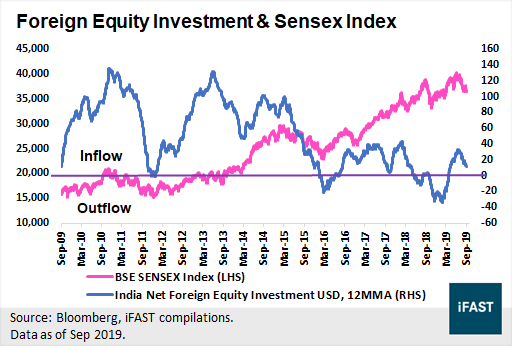
The dismal economic performance from India, aggravated by global risk aversion, triggered a mass exodus of foreign equity investment (Chart 3). The relentless outflow continued even after a slew of government stimulus were released, in an attempt to arrest the dwindling market sentiment.

Moving forward, we believe India’s economic fragility will also be a headwind for the equity market via the suppression of market sentiments. Nonetheless, hopes for a resuscitation in India’s economy is very much alive and we see a high likelihood of a cyclical economic recovery to materialise by early 2020, after considering policy and transmission lag.

Current growth revival measures (unveiled at India’s union budget) and hefty support by the central bank via liquidity boosting, transfer of capital reserves, easing regulations and rate cut (RBI slashed key repo rate to 5.40% at its last meeting) should act as growth boosters.

While any meaningful fiscal stimulus is limited due to India’s fiscal target, the negative surprise of economic growth should embolden policymakers to adopt aggressive easing and additional growth policies, which in turn will buttress the cyclical recovery in our view.

Chart 3: Plunging sentiments exacerbated by weak economy dragged equity market down


Risk for Rupee tilted to the downside


This year has been tumultuous for the Indian Rupee, as it was relegated to one of Asia’s worst performing currency thus far in 2019, alongside the Chinese Renminbi and South Korean Won. Against the greenback, the Rupee depreciated by almost 4% in the year-to-date (Chart 4). 

Weakness in the Rupee is a reflection of capital outflows driven by three main factors: (1) India’s twin deficit, (2) broader risk aversion and (3) depreciation of the China’s Renminbi (RMB).  We expect the latter two factors to be near term drivers influencing the Indian Rupee, while the former remains a cardinal driver in the longer term.

In the near-term, broader risk aversion triggered by the tempestuous trade relationship and yield curve inversion have invoked investment outflows from India. Such excessive outflows has dampened the Rupee’s strength against the dollar and is likely to extend as risk aversion clings firmly to the regressing trade narrative. The enveloping threat of a US-Sino currency war precipitated the depreciation of the RMB, and any further weakening will inflict greater pressure on emerging market currencies, particularly Asian currencies.

In the longer term, we believe India’s twin deficit – current account and fiscal deficit, will maintain its headlock on the Rupee, thus, dampening its strength against the greenback. We expect India’s current account deficit to remain manageable as crude oil price moderates due to weaker global demand. India’s oil imports are around three times its exports and a fall in oil prices help mend the current account deficit. 

Nevertheless, factoring India’s heavy dependency on oil (27% of total imports), a moderating global demand and weaker Rupee (making imports costly), it is prudent to anticipate a continuing deficit for India’s current account. 

Softening economic growth has also elevated pressure for more fiscal stimulus while simultaneously depleting tax revenues and this inflicts tremendous strain on the fiscal balance, which India targets to abide by the limit. Therefore, we foresee the inability by policymaker to close the fiscal gap as long as the economy remains poor.

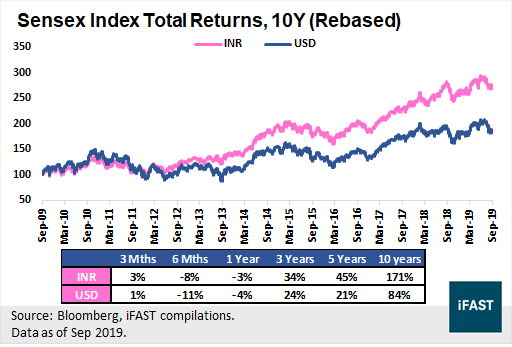
Weighing all three factors, we believe the Indian Rupee is likely to face headwinds in both the shorter and longer term. Thus, risks for the Rupee are tilted to the downside and we believe it may further depreciate. As such, this will impact the bottom line of Indian corporates and also compresses the returns for Indian equities (Chart 5).

Chart 4: USDINR weakened dramatically after trade dispute
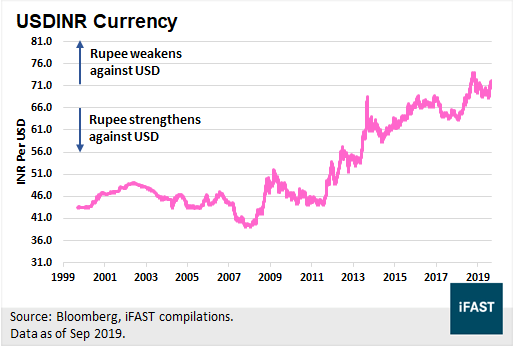


Chart 5: Rupee swings have heavily influenced total returns of the Sensex index


Earnings growth of India equities to outpace global average


The Sensex Index is one of two prominent equity indexes for India – the other being the Nifty 50 Index – and is our index of choice for an exposure to Indian equities. It features a total of 30 large-cap Indian companies, spanning across various major sectors and industries. 

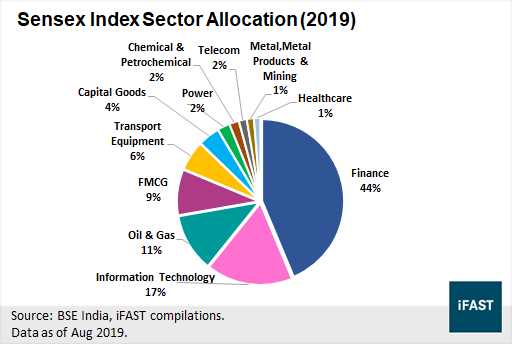
Among which, Financials (44%), IT services (17%) and Energy (11%) ranks among the largest sectors, collectively accounting for more than seventy percent of the total market capitalisation of the SENSEX Index. Similarly, much of the index earnings are also attributable to the abovementioned three largest sectors (Chart 6). 

Chart 6: Financials, IT services and Energy sectors account for bulk of SENSEX index


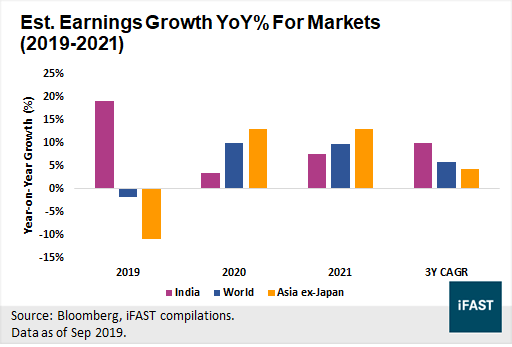
For this year, SENSEX Index consensus earnings is estimated to grow 16% year-on-year, beating both the global average growth rate of -1.7% and Asia ex-Japan’s -10.9% (Chart 7).

We expect this outperformance in earnings growth to be driven mainly by the improved domestic liquidity situation and financial conditions, combined with the government’s drive for growth (mentioned above) to bolster earnings growth momentum for domestic sectors in coming quarters. 

Across sectors, we believe the major sectors such as Financials and IT services are set to benefit from an improved earnings environment, as explain in the subsequent section.

However, we think there is still room for negative earnings revisions for Indian equities ahead. SENSEX index’s consensus earnings estimates for the current fiscal year have only been moderately revised down by 2-3% since the start of the year. With the slowing external and domestic macro environment as backdrop, we anticipate further earnings revisions, especially since majority of Indian corporates surprised negatively in the latest quarterly earnings season. 

Chart 7: Earnings of India corporates are poised to grow faster than those in Global and Asian markets


Mixed Earnings Growth Outlook for Major Sectors


Within SENSEX index, Financials, IT services and Energy rank among the largest sectors, collectively accounting for more than seventy percent of the total market capitalisation. They are also responsible for much of SENSEX’s underlying earnings. 

Looking ahead, as we expect the earnings outlook for these sectors to be rather mixed – improving but still impeded with considerable idiosyncratic headwinds – therefore, further downward revisions to SENSEX’s earnings remain a near-term possibility.

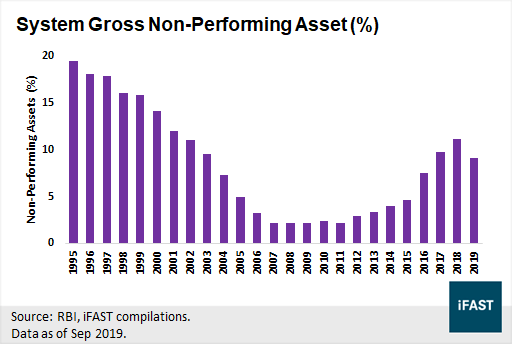
Starting with Financials, the largest sector (44% of total market cap) in SENSEX Index, earnings outlook ahead is mixed. On the positive end, non-performing assets (NPA) level across the financial system have declined, after peaking last year, with slippages from corporates – standard assets turning into bad loans – marking a deceleration (Chart 8).

Chart 8: Overall credit risk of Indian financial system have improved this year


While asset quality issues are starting to surface for housing and agricultural financing companies, due to the weak monsoon season and decline in rural wage, we see an overall reduction in the credit risk of India’s financial system. We think this will lead to improvements in credit cost management for banks with exposure to unsecured lending.

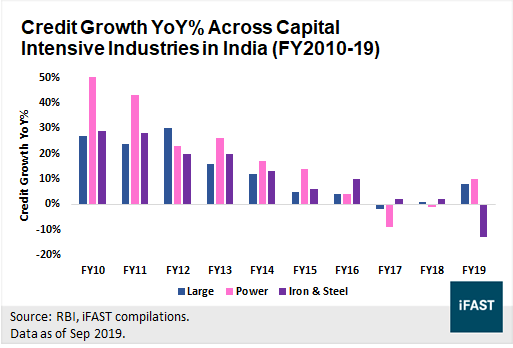
Despite the reduction in NPA levels, the growth of corporate credit remains rather lacklustre. Amid the weak macro environment, private banks remain concerned about the health of the real estate sector and auto demand, and are starting to restrict credit flow to corporates with better ratings. Coupled with the general trend of debt reduction across corporate balance sheets, we see a major drag to a possible rebound in loan growth in the near-term (Chart 9).

To further complicate the earnings outlook for Financials, we expect net interest margins (NIM) for Indian banks to decline in the down-trending interest rate environment. RBI, like most central banks around the world, have embarked on monetary easing to help spur economic growth. As a result, it is prudent to expect earnings growth for Financials to come in mixed for the coming quarters. 

Chart 9: Credit growth have been lacklustre in Indian large industries over the last few years


The second largest sector, the IT Services are likely to benefit from a more positive demand environment ahead. Indian software developers, especially those that cater to the banking & financial services and retail segments, are poised to generate greater amount of revenue, notwithstanding the ongoing digital disruptions in traditional industries. Businesses, across industries, are also embracing new technologies to automate all the mundane and repetitive tasks.
 
Globally, enterprises are allocating greater proportion of their budget to digitalise not only their consumer facing front-end functions, but also internally within their organisations, which is a boon for IT service providers. Looking ahead, we foresee robust foreign demand for Indian IT services firms, especially from US corporates. 

Overall, the IT Services sector is entering the early stages of a cyclical recovery in global IT spending, and we believe Indian software developers are primed to be the largest beneficiary of such secular growth trend.  Within the industry, hiring has picked up significantly in recent months and is a clear signal of firms investing greater resources to cater to strong impending demand. 

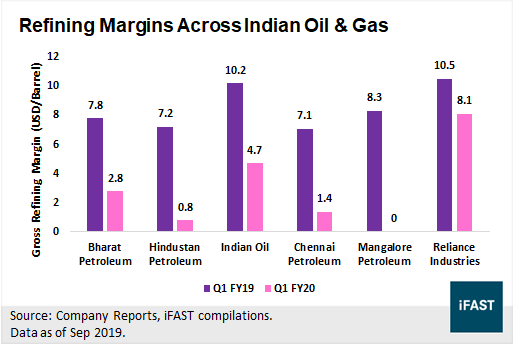
Lastly, the Energy sector, which forms the third largest sector in SENSEX Index, is expected to face setbacks in earnings ahead. Both upstream and downstream energy companies are facing the reality of compressed margins. For upstream crude producers, earnings are likely to weaken amid a decline in prices of Brent crude, which in turn was caused by soft global demand environment. For downstream refineries, the continued compression in gross refining margins (GRM) has dragged down overall earnings for the oil companies (Chart 10). 

Chart 10: Refining margins compressed across Indian Oil & Gas companies amid low demand

All in all, while earnings growth of Indian equities are currently projected to outpace global and Asian averages, we are incline to believe that idiosyncratic sector headwinds pose a downside risk to earnings moving ahead. We think that further earnings revisions this year is likely, and is set to lower earnings growth of Indian equity market.  

Expensive Valuation Limits Upside Potential


While earnings growth for SENSEX remains robust (CAGR of 10% in three years) in the next two years, overheated valuations limits the upside potential for Indian equity market at the current juncture.

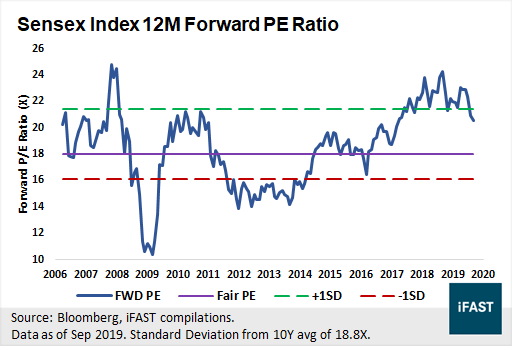
The SENSEX Index is currently trading at a forward PE ratio of 20.5X, which is near one standard deviation above its ten-year average level. With our fair PE ratio of 18.0X allotted to Indian equity market, the current valuation of SENSEX index represents more than ten percent overvalued (Chart 11).

Chart 11: SENSEX is currently trading near one standard deviation above its 10-year average.


Using our fair PE ratio of 18.0X on projected 2020/21 earnings, the potential upsides for SENSEX index by end-2020 and end-2021 are relatively modest at +2% and +10% respectively. With near-term unappealing capital appreciation prospects, Indian equities also ranked among one of the least attractive markets under our coverage (Table 1).

Table 1: The expensive current valuation of SENSEX Index leave little room for valuation expansion. 

SENSEX Index

2018

2019

2020

2021

Forward PE Ratio (X)

21.8

18.3

17.7

16.4

Expected Earnings Growth YoY

8%

19.2%

3.6%

7.7%

Earnings Per Share (EPS)

1,679

2,001

2,073

2233

Projected Fair Price

-

-

37,319

40,199

Potential Upside (%) from Today

-

-

2%

10%


Not only is the capital gain prospect dull, adding to the unattractiveness, the projected dividend yield of SENSEX index is also pretty modest at about 1.5%-2% for the next two years. 

Overall, with both capital gains and dividends yields modest at best, we think that the Indian equity market as a rather unexciting investment opportunity at this current juncture. Thus, we maintain our star rating of 3.0 stars “Fairly Attractive” for Indian equity market.

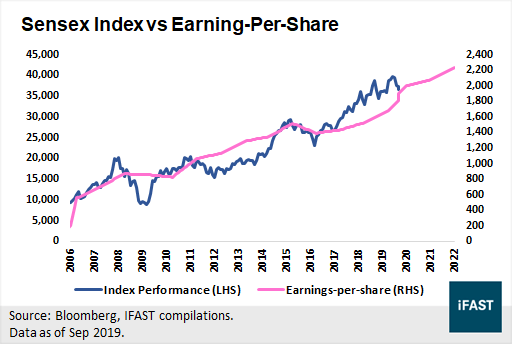
Chart 12: SENSEX Index trends upwards with its underlying earnings in the long run. 

India – A Shining Star in the Long-Term 


While India’s near-term economic growth is chilled by the cold winds of US-Sino trade conflict and challenged by domestic macro roadblocks, its long-term growth remains alluring to us. Strong structural macro drivers (rising middle class, rural-urban migration and population dividend etc.) underpins India’s long term growth potential, while Prime Minister Modi’s reform plans may potentially accelerate and amplify economic growth.

Similarly, the longer-term outlook for Indian corporates clears up as rosier prospect takes the lead. We see the above macro drivers and reforms as crucial earning boosters across sectors. 

Once near-term headwind (discussed above) clears, we believe successful reforms and the materialization of structural macro drivers can unlock higher earnings growth rates, which are sustainable for a longer period of time. Stronger corporate and economic fundamentals will support valuations and lead Indian equity northwards. 

Investors seeking an actively-managed solution should definitely consider our recommended fund for India, First State Regional India A Acc SGD


All materials and contents found in this site are strictly for general circulation and informational purposes only and should not be considered as an offer, or solicitation, to deal in any of the funds or products found/identified in this site. While iFAST Financial Pte Ltd ("IFPL") has tried to provide accurate and timely information, there may be inadvertent delays, omissions, technical or factual inaccuracies and typographical errors. Any opinion or estimate contained in this report is made on a general basis and neither IFPL nor any of its servants or agents have given any consideration to nor have they or any of them made any investigation of the investment objective, financial situation or particular need of any user or reader, any specific person or group of persons. You should consider carefully if the products you are going to purchase are suitable for your investment objective, investment experience, risk tolerance and other personal circumstances. If you are uncertain about the suitability of the investment product, please seek advice from a financial adviser, before making a decision to purchase the investment product. Past performance is not indicative of future performance. The value of the investment products and the income from them may fall as well as rise. Opinions expressed herein are subject to change without notice. In respect of any matters arising from, or in connection with the said research analyses or research reports, recipients of the report are to contact IFPL at 10 Collyer Quay, #26-01 Ocean Financial Centre Building, Singapore 049315, or by telephone at +65 6557 2853. Where the report contains research analyses or research reports from a foreign research house and if the recipient of such research analyses or research reports is not an accredited investor, expert investor, institutional investor or an ex-accredited investor, IFPL accepts legal responsibility for the contents of such analyses or reports to such persons only to the extent as required by law. Please note that only certain security(ies) herein are available to all investors, while the rest are only available for certain persons to invest in, such as Accredited Investors (as defined in the Securities and Futures Act) or one who invests at least S$200,000 (or its equivalent currency) per transaction. To qualify as an Accredited Investor, one needs to submit a declaration form and certain relevant supporting documents, according to iFAST’s prevailing policies and procedures.

Please read our full disclaimers on the website at ( https://secure.fundsupermart.com/fsmone/policies/328125/investment-account-terms-&-conditions).

iFAST Financial Pte Ltd (IFPL) (registered address: 10 Collyer Quay #26-01 Ocean Financial Centre Singapore 049315, Telephone: 6557 2000) holds the Financial Advisers Licence issued by the Monetary Authority of Singapore ('MAS') to conduct regulated activities of advising on securities, marketing of collective investment schemes and arranging of any contract of insurance in respect of life policies, other than a contract of reinsurance and the Capital Markets Services Licence issued by the MAS to conduct regulated activities of dealing in securities and providing custodial services for securities. While IFPL has made every effort to ensure the independence of the report's contents, IFPL's nature of business is such that IFPL and its connected and associated entities together with their respective directors, officers and staff may be involved in providing dealing or investment-related services in the abovementioned securities, and have taken or may take positions in the securities mentioned in this report, and may also act as the principal for any buy or sell trades.

Ways to Invest with FSM Global
Why FSM Global
Don't have an account with us?
Open an account here
Need Financial Advice?
Make an appointment

We use cookies If you close this message or continue to use this site, you will consent to the use of Cookies, unless you choose to disable them. Click on our Privacy Policy to understand more.