


' fill='%23fff' stroke='%23707070' d='M0 0h21.6v21.6H0z'/%3e%3c/clipPath%3e%3cclipPath id='c'%3e%3cpath data-name='Rectangle 6531' transform='translate(-6319 -2048)' fill='%23fff' stroke='%23707070' d='M0 0h43.2v21.6H0z'/%3e%3c/clipPath%3e%3cclipPath id='a'%3e%3cpath d='M0 0h21.6v21.6H0z'/%3e%3c/clipPath%3e%3c/defs%3e%3cg data-name='Malaysia -Square' clip-path='url(%23a)'%3e%3cpath fill='%23fff' d='M0 0h21.6v21.6H0z'/%3e%3cg data-name='Mask Group 325' transform='translate(6348 2048)' clip-path='url(%23b)'%3e%3cg data-name='Mask Group 324' transform='translate(-35)' clip-path='url(%23c)'%3e%3cg data-name='Group 21195'%3e%3cpath data-name='Path 14718' d='M-6319-2048h43.2v21.6h-43.2z' fill='%23fff'/%3e%3cpath data-name='Path 14719' d='M-6317.457-2047.229h41.657m0 3.086h-41.657m0 3.086h41.657m0 3.086h-41.657' fill='none' stroke='%23c00' stroke-width='1.543'/%3e%3cpath data-name='Path 14720' d='M-6319-2048h21.6v13.114h-21.6z' fill='%23006'/%3e%3cpath data-name='Path 14721' d='M-6319-2034.886h43.2m0 3.086h-43.2m0 3.086h43.2' fill='none' stroke='%23c00' stroke-width='1.543'/%3e%3c/g%3e%3cpath data-name='Path 14722' d='M-6302.5-2045.686l.344 2.353 1.331-1.967-.714 2.269 2.054-1.2-1.626 1.731 2.372-.19-2.218.858 2.218.858-2.372-.19 1.626 1.736-2.054-1.2.714 2.269-1.331-1.97-.344 2.358-.344-2.353-1.331 1.97.714-2.269-2.054 1.2 1.626-1.737-2.372.19 2.218-.858-2.218-.859 2.372.19-1.626-1.736 2.054 1.2-.714-2.267 1.331 1.97zm-1.929.1a4.114 4.114 0 100 7.521 4.629 4.629 0 110-7.521z' fill='%23fc0'/%3e%3c/g%3e%3c/g%3e%3c/g%3e%3c/svg%3e "malaysiaIcon")
'%3e%3cpath fill='%23fff' d='M0 0h21.6v21.6H0z'/%3e%3cg data-name='067-hong-kong'%3e%3cpath data-name='Rectangle 6488' fill='%23d80027' d='M0 0h22v22H0z'/%3e%3cg data-name='Group 21086' fill='%23f0f0f0'%3e%3cpath data-name='Path 14432' d='M11.911 8.264c-.248 1.032-.689.835-.905 1.735a2.373 2.373 0 011.109-4.614c-.429 1.803.018 1.956-.204 2.879z'/%3e%3cpath data-name='Path 14433' d='M8.606 9.029c.9.555.581.913 1.37 1.4a2.373 2.373 0 01-4.045-2.481c1.577.964 1.866.586 2.675 1.081z'/%3e%3cpath data-name='Path 14434' d='M8.311 12.409c.807-.689 1.048-.271 1.752-.871a2.373 2.373 0 11-3.609 3.081c1.408-1.202 1.136-1.594 1.857-2.21z'/%3e%3cpath data-name='Path 14435' d='M11.435 13.734c-.406-.98.066-1.08-.287-1.935a2.373 2.373 0 111.815 4.385c-.708-1.71-1.165-1.573-1.528-2.45z'/%3e%3cpath data-name='Path 14436' d='M13.66 11.173c-1.058.083-1.007-.4-1.929-.325a2.373 2.373 0 114.731-.371c-1.846.145-1.856.621-2.802.696z'/%3e%3c/g%3e%3c/g%3e%3c/g%3e%3c/svg%3e "hongKongIcon")


- China’s stock market ended the first month of 2025 in the green, with DeepSeek revitalising investor confidence and helping the market shrug off tariff concerns. AI-related stocks soared to new highs.
- DeepSeek highlights AI efficiency as a potentially more cost-effective path forward. China is expected to continue advancing algorithmic innovation while reducing reliance on compute-heavy AI models.
- Despite AI efficiency gains, computing power remains the foundation of AI progress. China’s challenges in producing lower-node chips will ultimately limit its ability to scale AI advancements.
- China’s semiconductor stocks are currently trading at three times the valuations of their international peers. With price surges outpacing fundamental growth, investors should remain cautious about potential pullbacks.
- We take a balanced view - avoiding over-optimism on China’s semiconductor sector while recognising the strength of US chipmakers. US semiconductor stocks still present a promising 23.0% upside by FY2026.
China’s stock market closed the first month of 2025 in the green, defying investor expectations of a downturn amid escalating trade disputes following Trump’s return to office and ongoing economic concerns. Instead of a sharp selloff, markets found relief as the initial round of US tariffs on China came in at 10%, much lower than expected. While Beijing responded with countermeasures, its retaliation was notably muted compared to the US. Additionally, Trump granted reprieves to Canada and Mexico, fuelling speculation that China might also strike a deal in upcoming negotiations between the two presidents. This optimism has lifted sentiment across China’s broader market.
More importantly, DeepSeek is revitalising investor confidence, helping the market overlook tariff disruptions. Just before the Chinese New Year, the China-based AI startup hammered the entire technology sector with its R1 model, which demonstrated reasoning capabilities comparable to OpenAI’s o1 reasoning model while using far less computing power and training costs. Its breakthrough has sparked a paradigm shift, leading investors to question the necessity of stacking computing power to achieve greater AI efficiency in the US.
The emergence of DeepSeek has also sparked a wave of investment across China’s market, driving gains in chipmakers, AI applications, and the broader technology sector. As of 14 February 2025, the Hang Seng SCHK Software & Semiconductors Index has surged 35.4% year-to-date (YTD), while the Hang Seng Index has also recorded 13.2% gains (total returns in HKD terms). Leading the sector’s rally, Semiconductor Manufacturing International Corporation (SMIC), listed in Hong Kong, has soared 64.8% YTD, reaching an all-time high.
DeepSeek is a catalyst for “Thinking” AI, but China’s production hurdles remain
DeepSeek is undoubtedly a catalyst for advancing "thinking" AI, challenging the long-held belief that stacking computing power is the only - or even the most efficient - strategy for AI development. DeepSeek demonstrates that a greater emphasis on algorithmic innovation could be a more cost-effective and efficient path forward. That said, strong computing power remains the cornerstone of AI progress.
Despite DeepSeek’s success, its research papers reveal a fundamental limitation: the V3 model was trained using 2,048 NVIDIA H800 chips, not domestically produced alternatives. China’s weaker semiconductor technology means its own chips lack the computational power to handle pre-training on large, generic datasets. Huawei’s Ascend 910C chips were only used in the later stages of distillation and fine-tuning, limiting their role to generating responses rather than training models.
NVIDIA’s H800 chips, though a scaled-down version of the H100, are still built on a 5nm process - a technology that China has yet to master. Due to US export controls, China remains cut off from ASML’s extreme ultraviolet (EUV) lithography machines, forcing its semiconductor industry to rely on older deep ultraviolet (DUV) technology. To manufacture 7nm chips, China must use complex multi-patterning techniques, which require more steps, time, and materials, significantly increasing costs and reducing efficiency. As a result, China’s 7nm chip production yield is estimated at 50%, far lower than TSMC’s over 90%. The Ascend 910 series, used in DeepSeek, has an even lower yield of around 20%, well below the 70% threshold typically required for commercial viability.
Despite these constraints, China is rapidly narrowing the performance gap with US AI models. AI efficiency, rather than raw computing power, could become the next battleground, where China holds a potential first-mover advantage. Tech giants like Microsoft have already integrated DeepSeek’s R1 model into Azure cloud computing and GitHub, allowing developers to build AI applications around it. If China continues to push the boundaries of algorithmic innovation, it could reduce its reliance on compute-heavy AI models and incorporate more domestically produced chips into its AI applications.
However, US restrictions on cutting-edge chips and manufacturing equipment have become even stricter under former President Joe Biden’s AI diffusion rule. These controls will make it increasingly difficult for Chinese firms to stockpile GPUs through third-party countries, ultimately limiting China’s ability to scale its AI systems - even if its algorithms become more efficient. Looking ahead, as AI evolves beyond simple tasks like trip planning and Q&A to automating complex workflows, computational power will remain essential for executing these tasks at speed and scale.
While DeepSeek’s innovation is a milestone, China’s long-term AI trajectory will ultimately depend on whether it can break through its semiconductor manufacturing chokepoint. While China’s AI applications are evolving rapidly, its chipmakers still have a long way to go before they catch up. The US’s robust semiconductor supply chain will continue to reinforce its AI dominance - at least for the foreseeable future.
Stretched valuation amid DeepSeek-fuelled rally
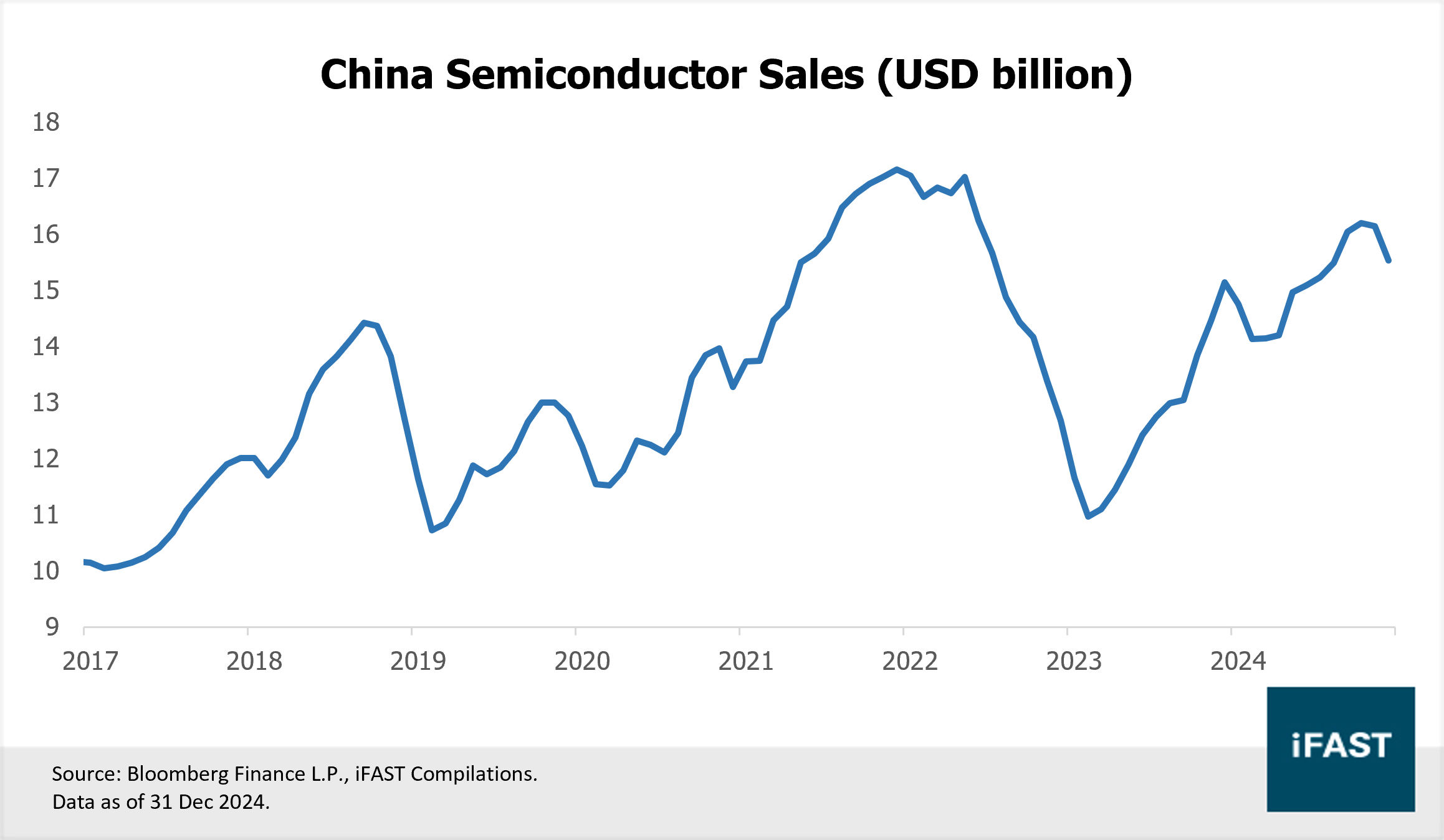
After a prolonged downturn since late 2022, China’s semiconductor output has begun to recover, in line with the global electronics upcycle that started in early 2023 (Figure 1). This recovery has driven a strong rebound in earnings and growth. For instance, China’s leading foundry, SMIC, reported a 25.4% year-over-year increase in revenue (in USD terms) for the first nine months of 2024, fuelled by strong demand for "legacy chips". Consumer electronics was the fastest-growing segment, with wafer sales surging 76.8% in 3Q24.
Figure 1: China semiconductors have experienced significant recovery
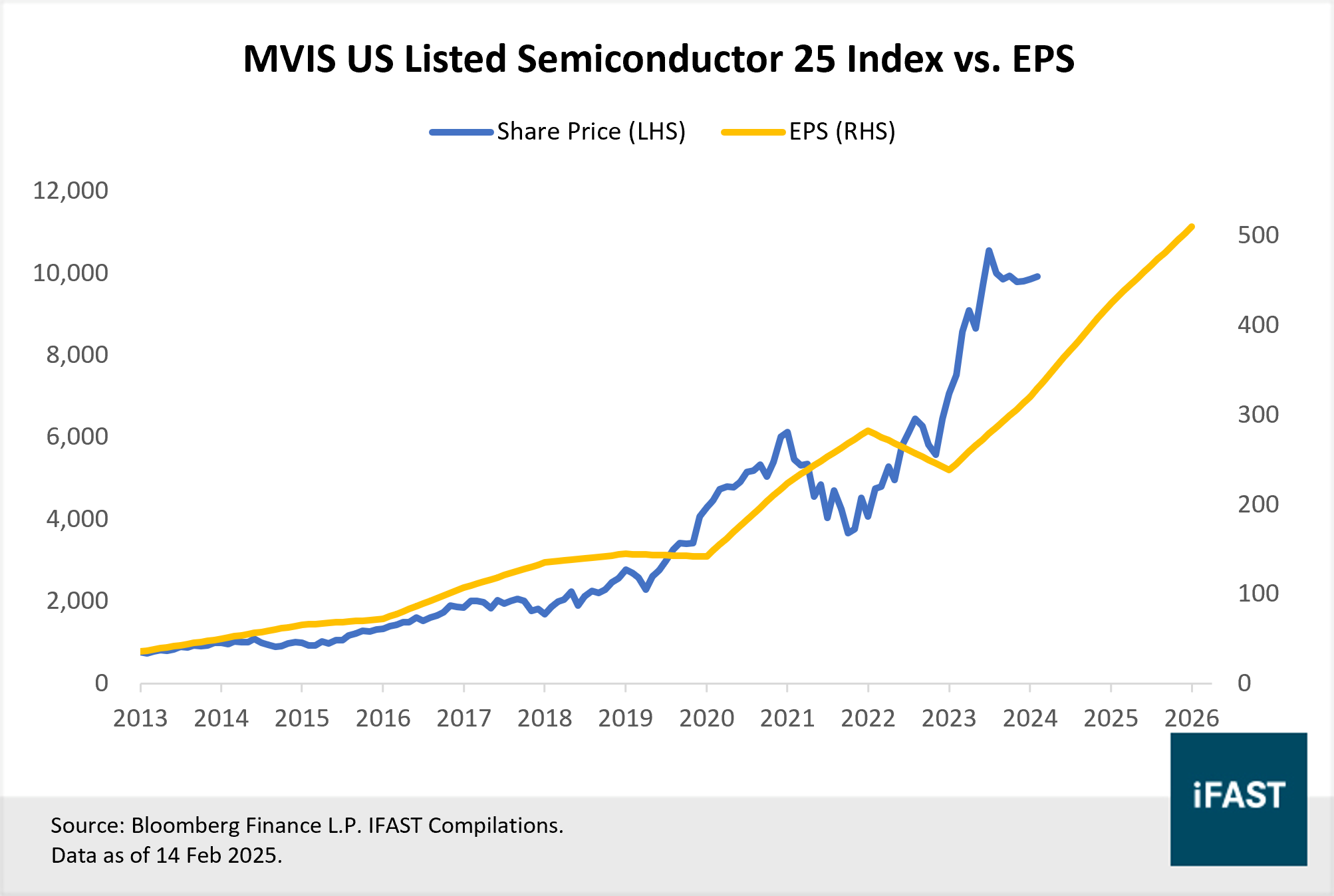
While improving fundamentals should support higher stock prices, the recent DeepSeek-driven rally, has pushed share prices ahead of earnings growth, leaving valuations stretched. Across the semiconductor supply chain - from chip equipment manufacturers to foundries to interconnect chip producers - many Chinese semiconductor stocks are now trading at valuations three times higher than their international peers based on current price-to-earnings (P/E) ratios. Even when considering forward P/E, valuations remain elevated (Table 1). Historically, consensus earnings estimates have often been overly optimistic ahead of actual results, increasing the risk of potential downward revisions and raising concerns about the sustainability of these lofty valuations.
Table 1: Chinese semiconductor stocks trading at nearly 3X the valuation of international peers
|
Category |
Semiconductor Players International vs China |
Current PE |
Forward PE |
|
Etching Equipment |
LAM Research |
24.7 |
21.5 |
|
Advanced Micro-Fabrication Equipment Inc China |
76.7 |
44.7 |
|
|
Thin Film Equipment |
Applied Materials |
19.0 |
17.6 |
|
NAURA Technology Group Co Ltd |
40.5 |
28.0 |
|
|
Foundry |
TSMC |
23.4 |
17.4 |
|
SMIC (H-shares) |
101.4 |
51.2 |
|
|
Interconnect chip products |
NXP Semiconductor |
19.5 |
18.7 |
|
Montage Technology |
69.7 |
38.7 |
|
|
Fabless Design |
Nvidia |
54.7 |
31.0 |
|
Birentech / Moore Threads |
Not listed |
||
|
Lithography Equipment |
ASML |
37.8 |
29.2 |
|
Shanghai Micro Electronics Equipment |
Not listed |
||
|
Source: Bloomberg Finance. L.P. IFAST Compilations. |
|||
Caution warranted on the recent surge in China’s semiconductor stocks
DeepSeek’s success has boosted investor confidence in China’s semiconductor industry and could accelerate efforts toward chip localisation. The strong positive sentiment has already driven a rally in China’s semiconductor stocks, and this momentum could continue in the near term. However, the sharp price increases - outpacing fundamental improvements - suggest that investors should be cautious about the sustainability of these gains.
Additionally, significant uncertainties remain regarding China’s ability to mass-produce advanced chips. Without access to ASML’s EUV lithography equipment, China’s production capabilities for cutting-edge semiconductors remain in question. As the US and its allies will only tighten export controls on semiconductor technology, China’s limited access to the global supply chain could constrain its AI development and scalability unless it achieves full supply chain self-sufficiency - a challenge that remains formidable.
While US chipmakers like NVIDIA have faced setbacks recently, we believe their dominance remains intact. The ongoing AI arms race and the pursuit of Artificial General Intelligence still depend heavily on supercomputing clusters, a domain where NVIDIA maintains a strong lead. Even if competing hardware architectures emerge, NVIDIA’s well-established CUDA ecosystem ensures its GPUs extract superior performance compared to rivals. This software advantage, combined with its technological leadership, reinforces NVIDIA’s long-term competitive edge.
We encourage investors to maintain a balanced view of the semiconductor sector - avoiding excessive optimism about China’s semiconductor prospects while also not being overly bearish on US players. Focusing on fundamentals will better help investors navigate market noise.
From a valuation standpoint, China’s semiconductor stocks appear stretched, raising the risk of a pullback. Conversely, US semiconductor stocks could present buying opportunities at current levels. Applying a fair P/E multiple of 24X to 2026 estimated earnings, we maintain our target price for the VanEck Semiconductor ETF (NASDAQ: SMH) at USD 311, representing an upside potential of 23.0%.
Table 2: Significant upside potential remains for US Chipmakers
|
MVSMHTR Index |
2023 |
2024E |
2025E |
2026E |
|
Earnings Per Share (EPS) |
238.66 |
317.00 |
418.00 |
527.00 |
|
EPS growth |
-15.61% |
32.82% |
31.86% |
26.08% |
|
PE Ratio |
29.61 |
32.43 |
24.59 |
19.51 |
|
Upside Potential |
|
|
|
23.04% |
|
Source: Bloomberg Finance.L.P., IFAST
Compilations. |
||||
Figure 2: Share prices vs EPS for the MVSMHTR Index
Related article: Why 2025 and the years that follow will be even better for chipmakers
Declaration:
For specific disclosure, at the time of publication of this report, IFPL (via its connected and associated entities) and the analyst who produced this report hold a NIL position in the abovementioned securities.

' d='M0 0h300v57H0z'/%3e%3c/svg%3e "sgFsmLogoEnIcon")


'%3e%3cpath fill='%23fff' d='M0 0h21.6v21.6H0z'/%3e%3cg data-name='141-singapore'%3e%3cpath data-name='Rectangle 6502' fill='%23f0f0f0' d='M0 0h22v22H0z'/%3e%3cpath data-name='Rectangle 6503' fill='%23d80027' d='M0 0h22v10H0z'/%3e%3cg data-name='Group 21092' fill='%23f0f0f0'%3e%3cpath data-name='Path 14455' d='M2.917 5.365A3.128 3.128 0 015.374 2.31a3.128 3.128 0 100 6.11 3.128 3.128 0 01-2.457-3.055z'/%3e%3cpath data-name='Path 14456' d='M6.939 2.46l.222.683h.718l-.581.422.222.683-.581-.422-.581.422.222-.683-.581-.422h.718z'/%3e%3cpath data-name='Path 14457' d='M5.193 3.801l.222.683h.718l-.581.422.222.683-.581-.422-.581.422.222-.683-.581-.422h.718z'/%3e%3cpath data-name='Path 14458' d='M8.68 3.801l.222.683h.718l-.581.422.222.683-.581-.422-.581.422.222-.683-.581-.422h.718z'/%3e%3cpath data-name='Path 14459' d='M8.01 5.811l.222.683h.718l-.581.422.222.683-.581-.422-.581.422.222-.683-.581-.422h.718z'/%3e%3cpath data-name='Path 14460' d='M5.863 5.811l.222.683h.718l-.581.422.222.683-.581-.422-.581.422.222-.683-.581-.422h.718z'/%3e%3c/g%3e%3c/g%3e%3c/g%3e%3c/svg%3e "singaporeIcon")


' d='M0 0h67v14H0z'/%3e%3c/svg%3e "msFooterLogoIcon")
