


' fill='%23fff' stroke='%23707070' d='M0 0h21.6v21.6H0z'/%3e%3c/clipPath%3e%3cclipPath id='c'%3e%3cpath data-name='Rectangle 6531' transform='translate(-6319 -2048)' fill='%23fff' stroke='%23707070' d='M0 0h43.2v21.6H0z'/%3e%3c/clipPath%3e%3cclipPath id='a'%3e%3cpath d='M0 0h21.6v21.6H0z'/%3e%3c/clipPath%3e%3c/defs%3e%3cg data-name='Malaysia -Square' clip-path='url(%23a)'%3e%3cpath fill='%23fff' d='M0 0h21.6v21.6H0z'/%3e%3cg data-name='Mask Group 325' transform='translate(6348 2048)' clip-path='url(%23b)'%3e%3cg data-name='Mask Group 324' transform='translate(-35)' clip-path='url(%23c)'%3e%3cg data-name='Group 21195'%3e%3cpath data-name='Path 14718' d='M-6319-2048h43.2v21.6h-43.2z' fill='%23fff'/%3e%3cpath data-name='Path 14719' d='M-6317.457-2047.229h41.657m0 3.086h-41.657m0 3.086h41.657m0 3.086h-41.657' fill='none' stroke='%23c00' stroke-width='1.543'/%3e%3cpath data-name='Path 14720' d='M-6319-2048h21.6v13.114h-21.6z' fill='%23006'/%3e%3cpath data-name='Path 14721' d='M-6319-2034.886h43.2m0 3.086h-43.2m0 3.086h43.2' fill='none' stroke='%23c00' stroke-width='1.543'/%3e%3c/g%3e%3cpath data-name='Path 14722' d='M-6302.5-2045.686l.344 2.353 1.331-1.967-.714 2.269 2.054-1.2-1.626 1.731 2.372-.19-2.218.858 2.218.858-2.372-.19 1.626 1.736-2.054-1.2.714 2.269-1.331-1.97-.344 2.358-.344-2.353-1.331 1.97.714-2.269-2.054 1.2 1.626-1.737-2.372.19 2.218-.858-2.218-.859 2.372.19-1.626-1.736 2.054 1.2-.714-2.267 1.331 1.97zm-1.929.1a4.114 4.114 0 100 7.521 4.629 4.629 0 110-7.521z' fill='%23fc0'/%3e%3c/g%3e%3c/g%3e%3c/g%3e%3c/svg%3e "malaysiaIcon")
'%3e%3cpath fill='%23fff' d='M0 0h21.6v21.6H0z'/%3e%3cg data-name='067-hong-kong'%3e%3cpath data-name='Rectangle 6488' fill='%23d80027' d='M0 0h22v22H0z'/%3e%3cg data-name='Group 21086' fill='%23f0f0f0'%3e%3cpath data-name='Path 14432' d='M11.911 8.264c-.248 1.032-.689.835-.905 1.735a2.373 2.373 0 011.109-4.614c-.429 1.803.018 1.956-.204 2.879z'/%3e%3cpath data-name='Path 14433' d='M8.606 9.029c.9.555.581.913 1.37 1.4a2.373 2.373 0 01-4.045-2.481c1.577.964 1.866.586 2.675 1.081z'/%3e%3cpath data-name='Path 14434' d='M8.311 12.409c.807-.689 1.048-.271 1.752-.871a2.373 2.373 0 11-3.609 3.081c1.408-1.202 1.136-1.594 1.857-2.21z'/%3e%3cpath data-name='Path 14435' d='M11.435 13.734c-.406-.98.066-1.08-.287-1.935a2.373 2.373 0 111.815 4.385c-.708-1.71-1.165-1.573-1.528-2.45z'/%3e%3cpath data-name='Path 14436' d='M13.66 11.173c-1.058.083-1.007-.4-1.929-.325a2.373 2.373 0 114.731-.371c-1.846.145-1.856.621-2.802.696z'/%3e%3c/g%3e%3c/g%3e%3c/g%3e%3c/svg%3e "hongKongIcon")


What is Biotechnology?
Biotechnology involves harnessing technology in cellular and biomolecular processes to develop technologies and products that can help improve our lives and the health of our planet.
Humans have been using innovations in biotechnology for thousands of years, starting out with the manufacture of bread and cheese, and to preserve dairy products. What was once cutting-edge technology, has become ubiquitous today.
In recent times, technological advancements in areas of data processing, cloud computing, machine learning and artificial intelligence have further paved the way for more innovations in the fusion of biology and technology. This is providing tremendous opportunity for the industry to bloom.
In his biography, Steve Jobs remarked, “I think the biggest innovations of the 21st century will be at the intersection of biology and technology”. Fast forward to today, further underscoring its importance and potential for opportunities, biotechnology saw the biggest amount of investments from Private Equity/Venture Capital and hedge funds within the healthcare sector.[1]
For retail investors who are interested to seize this opportunity, one actively managed strategy that they can consider is the Franklin Biotechnology Discovery Fund, which is designed to invest in biotechnology companies mainly located in the U.S. whose products are best-in-class, first-in-class, or only-in-class, and address diseases with significant unmet medical needs delivering clinical value to patients.
What’s Happening in Biotechnology?
While the Covid-19 pandemic has taken over the news cycle for a period of time, longer term demographic trends such as ageing population are still ongoing, which brings about growing demand for healthcare. As people live longer, they are likely to require significantly more healthcare products and services.
With an increased understanding of biology and the need for new treatments, Biotech companies today are more sophisticated in their approach to drug research and development and are investing more in the R&D process and building new drug discovery platforms to support future growth.
The biotechnology space is currently experiencing a wave of innovation, driven by advances in the understanding of biology and medical technology. As a result, new drugs and treatments have been developed for previously incurable conditions, and better treatment methods are also developed for many other conditions.
Another example of the fruit of biotechnology research and innovation is the recent development of mRNA vaccines, which were developed at unprecedented speed, and successfully deployed against Covid-19. These are also the vaccines which are key in helping the world recover from the pandemic induced downturn quickly.
Where does Franklin Templeton believe the biggest opportunities in biotechnology lie?
As the world population continues to age, and new diseases that emerge continue to afflict the wider population, investors are starting to recognize that demand for treatments will propel the biotechnology space to continue to expand and develop treatments. With the continuous advancement of science in this area and many medical conditions still awaiting the discovery of a treatment, there is ample runway for growth of the biotechnology sector.
According to a report published by Franklin Templeton, today, there is already a tremendous amount of innovation taking place in biotechnology, especially in the recent advancements made in the areas of gene therapy and gene editing, immuno-oncology, and precision oncology. These innovations have bore fruit through the development of novel mechanisms to address diseases with high unmet medical need, including Alzheimer’s disease, other neurodegenerative disorders, and NASH (the most severe form of non-alcoholic fatty liver disease).
There are also opportunities at the other end of the “prevalence spectrum” in addressing rare diseases as well as developments within background processes, where many novel discovery tools are being used behind the scenes to enable faster drug discovery and development.
Biotechnology as an investment idea is also beginning to come of age. Compared to the turn of the millennium, the Nasdaq Biotech Index consist of significantly more companies (270+ vs 60+). More companies are entering the space and have progressed from the developmental stages to the commercial stage.
Compared to before, the time taken for new drugs to progress
from the development stage has become both quicker and generally more
predictable. According to Franklin Templeton, this is due to “advancements in
both pre-clinical and early-stage development work that can be used to better
understand a drug’s mechanism of action, potential safety liabilities, and the
most suitable patient population in which to demonstrate efficacy.” This mitigates
the investment risk that investors had to take on when investing in
biotechnology companies.
From an investing standpoint, the fundamentals of the biotechnology sector are
attractive, with biotech sales growth in the past 10 years having outpaced
other sectors such as healthcare and information technology. This bodes
well for investors, who are looking for a wider range of opportunities within
the sector as well as a potential return.
This positive momentum is also noteworthy against the backdrop of the Nasdaq Biotechnology Index sitting at a P/E ratio more favorable than the broader S&P500 Index with the major biotech companies (Amgen, Biogen, Gilead, Regeneron, Vertex) are all trading at a P/E discount to the S&P 500.
How is the Fund helping people to invest in Biotechnology?
The involvement that biotechnology companies have in drug development is inherently risky due to uncertain clinical and regulatory outcomes and the team behind the Franklin Biotechnology Discovery Fund performs rigorous due diligence and careful stock selection to help reduce the risk of unexpected outcomes and manages position sizes to contain the downside risks that may result.
The portfolio is built from bottom-up using Franklin Templeton’s growth, quality and valuation framework. The analysts are generally focused on diseases, becoming experts in the various treatment regimens and can evaluate clinical trials in terms of comparing new treatments to the existing standards of care. These analysts also review clinical trial data to determine efficacy of new treatments and consult with professional experts including doctors to evaluate patient populations, likelihood of prescription, and cost of drugs. The information will then be incorporated when determining price targets for companies under review.
The Fund also uses position size as an effective risk management strategy, investing less in developmental-stage companies with few products, and more in commercial-grade companies with multiple products. They seek to limit downside on a single binary event such as trial success or regulatory approval to the overall portfolio to 75 bps and manage position sizes based on company profile.
The Fund has a solid track record of 20 years of competitive long-term performance and remains fully invested at all times using a bottom-up strategy, and like our constant reminder to investors on FSMOne.com, it invests globally in order to maximize the breadth of investment opportunities.
Performance
Investors looking to invest in this fund can allocate it to their thematic or tactical portion of the portfolios as a means to generate extra performance over the core holdings of the portfolio.

As one might potentially expect, due to the attention given to the biotechnology sector arising from public health concerns in 2020, the fund performed strongly from its March’s lows, outpaced the S&P 500’s rebound and returned 26.10% compared to 13.39% for the broader index.
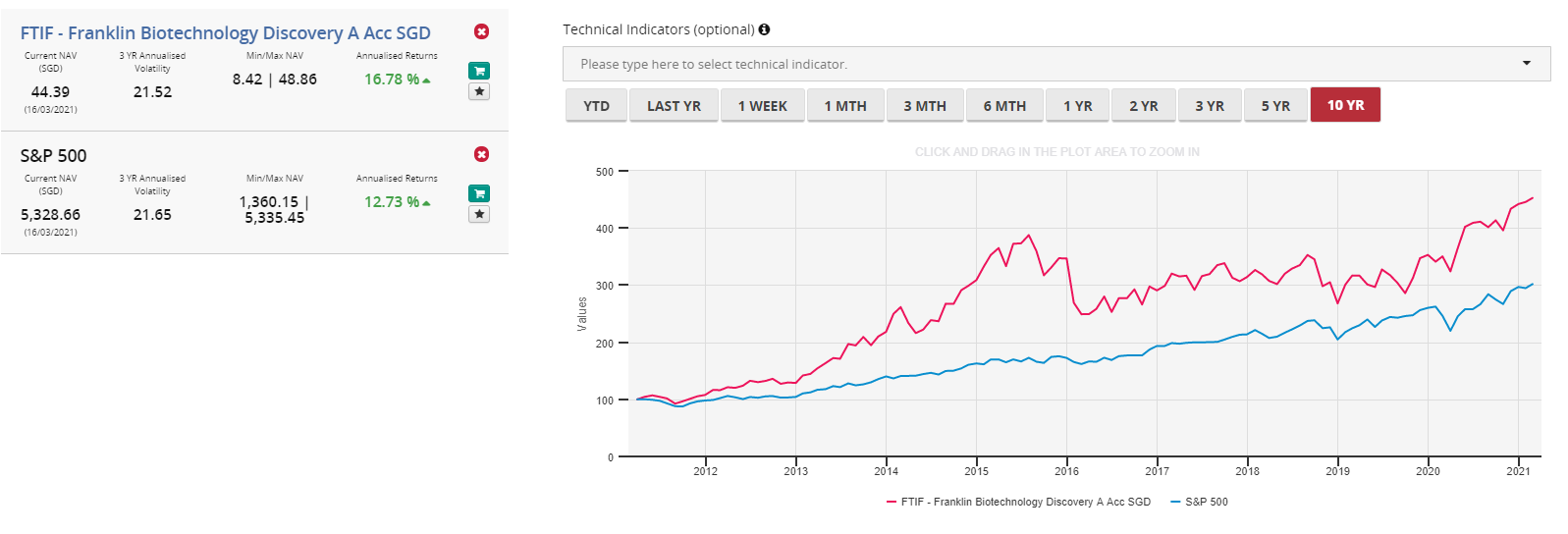
A sterner test for this strategy would be to compare its performance over a longer term time period. We’ve extended the period of comparison to the past decade and we find that the Franklin Biotechnology Discovery fund has returned 16.78% on an annualized basis vs the S&P 500’s 12.73%.
Summary
The impact of innovations in biotechnology are far-reaching. As populations age and the demand for healthcare increases, effective drugs and treatments will continue to be sought from breakthroughs in biotechnology. Coupled with the growth of technological innovations, there is ample room for biotechnology innovations to bloom.
With the valuations of the sector at a discount vs the broader index, investors could consider taking advantage of Franklin Templeton’s long track record of navigating the biotechnology space in order to reap the long term benefits from this sector.
[1] https://www.franklintempleton.com.sg/investor/article?contentPath=html/ftthinks/common/equity/the-business-of-biotechnology.html

' d='M0 0h300v57H0z'/%3e%3c/svg%3e "sgFsmLogoEnIcon")


'%3e%3cpath fill='%23fff' d='M0 0h21.6v21.6H0z'/%3e%3cg data-name='141-singapore'%3e%3cpath data-name='Rectangle 6502' fill='%23f0f0f0' d='M0 0h22v22H0z'/%3e%3cpath data-name='Rectangle 6503' fill='%23d80027' d='M0 0h22v10H0z'/%3e%3cg data-name='Group 21092' fill='%23f0f0f0'%3e%3cpath data-name='Path 14455' d='M2.917 5.365A3.128 3.128 0 015.374 2.31a3.128 3.128 0 100 6.11 3.128 3.128 0 01-2.457-3.055z'/%3e%3cpath data-name='Path 14456' d='M6.939 2.46l.222.683h.718l-.581.422.222.683-.581-.422-.581.422.222-.683-.581-.422h.718z'/%3e%3cpath data-name='Path 14457' d='M5.193 3.801l.222.683h.718l-.581.422.222.683-.581-.422-.581.422.222-.683-.581-.422h.718z'/%3e%3cpath data-name='Path 14458' d='M8.68 3.801l.222.683h.718l-.581.422.222.683-.581-.422-.581.422.222-.683-.581-.422h.718z'/%3e%3cpath data-name='Path 14459' d='M8.01 5.811l.222.683h.718l-.581.422.222.683-.581-.422-.581.422.222-.683-.581-.422h.718z'/%3e%3cpath data-name='Path 14460' d='M5.863 5.811l.222.683h.718l-.581.422.222.683-.581-.422-.581.422.222-.683-.581-.422h.718z'/%3e%3c/g%3e%3c/g%3e%3c/g%3e%3c/svg%3e "singaporeIcon")


' d='M0 0h67v14H0z'/%3e%3c/svg%3e "msFooterLogoIcon")
