


' fill='%23fff' stroke='%23707070' d='M0 0h21.6v21.6H0z'/%3e%3c/clipPath%3e%3cclipPath id='c'%3e%3cpath data-name='Rectangle 6531' transform='translate(-6319 -2048)' fill='%23fff' stroke='%23707070' d='M0 0h43.2v21.6H0z'/%3e%3c/clipPath%3e%3cclipPath id='a'%3e%3cpath d='M0 0h21.6v21.6H0z'/%3e%3c/clipPath%3e%3c/defs%3e%3cg data-name='Malaysia -Square' clip-path='url(%23a)'%3e%3cpath fill='%23fff' d='M0 0h21.6v21.6H0z'/%3e%3cg data-name='Mask Group 325' transform='translate(6348 2048)' clip-path='url(%23b)'%3e%3cg data-name='Mask Group 324' transform='translate(-35)' clip-path='url(%23c)'%3e%3cg data-name='Group 21195'%3e%3cpath data-name='Path 14718' d='M-6319-2048h43.2v21.6h-43.2z' fill='%23fff'/%3e%3cpath data-name='Path 14719' d='M-6317.457-2047.229h41.657m0 3.086h-41.657m0 3.086h41.657m0 3.086h-41.657' fill='none' stroke='%23c00' stroke-width='1.543'/%3e%3cpath data-name='Path 14720' d='M-6319-2048h21.6v13.114h-21.6z' fill='%23006'/%3e%3cpath data-name='Path 14721' d='M-6319-2034.886h43.2m0 3.086h-43.2m0 3.086h43.2' fill='none' stroke='%23c00' stroke-width='1.543'/%3e%3c/g%3e%3cpath data-name='Path 14722' d='M-6302.5-2045.686l.344 2.353 1.331-1.967-.714 2.269 2.054-1.2-1.626 1.731 2.372-.19-2.218.858 2.218.858-2.372-.19 1.626 1.736-2.054-1.2.714 2.269-1.331-1.97-.344 2.358-.344-2.353-1.331 1.97.714-2.269-2.054 1.2 1.626-1.737-2.372.19 2.218-.858-2.218-.859 2.372.19-1.626-1.736 2.054 1.2-.714-2.267 1.331 1.97zm-1.929.1a4.114 4.114 0 100 7.521 4.629 4.629 0 110-7.521z' fill='%23fc0'/%3e%3c/g%3e%3c/g%3e%3c/g%3e%3c/svg%3e "malaysiaIcon")
'%3e%3cpath fill='%23fff' d='M0 0h21.6v21.6H0z'/%3e%3cg data-name='067-hong-kong'%3e%3cpath data-name='Rectangle 6488' fill='%23d80027' d='M0 0h22v22H0z'/%3e%3cg data-name='Group 21086' fill='%23f0f0f0'%3e%3cpath data-name='Path 14432' d='M11.911 8.264c-.248 1.032-.689.835-.905 1.735a2.373 2.373 0 011.109-4.614c-.429 1.803.018 1.956-.204 2.879z'/%3e%3cpath data-name='Path 14433' d='M8.606 9.029c.9.555.581.913 1.37 1.4a2.373 2.373 0 01-4.045-2.481c1.577.964 1.866.586 2.675 1.081z'/%3e%3cpath data-name='Path 14434' d='M8.311 12.409c.807-.689 1.048-.271 1.752-.871a2.373 2.373 0 11-3.609 3.081c1.408-1.202 1.136-1.594 1.857-2.21z'/%3e%3cpath data-name='Path 14435' d='M11.435 13.734c-.406-.98.066-1.08-.287-1.935a2.373 2.373 0 111.815 4.385c-.708-1.71-1.165-1.573-1.528-2.45z'/%3e%3cpath data-name='Path 14436' d='M13.66 11.173c-1.058.083-1.007-.4-1.929-.325a2.373 2.373 0 114.731-.371c-1.846.145-1.856.621-2.802.696z'/%3e%3c/g%3e%3c/g%3e%3c/g%3e%3c/svg%3e "hongKongIcon")


The FTSE China A50 Index tracks the performance of the 50 largest A-share companies listed on the Shanghai and Shenzhen stock exchanges. From leading baijiu producer Kweichow Moutai to electric vehicle (EV) battery giant Contemporary Amperex Technology (CATL), the index holds some of China’s most influential domestic companies.
Notably, many of the index’s holdings pay out attractive dividends as well. The index has a dividend yield of 3.5 percent, compared to 2.1 percent for the broader China market1.
Overview
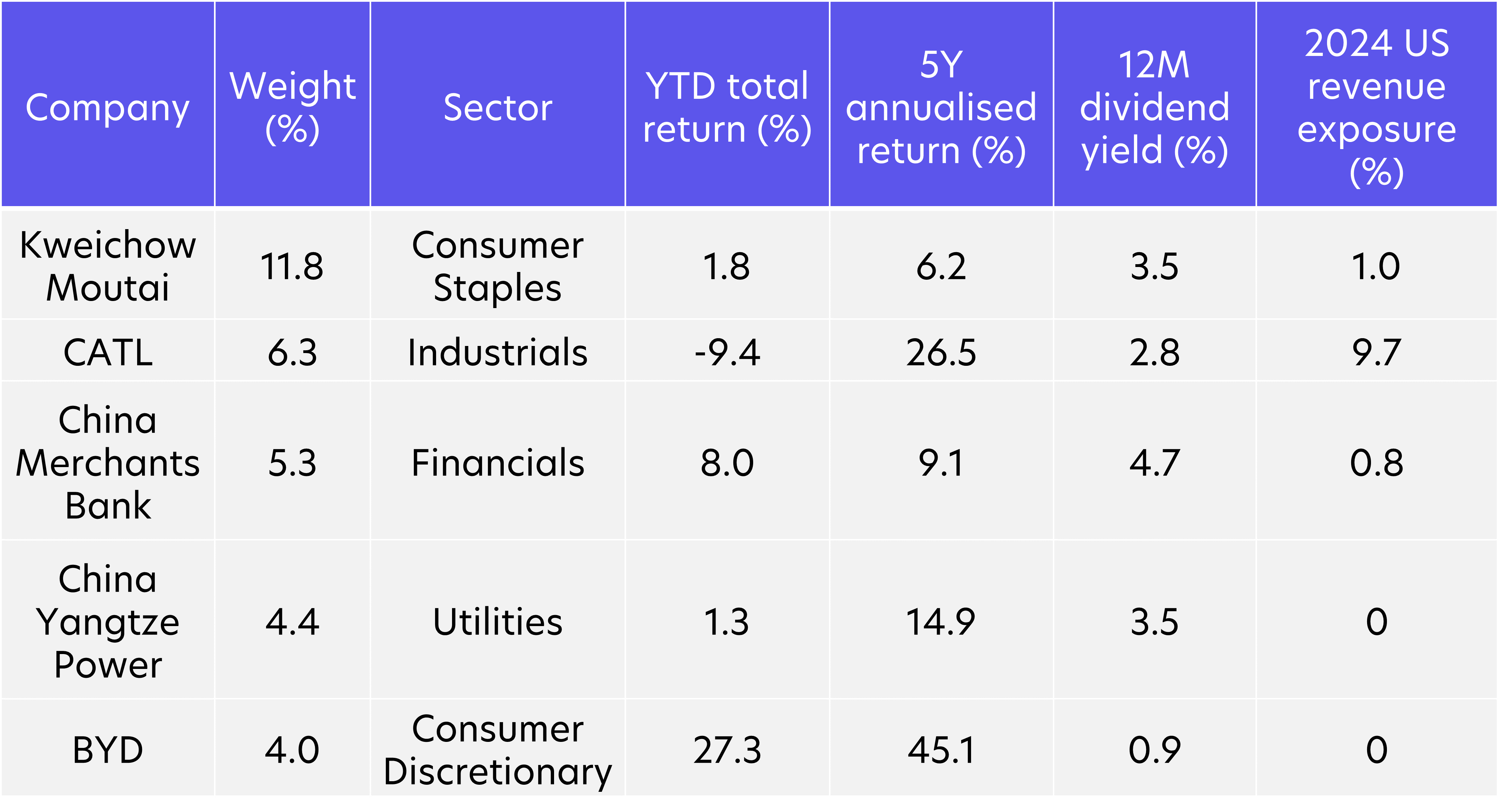
To better understand the FTSE China A50 Index, let’s take a closer look at its top five holdings, which make up one third of the index.
Sector composition: The top five companies represent five different industries (Consumer Staples, Industrials, Financials, Utilities, and Consumer Discretionary), highlighting the diversity within the index.
Performance2: Despite the market volatility from US tariffs, the top five companies have generally held up well, with only one company posting negative returns in the year to date.
Dividend yield3: On average, the top five
companies have a healthy 12-month dividend yield of 3.2 percent, a result of
their resilient business models and stable earnings.
Here’s what to know about each company.
1. Kweichow Moutai
What does the company do?
Kweichow Moutai is a producer of premium baijiu and it is regarded as China’s most distinguished baijiu brand. As China’s largest A-share company by market capitalisation, Kweichow Moutai has a strong brand presence with its liquor frequently being served at diplomatic ceremonies, business banquets and important family occasions.
The company has a keen focus on product innovation as well, having collaborated with other brands to co-launch Moutai-infused ice cream and coffee in recent years.
Outlook
Kweichow Moutai saw healthy revenue growth of 16 percent in 2024, despite raising prices of its flagship liquor by around 20 percent per bottle in late 20234. Although revenue growth came in slightly below guidance, the company has so far managed to weather a broader slowdown in the baijiu sector as consumers cut back on spending, reflecting its strong pricing power and superior brand equity.
Additionally, the Chinese government’s plans to boost domestic consumption could be a tailwind for Kweichow Moutai and help drive greater demand for its premium liquor.
Performance

Source: Bloomberg, as of 28 April 2025.
Kweichow Moutai has generated a modest return of 1.8 percent year to date. On average however, it has delivered 6.2 percent annual returns over the past five years. The company is trading at a price to book (P/B) value of 8.4 currently, below its five-year average P/B value of 11.7. This suggests that its stock is undervalued and there could be upside potential.
Dividends

Source: Bloomberg, as of 28 April 2025.
Kweichow Moutai had a dividend payout ratio of 40.2 percent in 2024, i.e. it paid out 40.2 percent of its net income as dividends to shareholders. Over the past five years between 2020 and 2024, Kweichow Moutai’s dividend per share has grown 38 percent5. Its current 12-month dividend yield stands at 3.5 percent and the company is forecasted to maintain about the same yield in 2025, according to Bloomberg estimates.
2. Contemporary Amperex Technology (CATL)
What does the company do?
CATL is the world’s largest manufacturer of electric vehicle (EV) batteries, and it is a major supplier to Tesla. The company recently announced advances in its EV battery technology, including superfast charging of up to 520 km in 5 minutes. Currently listed on the Shenzhen stock exchange, CATL has filed to also list in Hong Kong this year, with the deal expected to raise at least $5 billion6. If completed, it would be Hong Kong’s largest IPO since early 2021.
Outlook
CATL is the only company within the index’s top five constituents to record negative returns on a year-to-date basis, largely due to geopolitical headwinds. Of the five top holdings, CATL has the largest US revenue exposure at 9.7 percent7.
However, CATL is in a strong position to ride out current challenges. It continues to dominate the EV battery space with a global market share of around 38.2 per cent8. Despite a global slowdown in EV demand and falling battery prices, CATL registered a 33 per cent jump in Q1 2025 earnings9.
Although market sentiment on the stock has turned negative, the company notes that the US accounts for only a small share of its shipments and that tariffs are likely to have minimal impact on its future performance10.
Performance

Source: Bloomberg, as of 28 April 2025.
CATL has declined 9.4 percent year to date. But the company has historically been a strong performer, with annualised returns of 26.5 percent over the past five years. At current P/B valuations of 4.0 compared to its historical P/B value of 8.6, its stock appears undervalued, suggesting attractive upside potential.
Dividends

Source: Bloomberg, as of 28 April 2025.
CATL’s dividend per share has climbed from RMB 0.1 in 2020 to RMB 4.5 in 2024, representing a 3,400 percent increase over the past five years. In 2024, it paid out half of its net income as dividends.
Its current 12-month dividend yield stands at 3.7 percent though the yield is forecasted to drop to around 1.9 percent in 2025, according to Bloomberg estimates. This is not necessarily a bad thing as the company’s lower expected dividend is likely due to its increased investments in its global expansion and higher research and development, which diverts funds from dividend payouts12.
3. China Merchants Bank
What does the company do?
China Merchants Bank is one of China’s largest commercial banks. It offers a wide range of financial services, including retail banking, corporate banking, and wealth management, catering to both individual and institutional clients.
Outlook
China Merchants Bank reported earnings largely in line with expectations, with net profit up 1.2 percent in 202413. Notably, the bank’s wealth management business continues to grow from strength to strength. Its retail assets under management (AUM) rose 12 percent year-on-year in 2024, cementing its leading market share in the wealth management space14.
Year to date, the company has returned 8.0 percent, part of a wider trend of investors gravitating to Chinese banks for their attractive dividend yields15. The Chinese banking sector also stands to benefit from the government’s anticipated stimulus measures aimed at supporting economic growth.
Performance

Source: Bloomberg, as of 28 April 2025.
With returns of 8.0 percent, China Merchants Bank is the second-best performing company out of the index’s top five holdings. Over the past five years, the company has delivered 9.1 percent returns each year on average. At a current P/B value of 1.0, the company’s stock is fairly valued, though it is slightly below its historical P/B value of 1.2.
Dividends

Source: Bloomberg, as of 28 April 2025.
The dividend per share for China Merchants Bank has increased 60 percent over the past five years between 2020 and 202416. In 2024, it paid out about one third of its net income as dividends.
Of the FTSE China A50 Index’s top five holdings, China Merchants Bank currently has the highest 12-month dividend yield at 4.7 percent and the company is forecasted to maintain that yield in 2025, according to Bloomberg estimates.
4. China Yangtze Power
What does the company do?
China Yangtze Power is not only China’s largest listed electric power company, but it is also the world’s largest listed hydropower company17. It operates the Three Gorges Dam and several other major hydropower stations along the Yangtze River, contributing significantly to China’s clean energy output.
Outlook
According to preliminary data, China Yangtze Power reported a 19 percent increase in net profit in 2024, driven mainly by a year-on-year increase in electricity generation from its hydropower stations18. This came as China experienced heavy rains in 2024, which replenished water levels in the Yangtze River and enabled the company’s hydropower stations to operate at higher capacities.
The stock has longer-term tailwinds as well, such as supportive government policies on clean energy amid China’s push to reach peak carbon emissions by 2030 and become carbon neutral before 2060. Hydropower is one of the cleanest forms of energy, producing no direct emissions.
Performance
Source: Bloomberg, as of 28 April 2025.
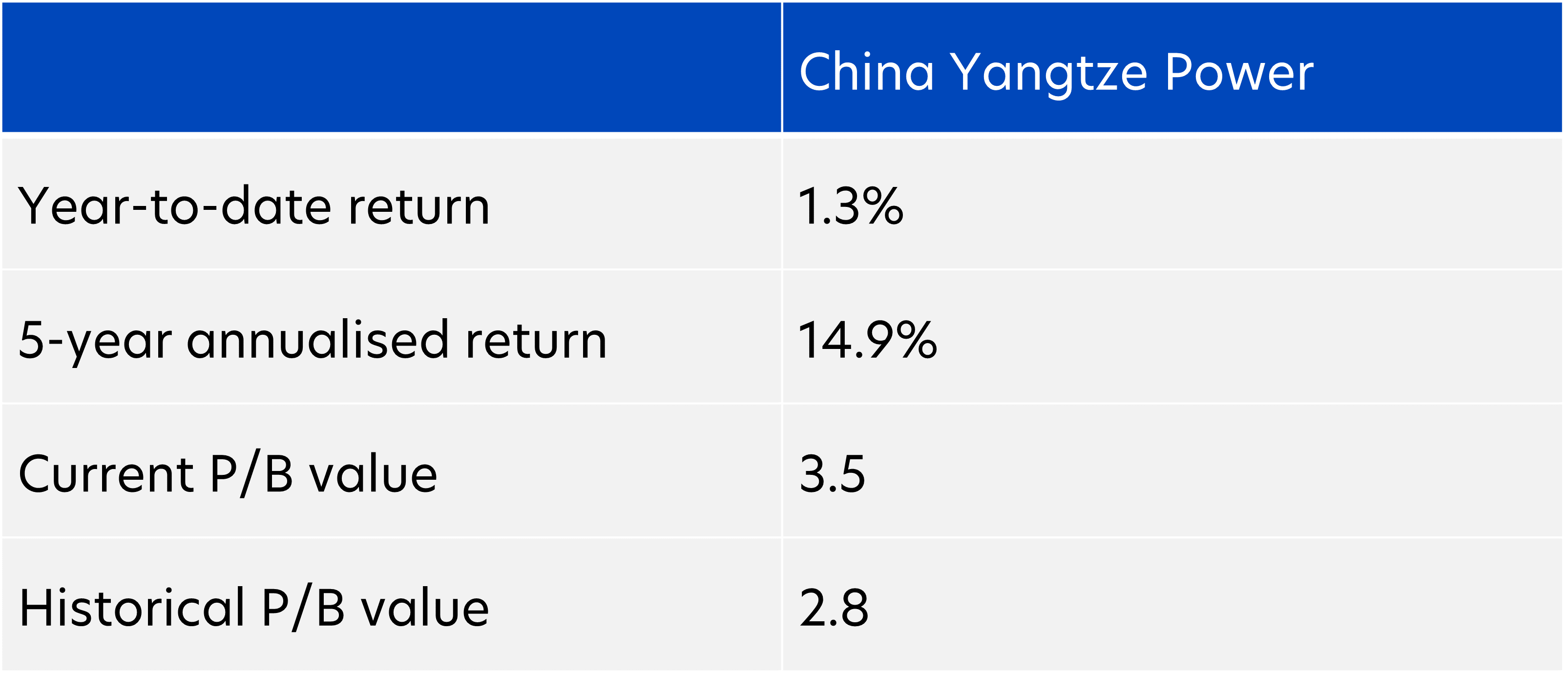
Year to date, China Yangtze Power is almost flat at 1.3 percent. However, the company has delivered good double-digit returns of 14.9 percent each year, looking back over the past five years. At a current P/B value of 3.5 compared to its historical P/B value of 2.8, the company’s stock is slightly overvalued.
Dividends

Source: Bloomberg, as of 28 April 2025.
China Yangtze Power’s dividend per share has risen 17 percent from 2020 to 202319, with results for 2024 still pending. The company paid out 73.7 percent of its income as dividends in 2023. While its current 12-month dividend yield stands at 3.5 percent, that is forecasted to drop to 0.7 percent in 2025, according to Bloomberg estimates.
5. BYD
What does the company do?
BYD is the world’s top EV seller and is currently the world’s sixth-largest automaker20. The company is well-known not just for its price competitiveness, but also its various innovations such as God’s Eye, an advanced driver-assistance system, and its fast-charging battery technology. In Singapore, BYD became the top-selling car brand in 2024, marking the first time a Chinese EV brand has done so21.
Outlook22
BYD is one of the most promising EV car brands in the market today, driven by strong sales and eye-catching innovations. In China, BYD has expanded its market share after undercutting competitors with aggressive pricing strategies and offering its God’s Eye technology at no extra cost for most of its cars. The company is also making strides in markets like Europe, Southeast Asia and South America, and aims to double overseas sales to more than 800,000 cars in 2025.
As a result, BYD’s net profit has doubled in Q1 2025 from a year earlier, the fastest pace in nearly two years. To overcome potential tariff issues on Chinese car imports, BYD also plans to assemble its cars in factories abroad. It is setting up factories in Brazil, Thailand, Hungary, and Turkey.
Performance
Source: Bloomberg, as of 28 April 2025.
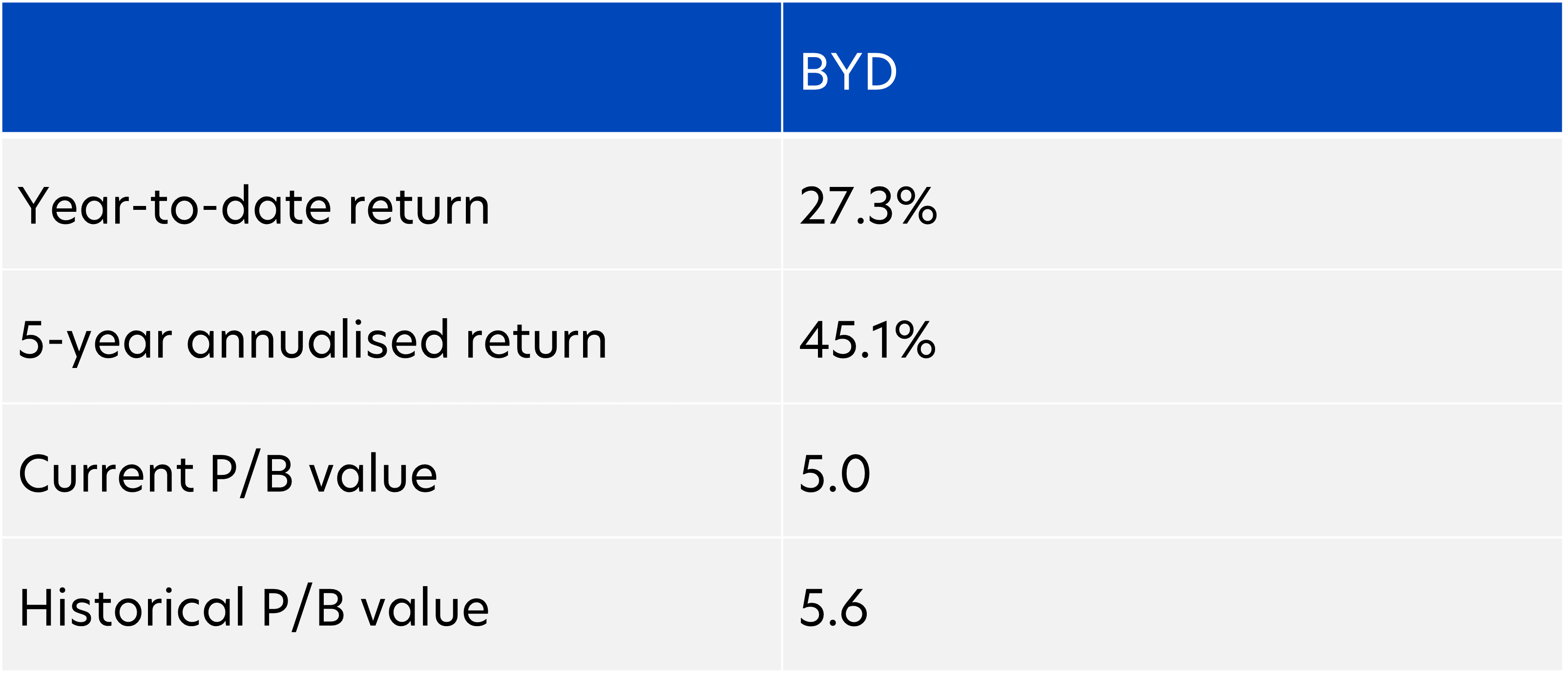
BYD has returned 27.3 percent year to date – offering the best performance out of the index’s top five holdings in 2025. BYD is also the best-performing stock over the past five years, with annual returns of 45.1 percent.
Despite a healthy performance so far this year, BYD’s stock remains slightly undervalued. Its current P/B value stands at 5.0 compared to its historical P/B value of 5.6.
Dividends
Source: Bloomberg, as of 28 April 2025.
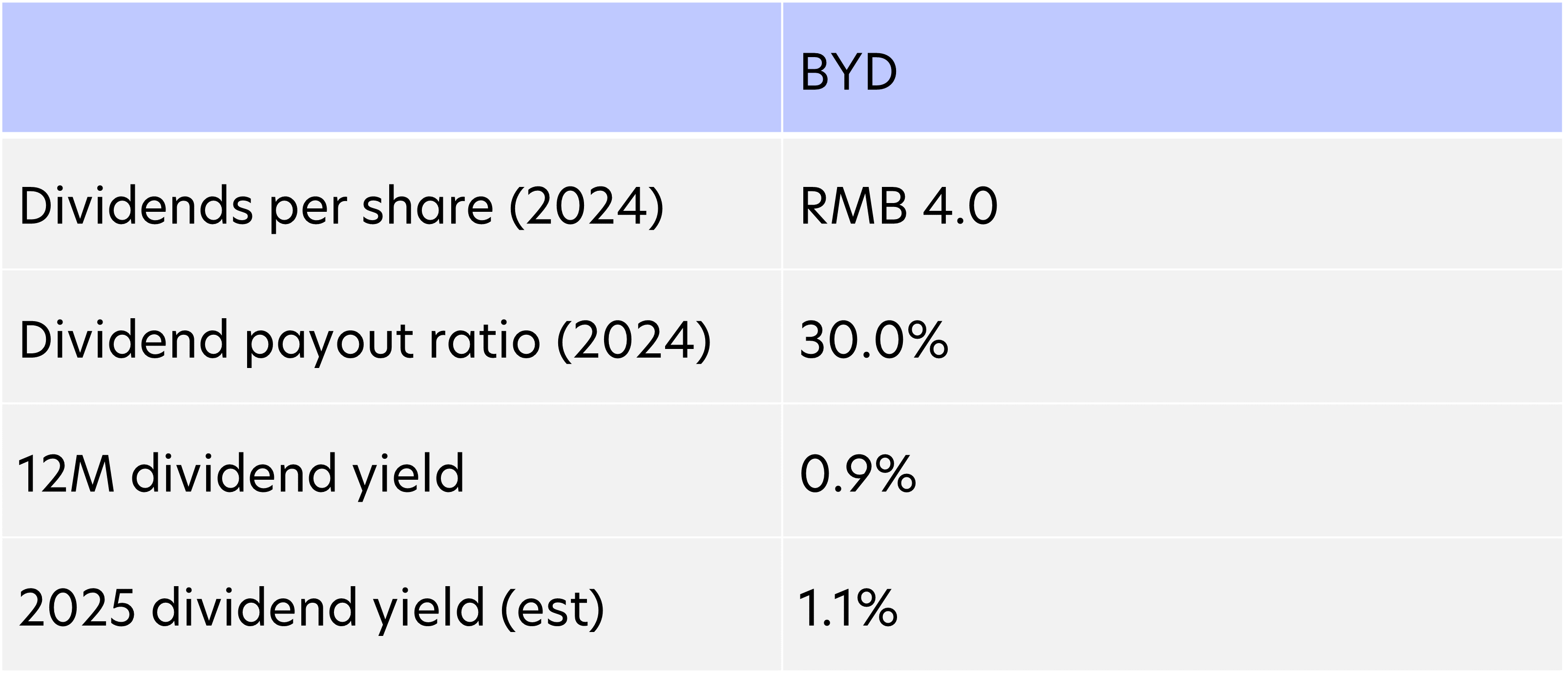
As BYD scaled up its operations and earnings, its dividend per share has increased from RMB 0.2 in 2020[23] to RMB 4.0 in 2024. This represents a 2,546 percent increase over the past five years.
Its
12-month dividend yield stands at 0.9 percent. Although the figure seems low,
this is due to how the dividend yield is calculated. BYD’s share price has
risen more significantly than the increase in dividends over the past 12
months, resulting in a lower yield. For 2025, Bloomberg estimates put BYD’s
dividend yield higher at 1.1 percent.
Will US tariffs affect dividend yields going forward?
US tariffs should not have a significant impact on the dividend yields of the index’s top five holdings. Four of the five top holdings have no or almost no revenue exposure to the US24. For CATL, its US revenue exposure is still relatively low at just 9.7 percent25. Overall, this should cushion the impact of US tariffs on their earnings and dividends.
While a global economic slowdown could still affect dividend yields in 2025, their domestic focus means the index’s top five companies are well-positioned to benefit from China’s anticipated stimulus plans to boost consumption and shore up economic growth. As such, we would continue to expect resilient dividend payouts from the index’s top five constituents.
Source: Bloomberg, as of 28 April 2025
How to invest in the FTSE China A50 Index?
Investors can gain exposure to the FTSE China A50 Index by investing in exchange traded funds (ETFs) that track the index.
For Singapore investors, the UOBAM FTSE China A50 Index (SGX: JK8) is an attractive option that is listed on the Singapore Exchange (SGX) and offers trading in SGD. This offers convenience for Singapore investors who do not wish to bother with currency exchange issues.
The ETF can be bought from just one unit, and Singaporeans can also invest in the ETF using their SRS funds.
Learn more about the UOBAM FTSE China A50 Index (SGX: JK8) here.
1 Source:
FTSE Russell, MSCI, as of 31 March 2025. Broader China market refers to the
MSCI China Index
2 Year to
date figures quoted in this article are sourced from Bloomberg, as of 28 April
2025
3 Dividend
figures quoted in this article are sourced from Bloomberg, as of 28 April
2025
4 Source:
Kweichow Moutai earnings report, as of 31 Dec 2024
5 Source:
Bloomberg, as of 28 April 2025
6 Source:
CATL gets Hong Kong approval for this year’s biggest listing, The Business
Times, 11 Apr 2025
7 Source:
Bloomberg, as of 28 April 2025
8 Source:
SNE Research, based on Jan and Feb data for 2025
9,10 Source:
CATL earnings report, as of 31 Mar 2025
11 Dividend
figures quoted in this section are all sourced from Bloomberg, as of 28 Apr
2025
12 Source:
CATL earnings report, as of 31 Mar 2025
13,14 Source:
China Merchants Bank earnings report, as of 31 Dec 2024
15,16 Source:
Bloomberg, as of 28 Apr 2025
17 Source:
China State-owned Assets Supervision and Administration Commission of the State
Council
18 Source:
China Yangtze Power Announcement on 2024 Preliminary accounting data
19 Source:
Bloomberg, as of 28 Apr 2025
20 Source:
China EV giant BYD reboots Europe operations after strategic stumbles, sources
say, Reuters, 23 Apr 2025
21 Source:
BYD tops 2024 new car sales in S’pore, first for a Chinese EV brand, The
Straits Times, 23 Jan 2025
22 BYD
earnings and outlook quoted sourced from BYD earnings call, 26 March 2025
23, 24, 25 Source:
Bloomberg, as of 28 Apr 2025

' d='M0 0h300v57H0z'/%3e%3c/svg%3e "sgFsmLogoEnIcon")


'%3e%3cpath fill='%23fff' d='M0 0h21.6v21.6H0z'/%3e%3cg data-name='141-singapore'%3e%3cpath data-name='Rectangle 6502' fill='%23f0f0f0' d='M0 0h22v22H0z'/%3e%3cpath data-name='Rectangle 6503' fill='%23d80027' d='M0 0h22v10H0z'/%3e%3cg data-name='Group 21092' fill='%23f0f0f0'%3e%3cpath data-name='Path 14455' d='M2.917 5.365A3.128 3.128 0 015.374 2.31a3.128 3.128 0 100 6.11 3.128 3.128 0 01-2.457-3.055z'/%3e%3cpath data-name='Path 14456' d='M6.939 2.46l.222.683h.718l-.581.422.222.683-.581-.422-.581.422.222-.683-.581-.422h.718z'/%3e%3cpath data-name='Path 14457' d='M5.193 3.801l.222.683h.718l-.581.422.222.683-.581-.422-.581.422.222-.683-.581-.422h.718z'/%3e%3cpath data-name='Path 14458' d='M8.68 3.801l.222.683h.718l-.581.422.222.683-.581-.422-.581.422.222-.683-.581-.422h.718z'/%3e%3cpath data-name='Path 14459' d='M8.01 5.811l.222.683h.718l-.581.422.222.683-.581-.422-.581.422.222-.683-.581-.422h.718z'/%3e%3cpath data-name='Path 14460' d='M5.863 5.811l.222.683h.718l-.581.422.222.683-.581-.422-.581.422.222-.683-.581-.422h.718z'/%3e%3c/g%3e%3c/g%3e%3c/g%3e%3c/svg%3e "singaporeIcon")


' d='M0 0h67v14H0z'/%3e%3c/svg%3e "msFooterLogoIcon")
