


' fill='%23fff' stroke='%23707070' d='M0 0h21.6v21.6H0z'/%3e%3c/clipPath%3e%3cclipPath id='c'%3e%3cpath data-name='Rectangle 6531' transform='translate(-6319 -2048)' fill='%23fff' stroke='%23707070' d='M0 0h43.2v21.6H0z'/%3e%3c/clipPath%3e%3cclipPath id='a'%3e%3cpath d='M0 0h21.6v21.6H0z'/%3e%3c/clipPath%3e%3c/defs%3e%3cg data-name='Malaysia -Square' clip-path='url(%23a)'%3e%3cpath fill='%23fff' d='M0 0h21.6v21.6H0z'/%3e%3cg data-name='Mask Group 325' transform='translate(6348 2048)' clip-path='url(%23b)'%3e%3cg data-name='Mask Group 324' transform='translate(-35)' clip-path='url(%23c)'%3e%3cg data-name='Group 21195'%3e%3cpath data-name='Path 14718' d='M-6319-2048h43.2v21.6h-43.2z' fill='%23fff'/%3e%3cpath data-name='Path 14719' d='M-6317.457-2047.229h41.657m0 3.086h-41.657m0 3.086h41.657m0 3.086h-41.657' fill='none' stroke='%23c00' stroke-width='1.543'/%3e%3cpath data-name='Path 14720' d='M-6319-2048h21.6v13.114h-21.6z' fill='%23006'/%3e%3cpath data-name='Path 14721' d='M-6319-2034.886h43.2m0 3.086h-43.2m0 3.086h43.2' fill='none' stroke='%23c00' stroke-width='1.543'/%3e%3c/g%3e%3cpath data-name='Path 14722' d='M-6302.5-2045.686l.344 2.353 1.331-1.967-.714 2.269 2.054-1.2-1.626 1.731 2.372-.19-2.218.858 2.218.858-2.372-.19 1.626 1.736-2.054-1.2.714 2.269-1.331-1.97-.344 2.358-.344-2.353-1.331 1.97.714-2.269-2.054 1.2 1.626-1.737-2.372.19 2.218-.858-2.218-.859 2.372.19-1.626-1.736 2.054 1.2-.714-2.267 1.331 1.97zm-1.929.1a4.114 4.114 0 100 7.521 4.629 4.629 0 110-7.521z' fill='%23fc0'/%3e%3c/g%3e%3c/g%3e%3c/g%3e%3c/svg%3e "malaysiaIcon")
'%3e%3cpath fill='%23fff' d='M0 0h21.6v21.6H0z'/%3e%3cg data-name='067-hong-kong'%3e%3cpath data-name='Rectangle 6488' fill='%23d80027' d='M0 0h22v22H0z'/%3e%3cg data-name='Group 21086' fill='%23f0f0f0'%3e%3cpath data-name='Path 14432' d='M11.911 8.264c-.248 1.032-.689.835-.905 1.735a2.373 2.373 0 011.109-4.614c-.429 1.803.018 1.956-.204 2.879z'/%3e%3cpath data-name='Path 14433' d='M8.606 9.029c.9.555.581.913 1.37 1.4a2.373 2.373 0 01-4.045-2.481c1.577.964 1.866.586 2.675 1.081z'/%3e%3cpath data-name='Path 14434' d='M8.311 12.409c.807-.689 1.048-.271 1.752-.871a2.373 2.373 0 11-3.609 3.081c1.408-1.202 1.136-1.594 1.857-2.21z'/%3e%3cpath data-name='Path 14435' d='M11.435 13.734c-.406-.98.066-1.08-.287-1.935a2.373 2.373 0 111.815 4.385c-.708-1.71-1.165-1.573-1.528-2.45z'/%3e%3cpath data-name='Path 14436' d='M13.66 11.173c-1.058.083-1.007-.4-1.929-.325a2.373 2.373 0 114.731-.371c-1.846.145-1.856.621-2.802.696z'/%3e%3c/g%3e%3c/g%3e%3c/g%3e%3c/svg%3e "hongKongIcon")


Overview
Growth stocks showed signs of revival starting in mid-May of 2021, but the continuously expanding commodity shortages have stalled their progress. Energy shortages in Europe and China have led to a rally in energy prices and inflation fears. The 10-year US Treasury bond yield is at a fresh multi-month high as the Fed has indicated they will start tapering in 2021. Rising commodity prices are coinciding with global slowing growth due to many factors, including fresh COVID-19 outbreaks and lockdowns in East Asia. Stagflation has become a potential risk. The stage appears to be set for another period of a value-style bias. Nonetheless, the attractiveness of growth stocks’ valuations should counterbalance commodity-facing emerging economies, especially in China.
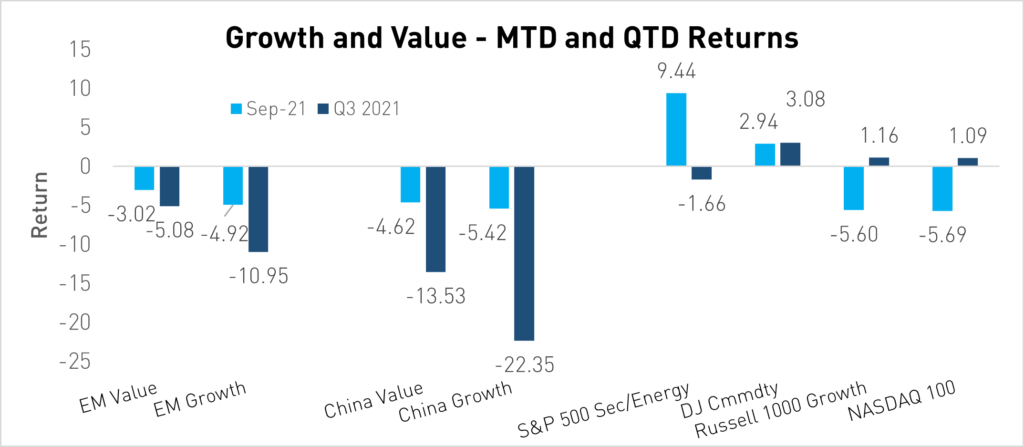
Source: Morningstar. Data as of 9/30/2021
Krane Emerging Markets Consumer Technology Review
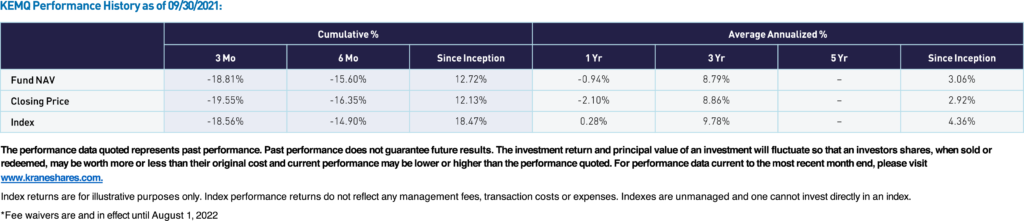
Inception Date: 10/11/2017; Total Annual Fund Operating Expense (Gross): 0.79%
The Fund’s overweight position versus MSCI EM to China technology detracted mostly due to regulations. The Fund’s underweight position in India also detracted. The Fund’s technology exposures in Russia and Saudi Arabia contributed the most as these markets received a substantial boost from energy prices. On a sector level, the Fund’s overweight positions in communication services and consumer discretionary detracted the most.
Source: Morningstar. Data as of 9/30/2021
Market Review
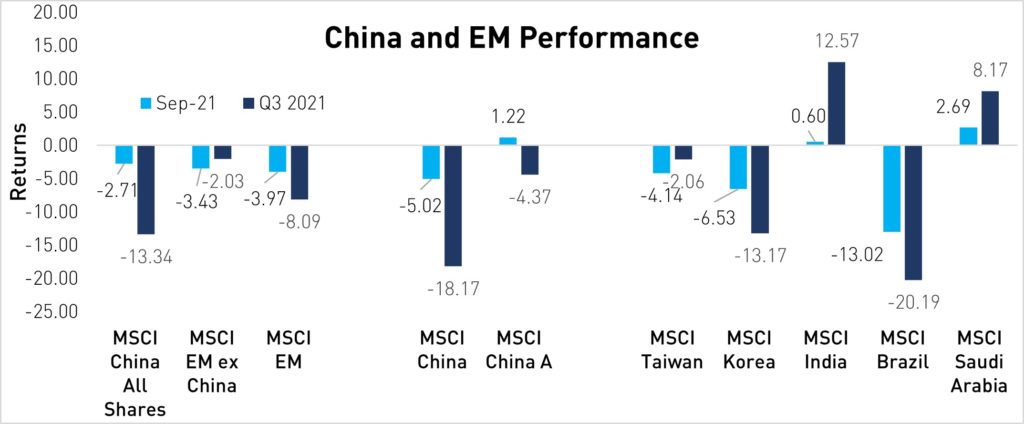
Q3 was a rocky quarter for China as the asset class underperformed Emerging Markets ex-China. China’s A-shares market held up better than China’s offshore market as it was removed from the impact of the regulatory noise. MSCI China All Shares Index ended the quarter down -13.34%1 versus -2.03%1 for emerging markets ex-China. MSCI China A edged MSCI China, returning -4.37%1 and -18.17%1, respectively. China growth underperformed China value for the third quarter in a row.
The slowdown of China’s leading economic indicators2, especially in July and August, rattled markets. The slowdown was mainly due to sluggish consumer demand as COVID-19 lockdowns across multiple regions in China dampened economic activity. In September, China’s largest developer, Evergrande, announced that it could not make its upcoming interest payment. The announcement led to a sharp slowdown in China’s real estate market, which represents close to 30%2 of the economy when considering all the market’s upstream and downstream consequences. Energy shortages began to spread in September, leading to energy rationing and, in some cases, production shutdowns within industries that require high energy consumption, such as steel, cement, and Aluminum. While the Consumer Price Index (CPI) in China remains close to 0.8%2, the Producer Price Index (PPI) is now in double digits2, a heavy burden on companies’ finances.
On the positive side in China, there seems to be some light at the end of the tunnel regarding regulations. Many internet companies were declared compliant in Q3, and the rapid-fire policy approach we saw during the beginning of the summer seems to have slowed down. The Meituan fine was not too hefty and provided investors with closure. Data from the Ministry of Industry and Information Technology (MIIT)showed that internet companies saw that their profits accelerated at a faster pace during the first eight months of the year. Valuations in China look attractive, especially vis-à-vis the US.
India was a standout during the third quarter, returning +12.57%1, led by a rally in technology companies and banks. COVID-19 cases in the country continue to decline, and vaccination is on the rise. Inflation in India was also lower than expected. Also, Saudi Arabia and Russia fared well, helped by the rally in energy prices. Taiwan declined slightly, but Korea suffered as it witnessed its worst COVID-19 wave yet during the summer. Also, slowing growth globally signals that exports, Korea’s leading contributor to GDP, will be slowing down and that the consumer will have to pick up the slack. Brazil was one of the worst performers in Q3 of 2021, driven by the collapse of Iron Ore prices and currency weakness.
Outlook
Investors have been dealing with a slew of global imbalances caused by a confluence of factors, including the pandemic. The low base effect from 2020 and the high bar set in 2021 will continue to impact growth targets. Pent-up demand from the pandemic, supply-side disruption, and decarbonization efforts have led to widespread supply-side shortages, impacting multiple industries. The reversal of loose monetary policy, especially in the US and EU, may begin in Q4 of 2021, sooner than many had anticipated. All this will continue to put upside pressure on inflation and rates and downside pressure on growth. We expect to see improvement in China concerning regulations and energy shortages. After all, next year is an important political year in which both the Beijing Olympics and the inauguration of the 14th National People’s Congress will take place. Despite the weak GDP print recently, China’s central bank now expects GDP to grow 8% this year, exceeding their previous growth target of 6%.3 China can deal with its issues but may save some of its ammunition for next year. The upside risk in inflation bodes well for commodity-facing countries in emerging markets ex-China. Despite all, emerging markets equities are currently offered at a steep discount to developed markets. Adjusting for quality, valuations are even more attractive in China’s growth stocks. We believe China and emerging markets are essential elements of a global portfolio due to current valuations and growth potential.
Citations
1 Data from Morningstar
2 Data from Bloomberg
3 People’s Bank of China Press Release as of October 18, 2021.

' d='M0 0h300v57H0z'/%3e%3c/svg%3e "sgFsmLogoEnIcon")


'%3e%3cpath fill='%23fff' d='M0 0h21.6v21.6H0z'/%3e%3cg data-name='141-singapore'%3e%3cpath data-name='Rectangle 6502' fill='%23f0f0f0' d='M0 0h22v22H0z'/%3e%3cpath data-name='Rectangle 6503' fill='%23d80027' d='M0 0h22v10H0z'/%3e%3cg data-name='Group 21092' fill='%23f0f0f0'%3e%3cpath data-name='Path 14455' d='M2.917 5.365A3.128 3.128 0 015.374 2.31a3.128 3.128 0 100 6.11 3.128 3.128 0 01-2.457-3.055z'/%3e%3cpath data-name='Path 14456' d='M6.939 2.46l.222.683h.718l-.581.422.222.683-.581-.422-.581.422.222-.683-.581-.422h.718z'/%3e%3cpath data-name='Path 14457' d='M5.193 3.801l.222.683h.718l-.581.422.222.683-.581-.422-.581.422.222-.683-.581-.422h.718z'/%3e%3cpath data-name='Path 14458' d='M8.68 3.801l.222.683h.718l-.581.422.222.683-.581-.422-.581.422.222-.683-.581-.422h.718z'/%3e%3cpath data-name='Path 14459' d='M8.01 5.811l.222.683h.718l-.581.422.222.683-.581-.422-.581.422.222-.683-.581-.422h.718z'/%3e%3cpath data-name='Path 14460' d='M5.863 5.811l.222.683h.718l-.581.422.222.683-.581-.422-.581.422.222-.683-.581-.422h.718z'/%3e%3c/g%3e%3c/g%3e%3c/g%3e%3c/svg%3e "singaporeIcon")


' d='M0 0h67v14H0z'/%3e%3c/svg%3e "msFooterLogoIcon")
