


' fill='%23fff' stroke='%23707070' d='M0 0h21.6v21.6H0z'/%3e%3c/clipPath%3e%3cclipPath id='c'%3e%3cpath data-name='Rectangle 6531' transform='translate(-6319 -2048)' fill='%23fff' stroke='%23707070' d='M0 0h43.2v21.6H0z'/%3e%3c/clipPath%3e%3cclipPath id='a'%3e%3cpath d='M0 0h21.6v21.6H0z'/%3e%3c/clipPath%3e%3c/defs%3e%3cg data-name='Malaysia -Square' clip-path='url(%23a)'%3e%3cpath fill='%23fff' d='M0 0h21.6v21.6H0z'/%3e%3cg data-name='Mask Group 325' transform='translate(6348 2048)' clip-path='url(%23b)'%3e%3cg data-name='Mask Group 324' transform='translate(-35)' clip-path='url(%23c)'%3e%3cg data-name='Group 21195'%3e%3cpath data-name='Path 14718' d='M-6319-2048h43.2v21.6h-43.2z' fill='%23fff'/%3e%3cpath data-name='Path 14719' d='M-6317.457-2047.229h41.657m0 3.086h-41.657m0 3.086h41.657m0 3.086h-41.657' fill='none' stroke='%23c00' stroke-width='1.543'/%3e%3cpath data-name='Path 14720' d='M-6319-2048h21.6v13.114h-21.6z' fill='%23006'/%3e%3cpath data-name='Path 14721' d='M-6319-2034.886h43.2m0 3.086h-43.2m0 3.086h43.2' fill='none' stroke='%23c00' stroke-width='1.543'/%3e%3c/g%3e%3cpath data-name='Path 14722' d='M-6302.5-2045.686l.344 2.353 1.331-1.967-.714 2.269 2.054-1.2-1.626 1.731 2.372-.19-2.218.858 2.218.858-2.372-.19 1.626 1.736-2.054-1.2.714 2.269-1.331-1.97-.344 2.358-.344-2.353-1.331 1.97.714-2.269-2.054 1.2 1.626-1.737-2.372.19 2.218-.858-2.218-.859 2.372.19-1.626-1.736 2.054 1.2-.714-2.267 1.331 1.97zm-1.929.1a4.114 4.114 0 100 7.521 4.629 4.629 0 110-7.521z' fill='%23fc0'/%3e%3c/g%3e%3c/g%3e%3c/g%3e%3c/svg%3e "malaysiaIcon")
'%3e%3cpath fill='%23fff' d='M0 0h21.6v21.6H0z'/%3e%3cg data-name='067-hong-kong'%3e%3cpath data-name='Rectangle 6488' fill='%23d80027' d='M0 0h22v22H0z'/%3e%3cg data-name='Group 21086' fill='%23f0f0f0'%3e%3cpath data-name='Path 14432' d='M11.911 8.264c-.248 1.032-.689.835-.905 1.735a2.373 2.373 0 011.109-4.614c-.429 1.803.018 1.956-.204 2.879z'/%3e%3cpath data-name='Path 14433' d='M8.606 9.029c.9.555.581.913 1.37 1.4a2.373 2.373 0 01-4.045-2.481c1.577.964 1.866.586 2.675 1.081z'/%3e%3cpath data-name='Path 14434' d='M8.311 12.409c.807-.689 1.048-.271 1.752-.871a2.373 2.373 0 11-3.609 3.081c1.408-1.202 1.136-1.594 1.857-2.21z'/%3e%3cpath data-name='Path 14435' d='M11.435 13.734c-.406-.98.066-1.08-.287-1.935a2.373 2.373 0 111.815 4.385c-.708-1.71-1.165-1.573-1.528-2.45z'/%3e%3cpath data-name='Path 14436' d='M13.66 11.173c-1.058.083-1.007-.4-1.929-.325a2.373 2.373 0 114.731-.371c-1.846.145-1.856.621-2.802.696z'/%3e%3c/g%3e%3c/g%3e%3c/g%3e%3c/svg%3e "hongKongIcon")


- Commodity prices, including agricultural commodities, have been rising steadily since last summer. The momentum appears well supported as inflation worries resurface; the sector tends to benefit from rising prices and can therefore add value to portfolios during periods of higher inflation.
- Although there are various ways to fight inflation, we think investors should revisit an allocation to commodities as a hedge against inflation.
- The VanEck Vectors Agribusiness ETF (NYSE: MOO) not only provides investors the opportunity to hedge against inflation, but also to leverage exponential growth in the global population, which is driving up food demand.
- In addition, increased consumption of high-protein food, climate change and urbanisation will shape agricultural markets in many ways not seen before.
- These factors contribute to the potential of the global agribusiness industry which spans the entire spectrum of businesses related to food production – from farm to table.
- Broader trends such as demographics and climate change underpin the industry’s longer term prospects.
Trending up
With agricultural commodities trending higher, the companies that support production and processing should benefit, given their sensitivity to prices. In commodities, rising prices lead to increased production, pushing the profits and share prices of the related companies higher. Agricultural commodities and companies in that sector present exciting growth areas for the coming years.
The VanEck Vectors Agribusiness ETF (NYSE: MOO), which invests in stocks of companies involved in agriculture and farming-related activities, stands to gain if momentum in the agriculture sector holds. The fund has made steady gains over the past five years, when stocks in the agribusiness industry climbed even as agricultural commodities dipped. More recently, MOO has also outperformed the broader agriculture indices by a significant margin after the global selloff in March last year (see Figure 1).
Figure 1: Agricultural commodities on the rise
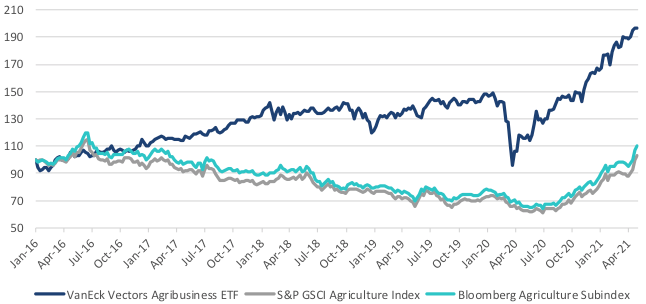
Source: Factset, as of 30 April 2021. ETF and indices rebased. The above chart represents past performance of the fund and various indices. Past performance is no guarantee of future performance. ETF returns assume that dividends and capital gains distributions have been reinvested in the fund at NAV and are net of fund expenses but do not include brokerage costs or bid/ask spreads. ETF returns reflect temporary contractual fee waivers and/or expense reimbursements. Had the ETF incurred all expenses and fees, investment returns would have been reduced.
Further room to run
Long-term prospects for agribusiness look promising. One of the most compelling trends underpinning the outlook is global population growth, which will push up demand for agricultural products.
Climate change is another factor: around the world, weather patterns are the biggest risk to global harvests. A severe La Nina weather event led to poor harvest and a rise in food prices in 2012, and the latest cold snap in the US is already lifting prices of crops such as corn and wheat. Higher prices will trigger more planting, lifting companies that support food production along with it.
There is also a need for efficient agricultural solutions to address a subsequent shortage of arable land or other food disruptions. And technology is providing a glimpse to the future of the agriculture industry. Vertical farming has generated much interest over the past year, as the pandemic disrupted supply chains and labour shortages fuelled fears over global food scarcity. Though still nascent and seen as a niche area, proponents believe that the technology will help increase food production and expand agricultural operations.
Ride on growth in agribusiness
The food business is a critical industry and one that’s growing in importance and potential opportunity for investors. Those looking to capitalise on growth in agriculture should consider the VanEck Vectors Agribusiness ETF (NYSE: MOO), which makes it easy for investors to get diversified agricultural exposure into their portfolios. The ETF focuses on companies that operate in the agriculture sector, including farm equipment, seed and fertiliser, animal health, food transport and processing industries.
Of the 52 stocks in the portfolio, about a third of the ETF's assets are in consumer staples; slightly over 20% each is in health care, materials, and industrials; and the remainder in consumer discretionary companies. Just over half of the fund's assets are in the US, with Germany, Canada and Japan taking the remaining positions among top countries.
Key points of MOO:
- A diversified agribusiness play that provides exposure to companies in the farm equipment, seed and fertiliser, animal health, and food transport and processing industries.
- Positioned to meet growing demand for food and the need for efficient agricultural solutions.
|
VanEck Vectors Agribusiness ETF |
|
|
Fund Ticker |
MOO |
|
Inception |
31 August 2007 |
|
Net expense ratio |
0.55% |
|
Index |
MVIS Global Agribusiness Index |
|
Number of holdings |
52 |
|
Bloomberg index ticker |
MVMOOTR |
|
Stock exchange |
NYSE Arca |
|
AUM as at 30 April 2021 |
US$1.2 billion |
Disclaimer:

' d='M0 0h300v57H0z'/%3e%3c/svg%3e "sgFsmLogoEnIcon")


'%3e%3cpath fill='%23fff' d='M0 0h21.6v21.6H0z'/%3e%3cg data-name='141-singapore'%3e%3cpath data-name='Rectangle 6502' fill='%23f0f0f0' d='M0 0h22v22H0z'/%3e%3cpath data-name='Rectangle 6503' fill='%23d80027' d='M0 0h22v10H0z'/%3e%3cg data-name='Group 21092' fill='%23f0f0f0'%3e%3cpath data-name='Path 14455' d='M2.917 5.365A3.128 3.128 0 015.374 2.31a3.128 3.128 0 100 6.11 3.128 3.128 0 01-2.457-3.055z'/%3e%3cpath data-name='Path 14456' d='M6.939 2.46l.222.683h.718l-.581.422.222.683-.581-.422-.581.422.222-.683-.581-.422h.718z'/%3e%3cpath data-name='Path 14457' d='M5.193 3.801l.222.683h.718l-.581.422.222.683-.581-.422-.581.422.222-.683-.581-.422h.718z'/%3e%3cpath data-name='Path 14458' d='M8.68 3.801l.222.683h.718l-.581.422.222.683-.581-.422-.581.422.222-.683-.581-.422h.718z'/%3e%3cpath data-name='Path 14459' d='M8.01 5.811l.222.683h.718l-.581.422.222.683-.581-.422-.581.422.222-.683-.581-.422h.718z'/%3e%3cpath data-name='Path 14460' d='M5.863 5.811l.222.683h.718l-.581.422.222.683-.581-.422-.581.422.222-.683-.581-.422h.718z'/%3e%3c/g%3e%3c/g%3e%3c/g%3e%3c/svg%3e "singaporeIcon")


' d='M0 0h67v14H0z'/%3e%3c/svg%3e "msFooterLogoIcon")
