


' fill='%23fff' stroke='%23707070' d='M0 0h21.6v21.6H0z'/%3e%3c/clipPath%3e%3cclipPath id='c'%3e%3cpath data-name='Rectangle 6531' transform='translate(-6319 -2048)' fill='%23fff' stroke='%23707070' d='M0 0h43.2v21.6H0z'/%3e%3c/clipPath%3e%3cclipPath id='a'%3e%3cpath d='M0 0h21.6v21.6H0z'/%3e%3c/clipPath%3e%3c/defs%3e%3cg data-name='Malaysia -Square' clip-path='url(%23a)'%3e%3cpath fill='%23fff' d='M0 0h21.6v21.6H0z'/%3e%3cg data-name='Mask Group 325' transform='translate(6348 2048)' clip-path='url(%23b)'%3e%3cg data-name='Mask Group 324' transform='translate(-35)' clip-path='url(%23c)'%3e%3cg data-name='Group 21195'%3e%3cpath data-name='Path 14718' d='M-6319-2048h43.2v21.6h-43.2z' fill='%23fff'/%3e%3cpath data-name='Path 14719' d='M-6317.457-2047.229h41.657m0 3.086h-41.657m0 3.086h41.657m0 3.086h-41.657' fill='none' stroke='%23c00' stroke-width='1.543'/%3e%3cpath data-name='Path 14720' d='M-6319-2048h21.6v13.114h-21.6z' fill='%23006'/%3e%3cpath data-name='Path 14721' d='M-6319-2034.886h43.2m0 3.086h-43.2m0 3.086h43.2' fill='none' stroke='%23c00' stroke-width='1.543'/%3e%3c/g%3e%3cpath data-name='Path 14722' d='M-6302.5-2045.686l.344 2.353 1.331-1.967-.714 2.269 2.054-1.2-1.626 1.731 2.372-.19-2.218.858 2.218.858-2.372-.19 1.626 1.736-2.054-1.2.714 2.269-1.331-1.97-.344 2.358-.344-2.353-1.331 1.97.714-2.269-2.054 1.2 1.626-1.737-2.372.19 2.218-.858-2.218-.859 2.372.19-1.626-1.736 2.054 1.2-.714-2.267 1.331 1.97zm-1.929.1a4.114 4.114 0 100 7.521 4.629 4.629 0 110-7.521z' fill='%23fc0'/%3e%3c/g%3e%3c/g%3e%3c/g%3e%3c/svg%3e "malaysiaIcon")
'%3e%3cpath fill='%23fff' d='M0 0h21.6v21.6H0z'/%3e%3cg data-name='067-hong-kong'%3e%3cpath data-name='Rectangle 6488' fill='%23d80027' d='M0 0h22v22H0z'/%3e%3cg data-name='Group 21086' fill='%23f0f0f0'%3e%3cpath data-name='Path 14432' d='M11.911 8.264c-.248 1.032-.689.835-.905 1.735a2.373 2.373 0 011.109-4.614c-.429 1.803.018 1.956-.204 2.879z'/%3e%3cpath data-name='Path 14433' d='M8.606 9.029c.9.555.581.913 1.37 1.4a2.373 2.373 0 01-4.045-2.481c1.577.964 1.866.586 2.675 1.081z'/%3e%3cpath data-name='Path 14434' d='M8.311 12.409c.807-.689 1.048-.271 1.752-.871a2.373 2.373 0 11-3.609 3.081c1.408-1.202 1.136-1.594 1.857-2.21z'/%3e%3cpath data-name='Path 14435' d='M11.435 13.734c-.406-.98.066-1.08-.287-1.935a2.373 2.373 0 111.815 4.385c-.708-1.71-1.165-1.573-1.528-2.45z'/%3e%3cpath data-name='Path 14436' d='M13.66 11.173c-1.058.083-1.007-.4-1.929-.325a2.373 2.373 0 114.731-.371c-1.846.145-1.856.621-2.802.696z'/%3e%3c/g%3e%3c/g%3e%3c/g%3e%3c/svg%3e "hongKongIcon")


People and innovation have always been at the heart of the megatrends. Past megatrends have shaped the world we know of today, from business, politics, and culture. Three industrial revolutions across the past two hundred years have propelled societies forward, enabling industrialised nations to enjoy greater wealth and higher standards of living.
Megatrends are immovable and irreversible structures, and their potential impact could be transformative and far reaching, even though they often take a long period to play out. As such, from an investment perspective, it is generally difficult to capture the essence of a particular megatrend from a single theme or investment.
In this article, we will share some of the funds available to retail investors, that they may invest in to capture the growth associated with megatrends happening around us today. The three megatrends we have identified that investors can easily gain access to, via actively managed strategies, are Environment, Demographics and Technological Innovation.
Environment
Earth’s climate is changing. The potential for excessive warming of our planet, as a result of increasing levels of heat-trapping emissions into our atmosphere, has been the biggest narrative driving the adoption of green-friendly businesses and policies worldwide. There is increasing belief that the world has entered a state of alarming climate emergency.
The Paris Accord, of which 195 countries are signatories, marks the new zeitgeist we are moving towards: a more climate-friendly generation. In the upcoming green revolution, businesses that can contribute to the goal of carbon reduction will likely experience new growth opportunities.
Psyche towards ESG investing is changing. From 2017 to 2019, Morgan Stanley conducted a survey regarding the general population’s interest towards sustainable investing. What they found was that interest in this area has been steadily on the rise, especially among millennials. Globally, the millennial population today is a larger cohort than the Generation X or Baby Boomer generations.
Chart 1: The world is slowly embracing ESG investing especially Millennials
Millennials’ greater appreciation for climate risks would mean that they are likely to vote on climate-friendly policies and hence have increasing sway on how investment capital will be allocated over the next few decades. Their ESG-centric preferences will favour certain segments of the market over another, which again, bring about its own investment implications. Moving forward, sustainable investing is likely to grow bigger as a theme.
Under the Environment megatrend we have identified, we believe there are sub-themes to break it down further. Namely, the three themes are: Electrification, ESG integration, and resource scarcity. The green energy and resource scarcity themes focuses on sustainable or impact investing, both slightly in a different way, by investing in companies whose financial returns rise alongside their ability to generate measurable and beneficial environmental impacts.
ESG Integration, on the other hand, focuses more on the identification of risk factors from an ESG perspective. With ESG considerations integrated into the investment process, hopefully it can help investment managers make better investment decisions, such as allocating capital to companies that do better for society.
Table 1: List of themes and funds under the Environment megatrend
| Megatrend | Themes | Equity funds (Theme) | Equity fund (Megatrend) | Bond Funds |
| Environment | Electrification | ▪ BNP Paribas Energy Transition Classic USD ▪ Blackrock Future of Transport A2 USD ▪ Blackrock Sustainable Energy A2 USD ▪ Neuberger Berman Next Generation Mobility A Acc USD |
▪ Natixis Mirova Global Sustainable Equity R-NPF/A USD |
- |
| ESG Integration/Exclusionary screening | ▪ United Global Quality Growth Fund Acc SGD ▪ CPR Invest - Climate Action A2 Acc SGD-H ▪ Allianz Global Sustainability Cl AM Dis H2-SGD ▪ Threadneedle (Lux) Global Focus AU Acc USD |
▪ Fidelity Sustainable Strategic Bond A-ACC-USD ▪ Manulife Global Fund - Sustainable Asia Bond AA (G) MDIST SGD-H ▪ Blackrock ESG Emerging Markets Bond A2 USD ▪ JPMorgan Funds - Global Bond Opportunities Sustainable A (mth) SGD-H |
||
| Resource scarcity | ▪ Natixis Thematics Water R/A SGD ▪ Blackrock Circular Economy A2 USD ▪ Fidelity Sustainable Water & Waste Fund A-ACC-USD |
- |
Demographics
A post-World War II economic boom in the 1950s & 1960s led to high population growth rates across the globe, particularly in the US, spawning a generation known as the baby boomers who sit at the centre of demographic trends today. The parents’ of millennials who are in their 20s or 30s are likely part of the baby boomer generation.
Chart 2: The world is becoming older with the proportion of older people set to rise in the next decades

As people are living longer than ever, this means that the world, on aggregate, is forecasted to grow older over the next three decades. Comparatively, developed markets are expected to grow older at a faster rate than emerging markets. Ageing demographics present opportunities for certain businesses. For example, there is a secular rising demand for healthcare given the greater need for therapeutics and healthcare services.
The world is not only getting older, but also wealthier too. Over the next decade, middle class consumption globally is expected to rise. Much of it will be contributed by countries like China, India and Indonesia. The share of global middle class by region, is forecasted to be wholly contributed by the Asia Pacific region.
Chart 3: Asia Pacific will be adding most of the new global middle class over the next 10 years

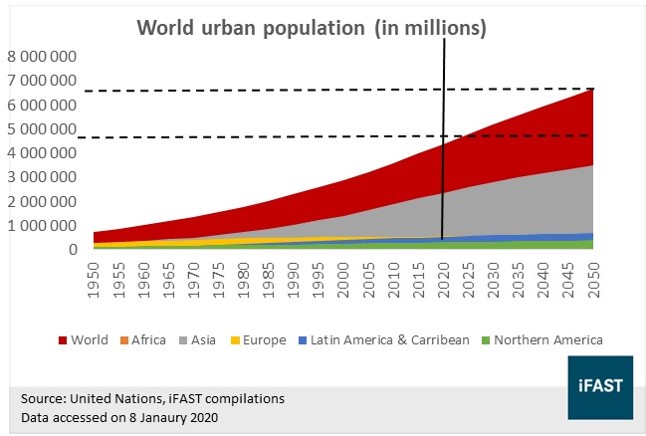
As emerging markets experience consumption upgrades, more would flock towards urbanisation in cities and away from the rural countryside. The global urban population is expected to rise by one-third to 6.5 billion in just three decades from now. Further, developed markets are in dire need for infrastructure upgrades, if they were to be successful in their electrification ambitions.
Given the current low levels of infrastructure and capital expenditure, significant investments into various infrastructure (utilities, communications, airports, roads, energy, water etc) will be required over the next decades, and this could potentially drive earnings higher for infrastructure related companies over the long term.
Table 2: List of themes and funds under the Demographics megatrend
| Megatrend | Themes | Equity funds (Theme) | Equity fund (Megatrend) | Bond Funds |
| Demography | Ageing population | ▪ Blackrock World Healthscience A2 USD ▪ United Global Healthcare Acc USD ▪ Janus Henderson Global Life Sciences A Acc USD ▪ FTIF - Franklin Biotechnology Discovery A (acc) USD |
▪ Fidelity Global Demographics A-ACC-SGD | - |
| Urbanisation | ▪ Legg Mason ClearBridge Infrastructure Value A SGD-H (mdis) plus ▪ DWS Invest Global Infrastructure LDMH(P) SGD ▪ First Sentier Global Listed Infrastructure A DIS SGD |
|||
| Consumption upgrades | ▪ JPMorgan Funds - China A (acc) SGD ▪ Fidelity China Consumer A-SGD ▪ Allianz China A Shares AT Acc SGD ▪ CPR Invest - Education A2 Acc SGD-H |
Technological innovation
By far, digitalisation has been the most transformative secular force driving the shifting of norms and behaviours. E-commerce is one example of digitalisation megatrend upending traditional industries like retail, as consumers grow increasingly comfortable with shopping online. This is merely a small piece of a much larger picture. Digitalisation is now spreading towards previously untouched sectors such as financials (fintech) and industrials (5G/IoT).
Our digital footprints will likely increase as we transact online more frequently. Cybersecurity will be a key area of concern for both businesses and consumers as the world becomes increasingly data driven. The usage of artificial intelligence, whether for automation or to generate business insights, has the potential to disrupt a broad spectrum of technologies and sectors. Boundless computing power will be needed as this trend accelerates and proliferates.
Disruptive innovation is one theme which we think is an offshoot of the digitalisation trend. Generally speaking, disrupters are often companies offering goods or services at the infancy stage of a particular technological adoption cycle, that have the potential to change the way the world works, years or a decade from now. Think of disruptive innovation as investing in companies like Apple or Amazon before e-commerce or iPhone adoption became widespread. These winners took twenty years to develop themselves to where they are today.
From industrials, healthcare, financials, to internet-related industries, there are a number of sectors primed for disruptive innovation today. Therefore, funds that invest in this theme are often sector-agnostic, even though the sector exposure may at times be concentrated in a handful. The product lifecycle of disruptive innovators’ tend to belong in the introductory stage, and therefore are usually small to mid-cap companies. As such, the risk of investing in such companies is that not all may succeed over the next decade.
Table 3: List of themes and funds under the Digitalisation megatrend
| Megatrend | Themes | Equity funds (Theme) | Equity fund (Megatrend) | Bond Funds |
| Digitalisation | 5G/IoT/Artificial intelligence | ▪ Neuberger Berman 5G Connectivity A Acc USD ▪ Allianz Global Artificial Intelligence AT Acc USD ▪ Natixis Thematics AI & Robotics Fund R/A SGD ▪ Blackrock Next Generation Technology A2 USD |
▪ Blackrock World Technology Fund A2 USD ▪ FTIF - Franklin Technology A (acc) USD |
- |
| Cybersecurity | ▪ Natixis Thematics Safety R/A SGD | |||
| FinTech | ▪ Blackrock FinTech A2 USD | |||
| E-commerce | ▪ Any growth centric regional/country equity fund | |||
| Disruptive Innovation | ▪ Nikko AM ARK Disruptive Innovation B SGD ▪ LionGlobal Disruptive Innovation Fund A SGD ▪ CPR Invest - Global Disruptive Opportunities A2 Acc SGD-H |
- | - |
Performance
Funds under the Environment theme have all performed quite well over the last couple of years – much of this outperformance really came from the funds with very strong tilt towards electric vehicles and solar energy. These two segments were the flavour of the year as investors flocked towards these areas in 2020 due to their high growth potential in a seemingly low growth environment.
But as we mentioned in ‘Green energy is the next big thing. But is it a right time to invest?’, these industries currently trade at expensive valuations, which could become a headwind should rates continue to march higher in the months ahead. Therefore, do not get starry-eyed simply for its recent performance. Think bigger picture and of longer time frames.
Table 4: Funds' performance under Environment theme

Among the three, demographics is arguably one of the broadest encompassing megatrends. As such, we see highly varied results across the healthcare, consumption and infrastructure themes. Despite categorised as a geographic region, China is a great play as a consumption theme given its burgeoning middle-class population and rising income levels.
Infrastructure related funds have not done so well thus far given that many of the sectors they delve into are generally more defensive in nature. In the current market cycle, investors have not found such companies attractive due to their stability and/or relatively low growth prospects. This stigma could change should fiscal spending continue to expand over the next decade to fund infrastructure programs.
Table 5: Funds' performance under Demographics theme
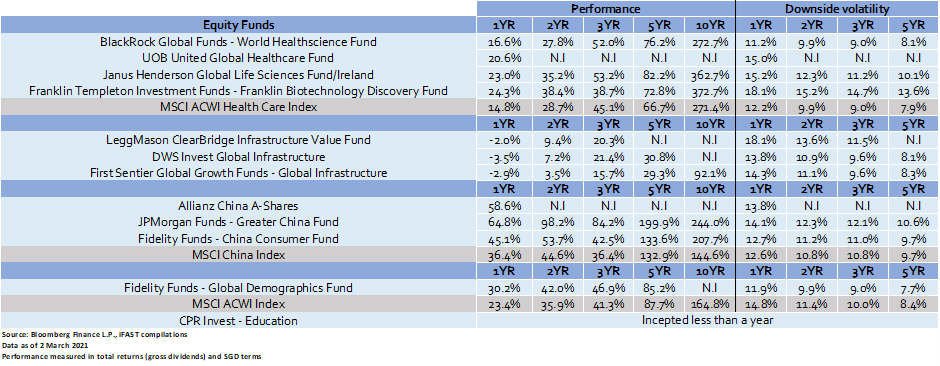
Tech-related funds have had a great year largely due to the paradigm shift in technology adoption by the broader economy during the COVID-19 period. With more people moving their daily lives over to the internet, it also means that companies whose business models rely on the consumption of digital media and goods benefitted in a major way. Even with the passing of the pandemic, we believe these norms and behaviours are unlikely to revert back to what it was.
Table 6: Funds' performance under Digitalisation theme

Conclusion
Framing our investments into themes or megatrends helps to give a better idea of what and why we invest. Megatrends offer numerous opportunities that likely spans across more than one industry or sector along the value chain. Given the world is highly inter-related, we should approach it in the same way for megatrend investing, through actively managed unit trusts that can provide holistic exposure towards various themes that are part of a megatrend. Time needs to be your ally when it comes to investing in megatrends. Investors are highly recommended to take up a regular savings plan to ride out the volatility that comes investing in long term trends.

' d='M0 0h300v57H0z'/%3e%3c/svg%3e "sgFsmLogoEnIcon")


'%3e%3cpath fill='%23fff' d='M0 0h21.6v21.6H0z'/%3e%3cg data-name='141-singapore'%3e%3cpath data-name='Rectangle 6502' fill='%23f0f0f0' d='M0 0h22v22H0z'/%3e%3cpath data-name='Rectangle 6503' fill='%23d80027' d='M0 0h22v10H0z'/%3e%3cg data-name='Group 21092' fill='%23f0f0f0'%3e%3cpath data-name='Path 14455' d='M2.917 5.365A3.128 3.128 0 015.374 2.31a3.128 3.128 0 100 6.11 3.128 3.128 0 01-2.457-3.055z'/%3e%3cpath data-name='Path 14456' d='M6.939 2.46l.222.683h.718l-.581.422.222.683-.581-.422-.581.422.222-.683-.581-.422h.718z'/%3e%3cpath data-name='Path 14457' d='M5.193 3.801l.222.683h.718l-.581.422.222.683-.581-.422-.581.422.222-.683-.581-.422h.718z'/%3e%3cpath data-name='Path 14458' d='M8.68 3.801l.222.683h.718l-.581.422.222.683-.581-.422-.581.422.222-.683-.581-.422h.718z'/%3e%3cpath data-name='Path 14459' d='M8.01 5.811l.222.683h.718l-.581.422.222.683-.581-.422-.581.422.222-.683-.581-.422h.718z'/%3e%3cpath data-name='Path 14460' d='M5.863 5.811l.222.683h.718l-.581.422.222.683-.581-.422-.581.422.222-.683-.581-.422h.718z'/%3e%3c/g%3e%3c/g%3e%3c/g%3e%3c/svg%3e "singaporeIcon")


' d='M0 0h67v14H0z'/%3e%3c/svg%3e "msFooterLogoIcon")
